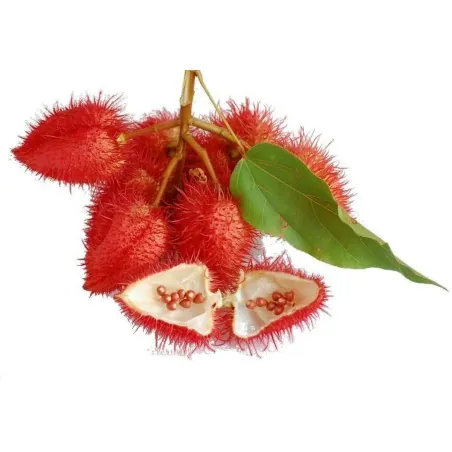
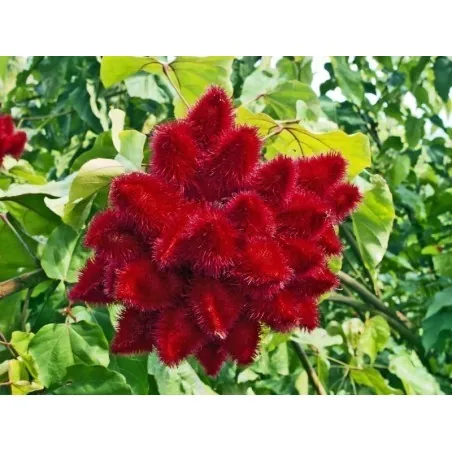
Common name: Achiote, Aploppas, Annatto,Annatto, Annato, Arnotta, Bija, Latkan, Lipstick Tree, Rocou, Rocouyer, Roucou. This lovely tropical and sub-tropical shrub or bushy tree has glossy, ovate, evergreen leaves on twigs which are covered with rust-coloured scales when young and are bare when older. Sprays of
This lovely tropical and sub-tropical shrub or bushy tree has glossy, ovate, evergreen leaves on twigs which are covered with rust-coloured scales when young and are bare when older. Sprays of attractive pink and white flowers open, producing striking, bright red, two-valved fruits, covered with dense soft bristles. When ripe, they split open revealing masses of small, inedible, fleshy seeds, covered with red-orange pulp. The inedible fruit is harvested for its seeds which produce the reddish orange dye annatto, which is one of the most important food grade natural colourants widely used in the dairy industry, and also for confectionery and bakery products, as well as non-edible purposes such as cosmetics and dying leather.
Sowing advice: These seeds have already been thoroughly cleaned and should be sown into a well-drained, sandy compost at any time of the year, and covered thinly with sand or grit and kept moist. Keep at between 20-25 degrees C. Seeds sometimes germinate within 4 to 6 weeks although some varieties may take very much longer so please be patient. Plant out in the open ground in warmer countries or in a large container elsewhere.
An investigation on germination of annatto (Bixa orellana L.) was conducted. Water uptake studies showed that seeds were fully imbibed after 24 h. Soaking in water for 24 h enhanced germination (82%) compared to the untreated control (57%). Germination was improved to 93% and was coupled with a significant (p < 0.001) reduction in mean time to germination (MTG, 3.64 d) by soaking seeds in a 50 ppm gibberellic acid (GA3) solution for 24 h. Germination capacity for medium (97%) weight class seeds was higher than light (40%) or heavy seeds (60%). Significant (p < 0.001) germination variability was recorded among eight seed collections. Seeds collected from populations in Kariavattom (82%) and Kulathupuzha (80%) produced significantly higher germination coupled with a low mean time to germination.
WIKIPEDIA:
Achiote (Bixa orellana) is a shrub or small tree originating from the tropical region of the Americas. North, Central and South American natives originally used the seeds to make red body paint and lipstick. For this reason, the achiote is sometimes called the lipstick tree.
The tree is best known as the source of annatto, a natural orange-red condiment (also called "achiote" or "bijol") obtained from the waxy arils that cover its seeds. The ground seeds are widely used in traditional dishes in South and Central America, the Caribbean, and Mexico; such as cochinita pibil, chicken in achiote and caldo de olla. Annatto and its extracts are also used as an industrial food coloring to add yellow or orange color to many products such as butter, cheese, sausages, cakes, and popcorn.
The species name was given by Linnaeus after the Spanish conquistador Francisco de Orellana, an early explorer of the Amazon River.[2] The name achiote derives from the Nahuatl word for the shrub, āchiotl [aːˈt͡ʃiot͡ɬ]. It may also be referred to as aploppas, or by its original Tupi name uruku, urucu or urucum ("red color"), which is also used for the body paint prepared from its seeds.
Culinary uses
Ground B. orellana seeds are often mixed with other seeds or spices to form a paste or powder for culinary use especially in Latin American, Jamaican, Chamorro, and Filipino cuisines. The seeds are heated in oil or lard to extract its dye and flavor for use in dishes and processed foods such as cheese, butter, soup, gravy, sauces, cured meats, and other items. The seeds impart a subtle flavor and aroma and a yellow to reddish-orange color to food. The seeds are used to color and flavor rice instead of the much more expensive saffron.
In Brazil, a powder known as colorau or colorífico is made from the ground seeds combined with filler seeds like maize. This powder is similar to and sometimes replaces paprika.[6]
The Yucatecan condiment called recado rojo or "achiote paste" is made from ground seeds combined with other spices. It is a mainstay of the Mexican and Belizean cuisines.
A condiment called sazón ("seasoning" in Spanish) is commonly used in Puerto Rican cuisine for meats and fish. Sazón is made from achiote seeds, cumin, coriander seeds, salt, and garlic powder.
Traditional medical uses
The tree was incorporated into the traditional medicine of India, where different parts of the plant are used to treat various disorders,[7] although no treatment has been verified by clinical research.
Other uses
Achiote has long been used by American Indians to make a bright red paint for the body and hair. Body-painting with urucu remains an important tradition of many Brazilian native tribes. It was reportedly used for body paint among the native Taínos in Borinquen, Puerto Rico. The use of achiote hair dye by men of the Tsáchila of Ecuador is the origin of their Spanish name, the Colorados.
The Aztec people of Mexico used achiote seeds as source of a red ink for manuscript painting in the 16th century.
The plant is also valued for its stem fibre (used in rope mats) and an adhesive gum which is extracted from all parts.
Characteristics
Bixa orellana is a tall shrub to small evergreen tree 6–10 m (20–33 ft) high. It bears clusters of 5 cm (2 in) bright white to pink flowers, resembling single wild roses, appearing at the tips of the branches. The fruits are in clusters: spiky looking red-brown seed pods covered in soft spines. Each pod contains many seeds covered with a thin waxy blood-red aril. When fully mature, the pod dries, hardens, and splits open, exposing the seeds.
The color of the seed coating is due mainly to the carotenoid pigments bixin and norbixin.
Cultivation
Bixa orellana originated in South America but it has spread to many parts of the world. It is grown easily and quickly in frost-free regions, from sub-tropical to tropical climates, and sheltered from cool winds. It prefers year-round moisture, good drainage, and moderately fertile soil in full sun or partial shade. It can be propagated from seed and cuttings. Cutting-grown plants flower at a younger age than seedlings.
The main commercial producers are countries in South America, Central America, the Caribbean, Africa, and also India and Sri Lanka, where it was introduced by the Spanish in the 17th century. Production statistics are not usually available, and would not provide a reliable guide to international trade since many of the producing countries use significant quantities domestically (e.g. Brazil is a large producer and consumer, needing additional imports). Annual world production of dried annatto seed at the beginning of the 21st century was estimated at about 10,000 tons, of which 7,000 tons enter international trade. Peru is the largest exporter of annatto seed, annually about 4,000 tons; Brazil the largest producer with about 5,000 tons. Kenya exports annually about 1,500 tons annatto seed and extracts and is the second-largest exporter, after Peru. Côte d'Ivoire and Angola are also exporters.
Industrial uses
Before synthetic dyes revolutionized industry, the tree was planted commercially for the pigment, extracted by solvent or boiling the seeds in oil, which was used to color cheese, margarine, chocolate, fabric and paints. Annatto oil is rich in tocotrienols, beta-carotene, essential oil, saturated and unsaturated fatty acids, flavonoids and vitamin C.[5] The seeds are collected from wild-growing bushes or from plantations in Latin America, Africa, and Asia.
Czy jesteś pewien, że chcesz zgłosić ten komentarz?
Zgłoszenie wysłane
Twój komentarz został wysłany i będzie widoczny po zatwierdzeniu przez moderatora.
Twoje zgłoszenie nie może zostać wysłane
Napisz swoją opinię
Recenzja została wysłana
Twój komentarz został dodany i będzie widoczny jak tylko zatwierdzi go moderator.
Twoja recenzja nie może być wysłana
🌍 Wysyłka na cały świat z UE
Wysyłamy na cały świat z Unii Europejskiej za pośrednictwem zarejestrowanej poczty lotniczej z wymaganym podpisem przy odbiorze.
📦 Śledzenie zamówienia
Aby znaleźć swój numer śledzenia, zaloguj się na swoje konto i przejdź do: Historia zamówień > Szczegóły. Twój numer śledzenia znajduje się bezpośrednio w szczegółach zamówienia.
Będziesz otrzymywać powiadomienia e-mail na każdym etapie zamówienia.
Jeśli nie widzisz tych wiadomości, sprawdź folder Spam/Wiadomości śmieci lub skontaktuj się ze swoim dostawcą e-mail. Alternatywnie poszukaj w Internecie informacji, jak odblokować wiadomości e-mail od nadawcy.
NASZ SERWIS E-MAIL DZIAŁA — Jeśli nie otrzymujesz wiadomości e-mail, prawdopodobnie jest to problem z Twoim dostawcą poczty lub ustawieniami.
📧 Jak zapewnić, aby e-maile z naszego sklepu internetowego zawsze trafiały do Twojej skrzynki odbiorczej
Aby zapobiec oznaczaniu naszych wiadomości jako spam, dodaj nasz adres e-mail do swoich kontaktów:
Otwórz Gmail (lub innego dostawcę) i znajdź e-mail od nas (xxxxxxxxxxxx@xxx.com).
Najedź kursorem na nazwę lub adres e-mail nadawcy.
Kliknij ikonę „Dodaj do kontaktów” (ikonka małej osoby).
Nie możemy Ci pomóc, jeśli Twoje ustawienia nie są skonfigurowane w ten sposób. Skontaktuj się ze swoim dostawcą e-mail, aby uzyskać pomoc.
Alternatywnie utwórz filtr w Gmailu:
Otwórz Gmail i przejdź do Ustawienia > Zobacz wszystkie ustawienia.
Przejdź do karty Filtry i zablokowane adresy.
Kliknij Utwórz nowy filtr i wpisz nasz adres e-mail.
Zaznacz Nigdy nie wysyłaj do spamu i kliknij Utwórz filtr.
📍 Śledź swoją paczkę
Twój numer śledzenia znajduje się w szczegółach zamówienia. Możesz śledzić swoje zamówienie za pośrednictwem następujących platform:
Podczas składania zamówienia zawsze podawaj ważny numer telefonu komórkowego z numerem kierunkowym kraju (np. +48 601 234 567).
NIE zamawiaj do skrytek pocztowych (P.O. Boxes) ani jeśli nie możesz być w domu, aby podpisać odbiór paczki. Paczek nie można zostawiać u sąsiadów.
Jeśli paczka wysłana do skrytki pocztowej zaginie lub nie zostanie doręczona, zwrot pieniędzy nie zostanie przyznany.
⚖️ Odpowiedzialność klienta za zgodność z prawem
Klient jest odpowiedzialny za upewnienie się, że produkt może być legalnie importowany do jego kraju, w tym za przestrzeganie wszystkich przepisów importowych, uzyskanie niezbędnych zezwoleń oraz opłacenie obowiązujących ceł, podatków i innych opłat. Przed złożeniem zamówienia sprawdź lokalne przepisy.
🔄 Paczki zagubione, zwrócone i ponowna wysyłka
Klienci z Brazylii i Meksyku: Nie możemy zwrócić pieniędzy za paczki zagubione lub zniszczone przez urząd celny.
Jeśli Twoja paczka zostanie zwrócona, zwrócimy tylko koszt produktu — koszty wysyłki nie podlegają zwrotowi.
Opłatę za zwrot (2 €) oraz wszelkie koszty ponownej wysyłki musi pokryć klient.
🚚 Dostawa przesyłki
Przesyłki polecone wymagają podpisu.
Jeśli śledzenie pokazuje, że paczka nadal znajduje się w placówce początkowej, oznacza to, że jest w drodze — skontaktuj się ze swoim lokalnym urzędem pocztowym, aby uzyskać aktualne informacje.
Niestety, ani my, ani poczta, za pośrednictwem której wysłano zamówienie, nie możemy pomóc w ustaleniu, gdzie dokładnie znajduje się paczka. Gdy zobaczysz, że paczka jest w Twoim kraju, MUSISZ skontaktować się ze swoją pocztą, podając numer śledzenia.
⏱️ Opcje dostawy i szacowany czas
Opcja dostawy
Czas przetwarzania
Uwagi
Priority Delivery
Wysyłka w ciągu 1–7 dni roboczych
Priorytetowe przetwarzanie; możliwe opóźnienia w okresie świątecznym (3–10 dni)
Secured Delivery
Wysyłka w ciągu 1–7 dni roboczych
Dostępne dla zamówień do 150 €; zwrot pieniędzy w przypadku zagubienia
Standard Delivery
Wysyłka w ciągu 7–10 dni roboczych
Bardziej ekonomiczna; możliwe opóźnienia w okresie świątecznym (7–14 dni)
Szacowany czas dostawy:
Wewnątrz UE: 3–20 dni
Reszta świata: 5–30 dni
Uwaga: Czas dostawy zależy od Twojej lokalizacji i lokalnego systemu pocztowego. COVID-19 lub sezony świąteczne mogą powodować dodatkowe opóźnienia.
💰 Koszty wysyłki
Koszty wysyłki i obsługi są obliczane automatycznie podczas składania zamówienia na podstawie wagi paczki i miejsca przeznaczenia.
⏰ Godziny przetwarzania zamówień
Nie przetwarzamy ani nie wysyłamy zamówień w soboty i niedziele.
💳 Opcje płatności
Chcielibyśmy poinformować o ważnej zmianie dotyczącej opłat za płatności. Niestety, ze względu na wyjątkowo wysokie opłaty transakcyjne nakładane przez PayPal, jesteśmy zmuszeni doliczać dopłatę do płatności dokonywanych za pośrednictwem ich serwisu.
Mamy jednak dla Ciebie rozwiązanie! Możesz uniknąć tych astronomicznych opłat, wybierając jedną z naszych alternatywnych metod płatności z PROWIZJĄ 0%:
✅ Płatność kartą kredytową/debetową – 0% prowizji
✅ Przelew bankowy – 0% prowizji
Przelew bankowy (SEPA / IBAN / SWIFT-BIC): W opisie płatności podaj numer referencyjny zamówienia. Zamówienia nieopłacone w ciągu 4 dni zostaną automatycznie anulowane.
PayPal: Płatności są akceptowane wyłącznie w euro. Prosimy o wybranie euro podczas finalizacji zakupu.
Płatność kartą: Akceptujemy karty Visa, MasterCard, American Express, CB, Diners Club, Discover, China UnionPay, JCB i Discover.
⚠️ Opłaty transakcyjne
Klienci są odpowiedzialni za wszelkie bankowe lub transakcyjne opłaty PayPal.
📝 Uwagi końcowe
Przed złożeniem zamówienia zawsze sprawdzaj naszą stronę internetową pod kątem specjalnych ogłoszeń, harmonogramów świątecznych lub określonych warunków wysyłki.