


Common Fig Seeds (Ficus carica)
SKU V-19-CF-(0,05g) Kategoria Strona główna
Cena: 1,95 €
Common Fig Seeds (Ficus carica)
Price for Package of 100 (0.05g) seeds.
The common fig (Ficus carica) is a species of flowering plant in the genus Ficus, from the family Moraceae, known as the common fig (or just the fig), anjeer (Iran, Pakistan), and dumur (Bengali). It is the source of the fruit also called the fig, and as such is an important crop in those areas
Share on
Common Fig Seeds (Ficus carica)
Price for Package of 100 (0.05g) seeds.
The common fig (Ficus carica) is a species of flowering plant in the genus Ficus, from the family Moraceae, known as the common fig (or just the fig), anjeer (Iran, Pakistan), and dumur (Bengali). It is the source of the fruit also called the fig, and as such is an important crop in those areas where it is grown commercially. Native to the Middle East and western Asia, it has been sought out and cultivated by man since ancient times, and is now widely grown throughout the temperate world, both for its fruit and as an ornamental plant.
Description
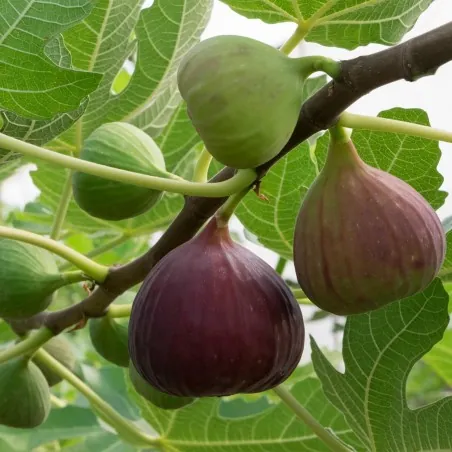
It is a gynodioecious (functionally dioecious),[3] deciduous tree or large shrub, growing to a height of 6.9–10 metres (23–33 ft), with smooth white bark. Its fragrant leaves are 12–25 centimetres (4.7–9.8 in) long and 10–18 centimetres (3.9–7.1 in) across, and deeply lobed with three or five lobes. The complex inflorescence consists of a hollow fleshy structure called the syconium, which is lined with numerous unisexual flowers. The flower itself is not visible outwardly, as it blooms inside the infructescence. Although commonly referred to as a fruit, the fig is actually the infructescence or scion of the tree, known as a false fruit or multiple fruit, in which the flowers and seeds are borne. It is a hollow-ended stem containing many flowers. The small orifice (ostiole) visible on the middle of the fruit is a narrow passage, which allows the specialized fig wasp Blastophaga psenes to enter the fruit and pollinate the flower, whereafter the fruit grows seeds. See Ficus: Fig pollination and fig fruit.
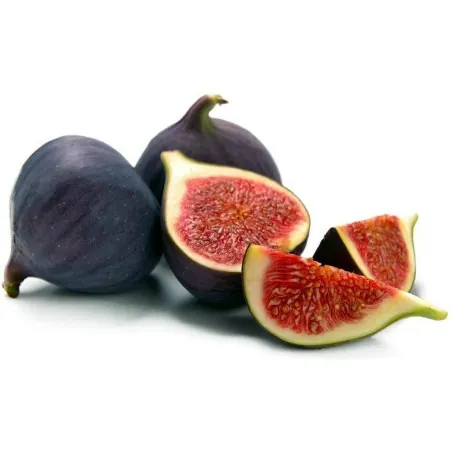
The edible fruit consists of the mature syconium containing numerous one-seeded fruits (druplets).[3] The fruit is 3–5 centimetres (1.2–2.0 in) long, with a green skin, sometimes ripening towards purple or brown. Ficus carica has milky sap (laticifer). The sap of the fig's green parts is an irritant to human skin.
Habitat
The common fig tree has been cultivated since ancient times and grows wild in dry and sunny areas, with deep and fresh soil; also in rocky areas, from sea level to 1,700 meters. It prefers light and medium soils, requires well-drained soil, and can grow in nutritionally poor soil. Like all fig trees, Ficus carica requires wasp pollination of a particular species of wasp (Blastophaga psenes) to produce seeds. The plant can tolerate seasonal drought, and the Middle Eastern and Mediterranean climate is especially suitable for the plant. Situated in a favorable habitat, old specimens when mature can reach a considerable size and form a large dense shade tree. Its aggressive root system precludes its use in many urban areas of cities, but in nature helps the plant to take root in the most inhospitable areas. Common fig tree is mostly a phreatophyte that lives in areas with standing or running water, grows well in the valleys of the rivers and ravines saving no water, having strong need of water that is extracted from the ground. The deep-rooted plant searches groundwater, in aquifers, ravines, or cracks in the rocks. The fig tree, with the water, cools the environment in hot places, creating a fresh and pleasant habitat for many animals that take shelter in its shade in the times of intense heat.
Ecology
Ficus carica is dispersed by birds and mammals that scatter their seeds in droppings. Fig fruit is an important food source for much of the fauna in some areas, and the tree owes its expansion to those that feed on its fruit. The common fig tree also sprouts from the root and stolon issues.
The infructescence is pollinated by a symbiosis with a kind of fig wasp (Blastophaga psenes). The fertilized female wasp enters the fig through the scion, which is a tiny hole in the crown (the ostiole). She crawls on the inflorescence inside the fig and pollinates some of the female flowers. She lays her eggs inside some of the flowers and dies. After weeks of development in their galls, the male wasps emerge before females through holes they produce by chewing the galls. The male wasps then fertilize the females by depositing semen in the hole in the gall. The males later return to the females and enlarge the holes to facilitate the females to emerge. Then some males enlarge holes in the scion, which enables females to disperse after collecting pollen from the developed male flowers. Females have a short time (<48 hours) to find another fig tree with receptive scions to spread the pollen, assist the tree in reproduction, and lay their own eggs to start a new cycle.
History
The edible fig is one of the first plants that was cultivated by humans. Nine subfossil figs of a parthenocarpic type dating to about 9400–9200 BC were found in the early Neolithic village Gilgal I (in the Jordan Valley, 13 km north of Jericho). The find predates the domestication of wheat, barley, and legumes, and may thus be the first known instance of agriculture. It is proposed that they may have been planted and cultivated intentionally, one thousand years before the next crops were domesticated (wheat and rye).[5]
Figs were also a common food source for the Romans. Cato the Elder, in his De Agri Cultura, lists several strains of figs grown at the time he wrote his handbook: the Mariscan, African, Herculanean, Saguntine, and the black Tellanian (De agri cultura, ch. 8). The fruits were used, among other things, to fatten geese for the production of a precursor of foie gras.
It was cultivated from Afghanistan to Portugal, also grown in Pithoragarh in the Kumaon hills of India and from the 15th century onwards, was grown in areas including Northern Europe and the New World.[1] In the 16th century, Cardinal Reginald Pole introduced fig trees to Lambeth Palace in London.
Cultivation
The common fig is grown for its edible fruit throughout the temperate world. It is also grown as an ornamental tree, and the cultivar 'Brown Turkey' has gained the Royal Horticultural Society's Award of Garden Merit.[6]
Figs can be found in continental climates with hot summers as far north as Hungary and Moravia, and can be harvested up to four times per year. Thousands of cultivars, most named, have been developed as human migration brought the fig to many places outside its natural range.
Two crops of figs are potentially produced each year.[7] The first or breba crop develops in the spring on last year's shoot growth. In contrast, the main fig crop develops on the current year's shoot growth and ripens in the late summer or fall. The main crop is generally superior in both quantity and quality to the breba crop. However, some cultivars produce good breba crops (e.g., 'Black Mission', 'Croisic', and 'Ventura').
There are basically three types of edible figs:
Persistent (or common) figs have all female flowers that do not need pollination; the fruit develop through parthenocarpic means. This is a popular horticulture fig for home gardeners. Adriatic, Black Mission, Brown Turkey, Brunswick, and Celeste are some representative cultivars.
Caducous (or Smyrna) figs require crosspollination by the fig wasp with pollen from caprifigs for the fruit to mature. Some cultivars are Calimyrna (the Great Central Valley Smyrna fig), Marabout, and Zidi.
Intermediate (or San Pedro) figs set an unpollinated breba crop, but need pollination, at least in most regions, for the later main crop. Examples are Lampeira, King, and San Pedro.
Propagation
Figs plants are easy to propagate through several methods. Propagation using seeds is not the preferred method since vegetative methods exist that are quicker and more reliable, that is, they do not yield the inedible caprifigs. However, those desiring to can plant seeds of dried figs with moist sphagnum moss or other media in a zip lock bag and expect germination in a few weeks to several months. The tiny plants can be transplanted out little by little once the leaves open, and despite the tiny initial size can grow to 1 foot (30 cm) or more within one year from planting seeds.
For propagation in the mid-summer months, air layer new growth in August (mid-summer) or insert hardened off 15–25 cm (6-10 inches) shoots into moist perlite or a sandy soil mix, keeping the cuttings shaded until new growth begins; then gradually move them into full sun. An alternative propagation method is bending over a taller branch, scratching the bark to reveal the green inner bark, then pinning the scratched area tightly to the ground. Within a few weeks, roots will develop and the branch can be clipped from the mother plant and transplanted where desired.
For spring propagation, before the tree starts growth, cut 15–25 cm (6-10 inches) shoots that have healthy buds at their ends, and set into a moist perlite and/or sandy soil mix located in the shade. Once the cuttings start to produce leaves, bury them up to the bottom leaf to give the plant a good start in the desired location.
Culinary use
Figs can be eaten fresh or dried, and used in jam-making. Most commercial production is in dried or otherwise processed forms, since the ripe fruit does not transport well, and once picked does not keep well. The widely produced fig newton or fig roll is a biscuit (cookie) with a filling made from figs.
Nutrition
Figs are among the richest plant sources of calcium and fiber. According to USDA data for the Mission variety, dried figs are richest in fiber, copper, manganese, magnesium, potassium, calcium, and vitamin K, relative to human needs. They have smaller amounts of many other nutrients. Figs have a laxative effect and contain many antioxidants. They are a good source of flavonoids and polyphenols[9] including gallic acid, chlorogenic acid, syringic acid, (+)-catechin, (−)-epicatechin and rutin.[10] In one study, a 40-gram portion of dried figs (two medium size figs) produced a significant increase in plasma antioxidant capacity.
According to the USDA,[12] 100 g of dried, uncooked fruit of the common fig (Ficus carica) contains the following:
Cultural aspects
In the Book of Genesis in the Bible, Adam and Eve clad themselves with fig leaves (Genesis 3:7) after eating the "forbidden fruit" from the Tree of Knowledge of Good and Evil. Likewise, fig leaves, or depictions of fig leaves, have long been used to cover the genitals of nude figures in painting and sculpture. Art collectors and exhibitors often added these depictions long after the original work was completed. The use of the fig leaf as a protector of modesty or shield of some kind has entered the language.
The Book of Deuteronomy specifies the fig as one of the Seven Species (Deuteronomy 8:7-8), describing the fertility of the land of Canaan. This is a set of seven plants indigenous to the Middle East that together can provide food all year round. The list is organized by date of harvest, with the fig being fourth due to its main crop ripening during summer.
Also in the Bible (Matthew 21:18–22 and Mark 11:12–14, 19–21) is a story of Jesus finding a fig tree when he was hungry; the tree only had leaves on it, but no fruit. Jesus, then, curses the fig tree, which withers.
The biblical quote "each man under his own vine and fig tree" (1 Kings 4:25) has been used to denote peace and prosperity. It was commonly quoted to refer to the life that would be led by settlers in the American West, and was used by Theodor Herzl in his depiction of the future Jewish Homeland: "We are a commonwealth. In form it is new, but in purpose very ancient. Our aim is mentioned in the First Book of Kings: 'Judah and Israel shall dwell securely, each man under his own vine and fig tree, from Dan to Beersheba".
Buddha achieved enlightenment under the bodhi tree, a large and old sacred fig tree (Ficus religiosa, or Pipal).
Sura 95 of the Qur'an is named al-Tīn (Arabic for "The Fig"), as it opens with the oath "By the fig and the olive." The fruit is also mentioned elsewhere in the Qur'an. Within the Hadith, Sahih al-Bukhari records Prophet Muhammad stating: "If I had to mention a fruit that descended from paradise, I would say this is it because the paradisiacal fruits do not have pits...eat from these fruits for they prevent hemorrhoids, prevent piles and help gout."[15]
In Greek mythology, the god Apollo sends a crow to collect water from a stream for him. The crow sees a fig tree and waits for the figs to ripen, tempted by the fruit. He knows that he is late and that his tardiness will be punished, so he gets a snake from the stream and collects the water. He presents Apollo with the water and uses the snake as an excuse. Apollo sees through the crow's lie and throws the crow, goblet, and snake into the sky where they form the constellations Hydra, Crater, and Corvus.
In Aristophanes' Lysistrata one of the women boasts about the "curriculum" of initiation rites she went through to become an adult woman (Lys. 641–7). As her final accomplishment before marriage, when she was already a fair girl, she bore the basket as a kanephoros, wearing a necklace of dried figs.
In the course of his campaign to persuade the Roman Republic to pursue a third Punic War, Cato the Elder produced before the Senate a handful of fresh figs, said to be from Carthage. This showed its proximity to Rome (and hence the threat), and also accused the Senate of weakness and effeminacy: figs were associated with femininity, owing to the appearance of the inside of the fruit.[17]
The word "sycophant" comes from the Greek word sykophantes, meaning"one who shows the fig". "Showing the fig" was a vulgar gesture made with the hand.
The fig tree is sacred to Dionysus Sukites (Συκίτης).
Since the flower is invisible, there are various idioms related to it in languages around the world. In a Bengali idiom as used in tumi yēna ḍumurēr phul hay.ē gēlē (তুমি যেন ডুমুরের ফুল হয়ে গেলে), i.e., 'you have become (invisible like) the fig flower (doomurer phool)'. The derisive English idiom I don't care a fig probably originates from the abundance of this fruit. There is a Hindi idiom related to flower of fig tree, गूलर का फूल (gūlar kā phūl i.e. flower of fig) means something that just would not ever see i.e. rare of the rarest[19] In Awadh region of Uttar Pradesh state of India apart from standard Hindi idiom a variant is also used; in the region it is assumed that if something or work or job contains (or is contaminated by) flower of fig it will not get finished e.g. this work contains fig flower i.e. it is not getting completed by any means.
Gular ka phool (flower of fig) is a collection of poetry in written in Hindi by Rajiv Kumar Trigarti.[20]
There is also a poem in Telugu written by Yogi Vemana, which says "Medi pandu chuda melimayyi undunu, potta vippi chuda purugulundunu", It means—"The fig fruit looks harmless but once you open you find tiny insects [refers to the fig wasp] in there". The phrase is synonymous to an English phrase—"Don't judge a book by its cover".
Komentarze (0)
Na razie nie dodano żadnej recenzji.
Chwilowo nie możesz polubić tej opinii
Zgłoś komentarz
Czy jesteś pewien, że chcesz zgłosić ten komentarz?
Zgłoszenie wysłane
Twój komentarz został wysłany i będzie widoczny po zatwierdzeniu przez moderatora.
Twoje zgłoszenie nie może zostać wysłane
Napisz swoją opinię
Recenzja została wysłana
Twój komentarz został dodany i będzie widoczny jak tylko zatwierdzi go moderator.
Twoja recenzja nie może być wysłana
🌍 Wysyłka na cały świat z UE
Wysyłamy na cały świat z Unii Europejskiej za pośrednictwem zarejestrowanej poczty lotniczej z wymaganym podpisem przy odbiorze.
📦 Śledzenie zamówienia
Aby znaleźć swój numer śledzenia, zaloguj się na swoje konto i przejdź do: Historia zamówień > Szczegóły. Twój numer śledzenia znajduje się bezpośrednio w szczegółach zamówienia.
Będziesz otrzymywać powiadomienia e-mail na każdym etapie zamówienia.
Jeśli nie widzisz tych wiadomości, sprawdź folder Spam/Wiadomości śmieci lub skontaktuj się ze swoim dostawcą e-mail. Alternatywnie poszukaj w Internecie informacji, jak odblokować wiadomości e-mail od nadawcy.
NASZ SERWIS E-MAIL DZIAŁA — Jeśli nie otrzymujesz wiadomości e-mail, prawdopodobnie jest to problem z Twoim dostawcą poczty lub ustawieniami.
📧 Jak zapewnić, aby e-maile z naszego sklepu internetowego zawsze trafiały do Twojej skrzynki odbiorczej
Aby zapobiec oznaczaniu naszych wiadomości jako spam, dodaj nasz adres e-mail do swoich kontaktów:
Otwórz Gmail (lub innego dostawcę) i znajdź e-mail od nas (xxxxxxxxxxxx@xxx.com).
Najedź kursorem na nazwę lub adres e-mail nadawcy.
Kliknij ikonę „Dodaj do kontaktów” (ikonka małej osoby).
Nie możemy Ci pomóc, jeśli Twoje ustawienia nie są skonfigurowane w ten sposób. Skontaktuj się ze swoim dostawcą e-mail, aby uzyskać pomoc.
Alternatywnie utwórz filtr w Gmailu:
Otwórz Gmail i przejdź do Ustawienia > Zobacz wszystkie ustawienia.
Przejdź do karty Filtry i zablokowane adresy.
Kliknij Utwórz nowy filtr i wpisz nasz adres e-mail.
Zaznacz Nigdy nie wysyłaj do spamu i kliknij Utwórz filtr.
📍 Śledź swoją paczkę
Twój numer śledzenia znajduje się w szczegółach zamówienia. Możesz śledzić swoje zamówienie za pośrednictwem następujących platform:
⚠️ Ważne uwagi
Płatność za pobraniem NIE jest dostępna.
Podczas składania zamówienia zawsze podawaj ważny numer telefonu komórkowego z numerem kierunkowym kraju (np. +48 601 234 567).
NIE zamawiaj do skrytek pocztowych (P.O. Boxes) ani jeśli nie możesz być w domu, aby podpisać odbiór paczki. Paczek nie można zostawiać u sąsiadów.
Jeśli paczka wysłana do skrytki pocztowej zaginie lub nie zostanie doręczona, zwrot pieniędzy nie zostanie przyznany.
⚖️ Odpowiedzialność klienta za zgodność z prawem
Klient jest odpowiedzialny za upewnienie się, że produkt może być legalnie importowany do jego kraju, w tym za przestrzeganie wszystkich przepisów importowych, uzyskanie niezbędnych zezwoleń oraz opłacenie obowiązujących ceł, podatków i innych opłat. Przed złożeniem zamówienia sprawdź lokalne przepisy.
🔄 Paczki zagubione, zwrócone i ponowna wysyłka
Klienci z Brazylii i Meksyku: Nie możemy zwrócić pieniędzy za paczki zagubione lub zniszczone przez urząd celny.
Jeśli Twoja paczka zostanie zwrócona, zwrócimy tylko koszt produktu — koszty wysyłki nie podlegają zwrotowi.
Opłatę za zwrot (2 €) oraz wszelkie koszty ponownej wysyłki musi pokryć klient.
🚚 Dostawa przesyłki
Przesyłki polecone wymagają podpisu.
Jeśli śledzenie pokazuje, że paczka nadal znajduje się w placówce początkowej, oznacza to, że jest w drodze — skontaktuj się ze swoim lokalnym urzędem pocztowym, aby uzyskać aktualne informacje.
Niestety, ani my, ani poczta, za pośrednictwem której wysłano zamówienie, nie możemy pomóc w ustaleniu, gdzie dokładnie znajduje się paczka. Gdy zobaczysz, że paczka jest w Twoim kraju, MUSISZ skontaktować się ze swoją pocztą, podając numer śledzenia.
⏱️ Opcje dostawy i szacowany czas
| Opcja dostawy | Czas przetwarzania | Uwagi |
| Priority Delivery | Wysyłka w ciągu 1–7 dni roboczych | Priorytetowe przetwarzanie; możliwe opóźnienia w okresie świątecznym (3–10 dni) |
| Secured Delivery | Wysyłka w ciągu 1–7 dni roboczych | Dostępne dla zamówień do 150 €; zwrot pieniędzy w przypadku zagubienia |
| Standard Delivery | Wysyłka w ciągu 7–10 dni roboczych | Bardziej ekonomiczna; możliwe opóźnienia w okresie świątecznym (7–14 dni) |
Szacowany czas dostawy:
Wewnątrz UE: 3–20 dni
Reszta świata: 5–30 dni
Uwaga: Czas dostawy zależy od Twojej lokalizacji i lokalnego systemu pocztowego. COVID-19 lub sezony świąteczne mogą powodować dodatkowe opóźnienia.
💰 Koszty wysyłki
Koszty wysyłki i obsługi są obliczane automatycznie podczas składania zamówienia na podstawie wagi paczki i miejsca przeznaczenia.
⏰ Godziny przetwarzania zamówień
Nie przetwarzamy ani nie wysyłamy zamówień w soboty i niedziele.
💳 Opcje płatności
Chcielibyśmy poinformować o ważnej zmianie dotyczącej opłat za płatności. Niestety, ze względu na wyjątkowo wysokie opłaty transakcyjne nakładane przez PayPal, jesteśmy zmuszeni doliczać dopłatę do płatności dokonywanych za pośrednictwem ich serwisu.
Mamy jednak dla Ciebie rozwiązanie! Możesz uniknąć tych astronomicznych opłat, wybierając jedną z naszych alternatywnych metod płatności z PROWIZJĄ 0%:
✅ Płatność kartą kredytową/debetową – 0% prowizji
✅ Przelew bankowy – 0% prowizji
Przelew bankowy (SEPA / IBAN / SWIFT-BIC): W opisie płatności podaj numer referencyjny zamówienia. Zamówienia nieopłacone w ciągu 4 dni zostaną automatycznie anulowane.
PayPal: Płatności są akceptowane wyłącznie w euro. Prosimy o wybranie euro podczas finalizacji zakupu.
Płatność kartą: Akceptujemy karty Visa, MasterCard, American Express, CB, Diners Club, Discover, China UnionPay, JCB i Discover.
⚠️ Opłaty transakcyjne
Klienci są odpowiedzialni za wszelkie bankowe lub transakcyjne opłaty PayPal.
📝 Uwagi końcowe
Przed złożeniem zamówienia zawsze sprawdzaj naszą stronę internetową pod kątem specjalnych ogłoszeń, harmonogramów świątecznych lub określonych warunków wysyłki.