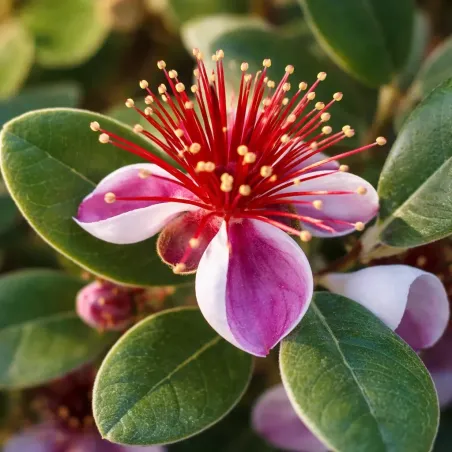
Here's a shrub to show visitors to your garden - with grey-green leaves, white-felted beneath, and most attractive and rather unusual flowers with crimson and white petals and numerous prominent crimson
Here's a shrub to show visitors to your garden - with grey-green leaves, white-felted beneath, and most attractive and rather unusual flowers with crimson and white petals and numerous prominent crimson stamens. In hot summer, these are followed by egg-sized and shaped berries that are edible, having a Guava-like flavor. However, not only are these fruits edible but the flower petals also, these having a rich, aromatic flavour. Almost hardy, but likes a warm, sunny position. Brazil.
Acca sellowiana, a species of flowering plant in the myrtle family, Myrtaceae, is native to the highlands of southern Brazil, eastern Paraguay, Uruguay, and northern Argentina, and Colombia.[1] It is widely cultivated as a garden plant and fruiting tree in New Zealand and can be found as a garden plant elsewhere such as in Australia, Azerbaijan, the West part of Georgia, South part of Russia and South Africa. [2] Common names include feijoa (pron.: /feɪˈʒoʊ.ə/, /feɪˈdʒoʊ.ə/,[3] or /feɪˈhoʊ.ə/)[4] pineapple guava and guavasteen. It is an evergreen, perennial shrub or small tree, 1–7 meters (3.3–23 ft) in height, widely cultivated as a garden plant and fruiting tree. The German botanist Otto Karl Berg named feijoa after João da Silva Feijó, a Portuguese botanist born in the colony of Brazil.
Fruit
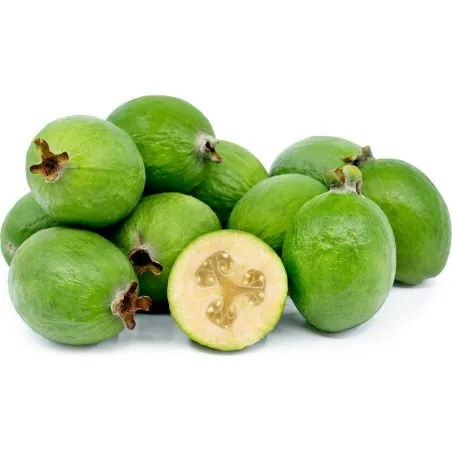
The fruit, maturing in autumn, is green, ellipsoid, and about the size of a chicken egg. It has a sweet, aromatic flavor. The flesh is juicy and is divided into a clear gelatinous seed pulp and a firmer, slightly granular, opaque flesh nearer the skin. The fruit falls to the ground when ripe and at its fullest flavor, but it may be picked from the tree prior to falling to prevent bruising.
The fruit pulp resembles the closely related guava, having a gritty texture. The feijoa pulp is used in some natural cosmetic products as an exfoliant. Feijoa fruit has a distinctive, potent smell that resembles that of a fine perfume. The aroma is due to the ester methyl benzoate and related compounds that exist in the fruit.
Growing conditions
It is a warm-temperate to subtropical plant that also will grow in the tropics, but requires at least 50 hours of winter chilling to fruit, and is frost-tolerant. When grown from seed, feijoas are noted for extremely slow growth during their first year or two, and young plants, though cold tolerant, can be very sensitive to high wind.
In the Northern Hemisphere, this species has been cultivated as far north as western Scotland, but under such conditions, it does not fruit every year, as winter temperatures below approximately −9 °C (16 °F) kill the flower buds. Summer temperatures above 90 °F (32 °C) may also have an adverse effect upon the fruit set. Feijoas are somewhat tolerant of drought and salt in soils, though fruit production can be adversely affected. Tolerant to partial shade, regular watering is essential while the fruit is maturing.
Seasonality
Large quantities of the fruit are grown in New Zealand, where it is a popular garden tree and the fruit commonly is available in season; the season runs from March to June. Feijoas are occasionally to be found as landscape plants in the far Southern United States, in regions from Texas to Florida, and southern California, though the fruit set can be unreliable in those locations. They are also grown in parts of northern California for their fruit. Fruits are an extremely rare sight away from cultivation areas, and when they can be found, they are often very, very expensive due to scarcity and demand even in places where the fruit isn't well-known.
Hardier varieties are grown in the Russian region of Buriatia (city Ulan-Ude).
Consumption and uses
The fruit usually is eaten by cutting it in half, then scooping out the pulp with a spoon.[5] The fruit has a juicy, sweet seed pulp and slightly gritty flesh nearer the skin. If the utensils needed to eat it this way are not available, the feijoa may be torn or bitten in half, and the contents squeezed out and consumed. An alternative method is to bite the end off and then tear the fruit in half lengthways, exposing a larger surface with less curvature and using one's teeth to scrape the pulp out closer to the skin. This method results in less waste of the fruit.
A feijoa may be used as an interesting addition to a fruit smoothie and may be used to make wine or cider and feijoa-infused vodka. The flavor is aromatic, very strong and complex, inviting comparison with guava, strawberry, pineapple, and often containing a faint wintergreen-like aftertaste. It also is possible to buy feijoa yogurt, fruit drinks, jam, ice cream, and such in New Zealand. It also may be cooked and used in dishes where one would use stewed fruit. It is a popular ingredient in chutney. The very strong, complex flavor can make using feijoas, in combination with other fruits or vegetables, a creative and complex undertaking.
Fruit maturity is not always apparent visually, as the fruits remain the same shade of green until they are overripe or rotting. One usually may sense ripeness, however, by giving the fruit a soft squeeze; a ripe feijoa will yield to pressure somewhat like a just-ripe banana. Generally, the fruit is at its optimum ripeness the day it drops from the tree. While still hanging, it may well prove bitter; once fallen, however, the fruit very quickly becomes overripe, so a daily collection of fallen fruit is advisable during the season.
When the fruit is immature, the seed pulp is white and opaque. It becomes clear and gelatinous when ripe. Fruits are at their optimum maturity when the seed pulp has turned into a clear jelly with no hint of browning. Once the seed pulp and surrounding flesh start to brown, the fruit is overripe, but still may be eaten, or used to make a delicious juice.
The flower petals are edible, with a flavor that is slightly sweet with hints of cinnamon. The most common use is as an addition to salads. They regularly are consumed by birds.
Feijoa is also cultivated in Azerbaijan. Besides its consumption in natural form, feijoa jam and compote is prepared and produced both in-home and on industrial scales.
Cultivation
Some grafted cultivars of feijoa are self-fertile. Most are not, and require a pollinator. Seedlings may or may not be of usable quality, and may or may not be self-fertile. Feijoas will mature into a sprawly shrub, but can be kept successfully as a large container plant, though accommodations will need to be made for the width of the plants, and the need to encourage new growth for fruit production. They can succeed in greenhouses in temperate parts of the United States, and have been grown in-ground as fruiting trees on the United States east coast in coastal Georgia and South Carolina as well as in California. Other regions of the United States: the Pacific Northwest, the southernmost Appalachian Mountains, and the immediate coastal region from North Carolina to Delaware all would warrant further investigation.
In California, robins, mockingbirds, hummingbirds, starlings, scrub jays, towhees, and grey squirrels feast on the petals and are presumed to be assisting with pollination.[citation needed] Honeybees also visit the flowers.
In the South Caucasus, feijoa was cultivated in the southern coastal region of Azerbaijan since 1928; cultivation in neighboring Georgia has gradually increased to about 988 hectares in 1986.
In New Zealand, the pollinators of this plant are bees, bumblebees, and medium-sized birds. The silvereye is a pollinator in the cooler parts of the South Island; the blackbird and the Indian myna, which feeds on the sweet, fleshy flower petals, are pollinators further north.
In some areas where the species has been introduced, however, the trees have been unproductive due to lack of pollinators. The shrub has very few insect pests.
Czy jesteś pewien, że chcesz zgłosić ten komentarz?
Zgłoszenie wysłane
Twój komentarz został wysłany i będzie widoczny po zatwierdzeniu przez moderatora.
Twoje zgłoszenie nie może zostać wysłane
Napisz swoją opinię
Recenzja została wysłana
Twój komentarz został dodany i będzie widoczny jak tylko zatwierdzi go moderator.
Twoja recenzja nie może być wysłana
🌍 Wysyłka na cały świat z UE
Wysyłamy na cały świat z Unii Europejskiej za pośrednictwem zarejestrowanej poczty lotniczej z wymaganym podpisem przy odbiorze.
📦 Śledzenie zamówienia
Aby znaleźć swój numer śledzenia, zaloguj się na swoje konto i przejdź do: Historia zamówień > Szczegóły. Twój numer śledzenia znajduje się bezpośrednio w szczegółach zamówienia.
Będziesz otrzymywać powiadomienia e-mail na każdym etapie zamówienia.
Jeśli nie widzisz tych wiadomości, sprawdź folder Spam/Wiadomości śmieci lub skontaktuj się ze swoim dostawcą e-mail. Alternatywnie poszukaj w Internecie informacji, jak odblokować wiadomości e-mail od nadawcy.
NASZ SERWIS E-MAIL DZIAŁA — Jeśli nie otrzymujesz wiadomości e-mail, prawdopodobnie jest to problem z Twoim dostawcą poczty lub ustawieniami.
📧 Jak zapewnić, aby e-maile z naszego sklepu internetowego zawsze trafiały do Twojej skrzynki odbiorczej
Aby zapobiec oznaczaniu naszych wiadomości jako spam, dodaj nasz adres e-mail do swoich kontaktów:
Otwórz Gmail (lub innego dostawcę) i znajdź e-mail od nas (xxxxxxxxxxxx@xxx.com).
Najedź kursorem na nazwę lub adres e-mail nadawcy.
Kliknij ikonę „Dodaj do kontaktów” (ikonka małej osoby).
Nie możemy Ci pomóc, jeśli Twoje ustawienia nie są skonfigurowane w ten sposób. Skontaktuj się ze swoim dostawcą e-mail, aby uzyskać pomoc.
Alternatywnie utwórz filtr w Gmailu:
Otwórz Gmail i przejdź do Ustawienia > Zobacz wszystkie ustawienia.
Przejdź do karty Filtry i zablokowane adresy.
Kliknij Utwórz nowy filtr i wpisz nasz adres e-mail.
Zaznacz Nigdy nie wysyłaj do spamu i kliknij Utwórz filtr.
📍 Śledź swoją paczkę
Twój numer śledzenia znajduje się w szczegółach zamówienia. Możesz śledzić swoje zamówienie za pośrednictwem następujących platform:
Podczas składania zamówienia zawsze podawaj ważny numer telefonu komórkowego z numerem kierunkowym kraju (np. +48 601 234 567).
NIE zamawiaj do skrytek pocztowych (P.O. Boxes) ani jeśli nie możesz być w domu, aby podpisać odbiór paczki. Paczek nie można zostawiać u sąsiadów.
Jeśli paczka wysłana do skrytki pocztowej zaginie lub nie zostanie doręczona, zwrot pieniędzy nie zostanie przyznany.
⚖️ Odpowiedzialność klienta za zgodność z prawem
Klient jest odpowiedzialny za upewnienie się, że produkt może być legalnie importowany do jego kraju, w tym za przestrzeganie wszystkich przepisów importowych, uzyskanie niezbędnych zezwoleń oraz opłacenie obowiązujących ceł, podatków i innych opłat. Przed złożeniem zamówienia sprawdź lokalne przepisy.
🔄 Paczki zagubione, zwrócone i ponowna wysyłka
Klienci z Brazylii i Meksyku: Nie możemy zwrócić pieniędzy za paczki zagubione lub zniszczone przez urząd celny.
Jeśli Twoja paczka zostanie zwrócona, zwrócimy tylko koszt produktu — koszty wysyłki nie podlegają zwrotowi.
Opłatę za zwrot (2 €) oraz wszelkie koszty ponownej wysyłki musi pokryć klient.
🚚 Dostawa przesyłki
Przesyłki polecone wymagają podpisu.
Jeśli śledzenie pokazuje, że paczka nadal znajduje się w placówce początkowej, oznacza to, że jest w drodze — skontaktuj się ze swoim lokalnym urzędem pocztowym, aby uzyskać aktualne informacje.
Niestety, ani my, ani poczta, za pośrednictwem której wysłano zamówienie, nie możemy pomóc w ustaleniu, gdzie dokładnie znajduje się paczka. Gdy zobaczysz, że paczka jest w Twoim kraju, MUSISZ skontaktować się ze swoją pocztą, podając numer śledzenia.
⏱️ Opcje dostawy i szacowany czas
Opcja dostawy
Czas przetwarzania
Uwagi
Priority Delivery
Wysyłka w ciągu 1–7 dni roboczych
Priorytetowe przetwarzanie; możliwe opóźnienia w okresie świątecznym (3–10 dni)
Secured Delivery
Wysyłka w ciągu 1–7 dni roboczych
Dostępne dla zamówień do 150 €; zwrot pieniędzy w przypadku zagubienia
Standard Delivery
Wysyłka w ciągu 7–10 dni roboczych
Bardziej ekonomiczna; możliwe opóźnienia w okresie świątecznym (7–14 dni)
Szacowany czas dostawy:
Wewnątrz UE: 3–20 dni
Reszta świata: 5–30 dni
Uwaga: Czas dostawy zależy od Twojej lokalizacji i lokalnego systemu pocztowego. COVID-19 lub sezony świąteczne mogą powodować dodatkowe opóźnienia.
💰 Koszty wysyłki
Koszty wysyłki i obsługi są obliczane automatycznie podczas składania zamówienia na podstawie wagi paczki i miejsca przeznaczenia.
⏰ Godziny przetwarzania zamówień
Nie przetwarzamy ani nie wysyłamy zamówień w soboty i niedziele.
💳 Opcje płatności
Chcielibyśmy poinformować o ważnej zmianie dotyczącej opłat za płatności. Niestety, ze względu na wyjątkowo wysokie opłaty transakcyjne nakładane przez PayPal, jesteśmy zmuszeni doliczać dopłatę do płatności dokonywanych za pośrednictwem ich serwisu.
Mamy jednak dla Ciebie rozwiązanie! Możesz uniknąć tych astronomicznych opłat, wybierając jedną z naszych alternatywnych metod płatności z PROWIZJĄ 0%:
✅ Płatność kartą kredytową/debetową – 0% prowizji
✅ Przelew bankowy – 0% prowizji
Przelew bankowy (SEPA / IBAN / SWIFT-BIC): W opisie płatności podaj numer referencyjny zamówienia. Zamówienia nieopłacone w ciągu 4 dni zostaną automatycznie anulowane.
PayPal: Płatności są akceptowane wyłącznie w euro. Prosimy o wybranie euro podczas finalizacji zakupu.
Płatność kartą: Akceptujemy karty Visa, MasterCard, American Express, CB, Diners Club, Discover, China UnionPay, JCB i Discover.
⚠️ Opłaty transakcyjne
Klienci są odpowiedzialni za wszelkie bankowe lub transakcyjne opłaty PayPal.
📝 Uwagi końcowe
Przed złożeniem zamówienia zawsze sprawdzaj naszą stronę internetową pod kątem specjalnych ogłoszeń, harmonogramów świątecznych lub określonych warunków wysyłki.