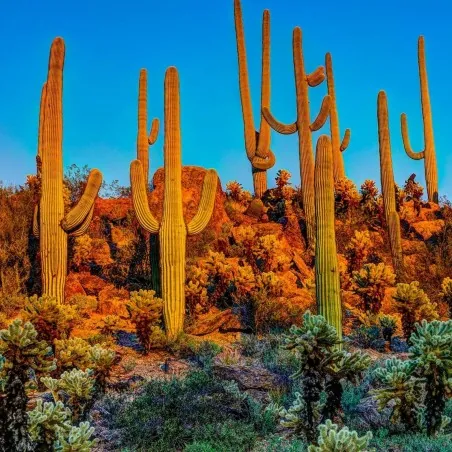
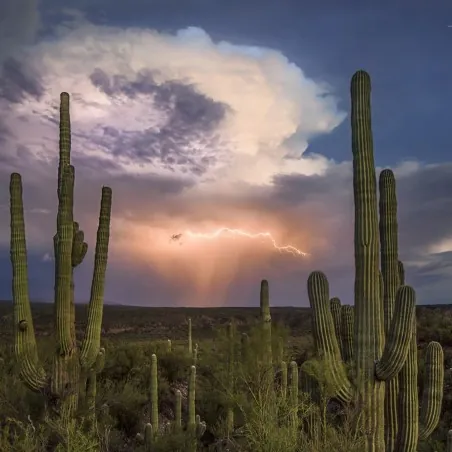
The saguaro (/səˈwɑroʊ/; scientific name Carnegiea gigantea) is a large, tree-sized cactus species in the monotypic genus Carnegiea, which can grow to be over 20 meters (~70 ft) tall. It is native to the
The saguaro (/səˈwɑroʊ/; scientific name Carnegiea gigantea) is a large, tree-sized cactus species in the monotypic genus Carnegiea, which can grow to be over 20 meters (~70 ft) tall. It is native to the Sonoran Desert in the U.S. state of Arizona, the Mexican state of Sonora, and the Whipple Mountains and Imperial County areas of California. The saguaro blossom is the State Wildflower of Arizona.
The common name saguaro came into the English language through the Spanish language, originating in the Mayo language.
Growth
Saguaros have a relatively long life span. They take up to 75 years to develop a side arm. A saguaro without arms is called a spear.
The arms are grown to increase the plant's reproductive capacity (more apices lead to more flowers and fruit). The growth rate of saguaros is strongly dependent on precipitation; saguaros in drier western Arizona grow only half as fast as those in and around Tucson, Arizona. Some specimens may live for more than 150 years;[1] the largest known saguaro is the Champion Saguaro. It grows in Maricopa County, Arizona, and is 13.8 meters (45.3 ft) tall with a girth of 3.1 meters (10 ft). These cacti can grow anywhere from 40 to 60 feet. They grow slowly from seed, and never from cuttings. Whenever it rains, saguaros soak up the rainwater. The cactus will visibly expand, holding in the rainwater. It conserves the water and slowly consumes it.
Spines
The spines on saguaro having a height less than 2 metres grow rapidly, up to a millimeter per day. When held up to the light or bisected, alternating light and dark bands transverse to the long axis of spines can be seen. These transverse bands have been correlated to daily growth. In columnar cacti, spines almost always grow in aureoles which originate at the apex of the plant. Individual spine growth reaches mature size in the first season and then cease to grow. Areoles are moved to the side and the apex continues to grow upwards. Thus, the older spines are towards the base of a columnar cactus and newer spines are near the apex. Current studies are underway to examine the relationship of carbon and oxygen isotope ratios in the tissues of spines to the past climate and photosynthetic history of the plant (acanthochronology).
Flowers
The night blooming white and yellow flowers appear April through June and the sweet, ruby-colored fruit matures by late June. Saguaro flowers are self incompatible thus require cross pollination. Large quantities of pollen are required for complete pollination as there are numerous ovules. A well pollinated fruit will contain several thousand tiny seeds.
The major pollinators are bats, primarily the lesser long-nosed bat, feeding on the nectar from the night-blooming flowers, which often remain open in the morning. There are a number of floral characteristics geared toward bat pollination: nocturnal opening of the flowers, nocturnal maturation of pollen, very rich nectar, position high above the ground, durable blooms that can withstand a bat's weight, and fragrance emitted at night. One additional piece of evidence is that the amino acids in the pollen appear to help sustain lactation in bats. The flowers remain open into the daylight hours and continue to produce nectar after sunrise. Doves and bees appear to be the primary daytime pollinators.
Fruit
The ruby red fruits are six to nine centimeters long and ripen in June. Each fruit contains around 2000 seeds plus sweet fleshy connective tissue. The fruits are edible and prized by local people.
The fruits cannot be picked by hand, but must be harvested using a pole 2 to 5 meters long, to the end of which is attached another pole.
The O'odham tribes have a long history of saguaro fruit use.[3] The Tohono O’odham tribes celebrate the beginning of their summer growing season with a ceremony using a fermented drink made from the bright red fruit to summon rains, vital for the crops.
Nests
Saguaro boot on display at Desert Botanical Garden in Phoenix, AZ
Native birds such as Gila woodpeckers, purple martins, house finches, and gilded flickers live inside holes in saguaros. Flickers excavate larger holes higher on the stem.[4] The nest cavity is deep, the parents and young entirely hidden from view. The saguaro creates callus tissue on the wound. When the saguaro dies and its soft flesh rots, the callus remains behind as a so-called "saguaro boot," which was used by natives for storage.
The Gila woodpeckers (Melanerpes uropygialis) create new nest holes each season rather than reuse the old ones, leaving convenient nest holes for other animals, such as elf owls, flycatchers, and wrens.[5] In recent years, early-breeding, aggressive, non-native birds have taken over the nests to the detriment of elf owls who breed and nest later.
Laws
Harming a saguaro in any manner, including cactus plugging, is illegal by state law in Arizona, and when houses or highways are built, special permits must be obtained to move or destroy any saguaro affected.
Ethnobotany
The saguaro is an important source of food and shelter for the Tohono O’odham. Saguaro spines are sometimes used as sewing needles and the ribs are used to make harvesting tools.
The ribs of the saguaro were used for construction and other purposes by Native Americans. A fine example can be seen in the roofing of the cloisters of the Mission San Xavier del Bac on the Tohono O'odham lands near Tucson, Arizona.
The Seri people of northwestern Mexico used the plant which they call mojépe for a number of purposes.
Location
The saguaro is often used as an emblem in commercials and logos that attempt to convey a sense of the Southwest, even if the product has no connection to Arizona or the Sonoran Desert. For instance, no saguaros are found within 250 miles (400 km) of El Paso, Texas, but the silhouette is found on the label of Old El Paso brand products. Though the geographic anomaly has lessened in recent years, Western films once enthusiastically placed saguaros in Monument Valley of Arizona as well as New Mexico, Utah, and Texas. There are no wild saguaros anywhere in the western U.S. states of Texas, Colorado, Utah, New Mexico, or Nevada, nor in the high deserts of northern Arizona.
Czy jesteś pewien, że chcesz zgłosić ten komentarz?
Zgłoszenie wysłane
Twój komentarz został wysłany i będzie widoczny po zatwierdzeniu przez moderatora.
Twoje zgłoszenie nie może zostać wysłane
Napisz swoją opinię
Recenzja została wysłana
Twój komentarz został dodany i będzie widoczny jak tylko zatwierdzi go moderator.
Twoja recenzja nie może być wysłana
🌍 Wysyłka na cały świat z UE
Wysyłamy na cały świat z Unii Europejskiej za pośrednictwem zarejestrowanej poczty lotniczej z wymaganym podpisem przy odbiorze.
📦 Śledzenie zamówienia
Aby znaleźć swój numer śledzenia, zaloguj się na swoje konto i przejdź do: Historia zamówień > Szczegóły. Twój numer śledzenia znajduje się bezpośrednio w szczegółach zamówienia.
Będziesz otrzymywać powiadomienia e-mail na każdym etapie zamówienia.
Jeśli nie widzisz tych wiadomości, sprawdź folder Spam/Wiadomości śmieci lub skontaktuj się ze swoim dostawcą e-mail. Alternatywnie poszukaj w Internecie informacji, jak odblokować wiadomości e-mail od nadawcy.
NASZ SERWIS E-MAIL DZIAŁA — Jeśli nie otrzymujesz wiadomości e-mail, prawdopodobnie jest to problem z Twoim dostawcą poczty lub ustawieniami.
📧 Jak zapewnić, aby e-maile z naszego sklepu internetowego zawsze trafiały do Twojej skrzynki odbiorczej
Aby zapobiec oznaczaniu naszych wiadomości jako spam, dodaj nasz adres e-mail do swoich kontaktów:
Otwórz Gmail (lub innego dostawcę) i znajdź e-mail od nas (xxxxxxxxxxxx@xxx.com).
Najedź kursorem na nazwę lub adres e-mail nadawcy.
Kliknij ikonę „Dodaj do kontaktów” (ikonka małej osoby).
Nie możemy Ci pomóc, jeśli Twoje ustawienia nie są skonfigurowane w ten sposób. Skontaktuj się ze swoim dostawcą e-mail, aby uzyskać pomoc.
Alternatywnie utwórz filtr w Gmailu:
Otwórz Gmail i przejdź do Ustawienia > Zobacz wszystkie ustawienia.
Przejdź do karty Filtry i zablokowane adresy.
Kliknij Utwórz nowy filtr i wpisz nasz adres e-mail.
Zaznacz Nigdy nie wysyłaj do spamu i kliknij Utwórz filtr.
📍 Śledź swoją paczkę
Twój numer śledzenia znajduje się w szczegółach zamówienia. Możesz śledzić swoje zamówienie za pośrednictwem następujących platform:
Podczas składania zamówienia zawsze podawaj ważny numer telefonu komórkowego z numerem kierunkowym kraju (np. +48 601 234 567).
NIE zamawiaj do skrytek pocztowych (P.O. Boxes) ani jeśli nie możesz być w domu, aby podpisać odbiór paczki. Paczek nie można zostawiać u sąsiadów.
Jeśli paczka wysłana do skrytki pocztowej zaginie lub nie zostanie doręczona, zwrot pieniędzy nie zostanie przyznany.
⚖️ Odpowiedzialność klienta za zgodność z prawem
Klient jest odpowiedzialny za upewnienie się, że produkt może być legalnie importowany do jego kraju, w tym za przestrzeganie wszystkich przepisów importowych, uzyskanie niezbędnych zezwoleń oraz opłacenie obowiązujących ceł, podatków i innych opłat. Przed złożeniem zamówienia sprawdź lokalne przepisy.
🔄 Paczki zagubione, zwrócone i ponowna wysyłka
Klienci z Brazylii i Meksyku: Nie możemy zwrócić pieniędzy za paczki zagubione lub zniszczone przez urząd celny.
Jeśli Twoja paczka zostanie zwrócona, zwrócimy tylko koszt produktu — koszty wysyłki nie podlegają zwrotowi.
Opłatę za zwrot (2 €) oraz wszelkie koszty ponownej wysyłki musi pokryć klient.
🚚 Dostawa przesyłki
Przesyłki polecone wymagają podpisu.
Jeśli śledzenie pokazuje, że paczka nadal znajduje się w placówce początkowej, oznacza to, że jest w drodze — skontaktuj się ze swoim lokalnym urzędem pocztowym, aby uzyskać aktualne informacje.
Niestety, ani my, ani poczta, za pośrednictwem której wysłano zamówienie, nie możemy pomóc w ustaleniu, gdzie dokładnie znajduje się paczka. Gdy zobaczysz, że paczka jest w Twoim kraju, MUSISZ skontaktować się ze swoją pocztą, podając numer śledzenia.
⏱️ Opcje dostawy i szacowany czas
Opcja dostawy
Czas przetwarzania
Uwagi
Priority Delivery
Wysyłka w ciągu 1–7 dni roboczych
Priorytetowe przetwarzanie; możliwe opóźnienia w okresie świątecznym (3–10 dni)
Secured Delivery
Wysyłka w ciągu 1–7 dni roboczych
Dostępne dla zamówień do 150 €; zwrot pieniędzy w przypadku zagubienia
Standard Delivery
Wysyłka w ciągu 7–10 dni roboczych
Bardziej ekonomiczna; możliwe opóźnienia w okresie świątecznym (7–14 dni)
Szacowany czas dostawy:
Wewnątrz UE: 3–20 dni
Reszta świata: 5–30 dni
Uwaga: Czas dostawy zależy od Twojej lokalizacji i lokalnego systemu pocztowego. COVID-19 lub sezony świąteczne mogą powodować dodatkowe opóźnienia.
💰 Koszty wysyłki
Koszty wysyłki i obsługi są obliczane automatycznie podczas składania zamówienia na podstawie wagi paczki i miejsca przeznaczenia.
⏰ Godziny przetwarzania zamówień
Nie przetwarzamy ani nie wysyłamy zamówień w soboty i niedziele.
💳 Opcje płatności
Chcielibyśmy poinformować o ważnej zmianie dotyczącej opłat za płatności. Niestety, ze względu na wyjątkowo wysokie opłaty transakcyjne nakładane przez PayPal, jesteśmy zmuszeni doliczać dopłatę do płatności dokonywanych za pośrednictwem ich serwisu.
Mamy jednak dla Ciebie rozwiązanie! Możesz uniknąć tych astronomicznych opłat, wybierając jedną z naszych alternatywnych metod płatności z PROWIZJĄ 0%:
✅ Płatność kartą kredytową/debetową – 0% prowizji
✅ Przelew bankowy – 0% prowizji
Przelew bankowy (SEPA / IBAN / SWIFT-BIC): W opisie płatności podaj numer referencyjny zamówienia. Zamówienia nieopłacone w ciągu 4 dni zostaną automatycznie anulowane.
PayPal: Płatności są akceptowane wyłącznie w euro. Prosimy o wybranie euro podczas finalizacji zakupu.
Płatność kartą: Akceptujemy karty Visa, MasterCard, American Express, CB, Diners Club, Discover, China UnionPay, JCB i Discover.
⚠️ Opłaty transakcyjne
Klienci są odpowiedzialni za wszelkie bankowe lub transakcyjne opłaty PayPal.
📝 Uwagi końcowe
Przed złożeniem zamówienia zawsze sprawdzaj naszą stronę internetową pod kątem specjalnych ogłoszeń, harmonogramów świątecznych lub określonych warunków wysyłki.