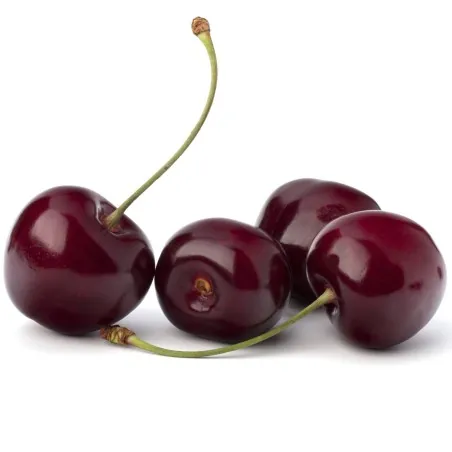
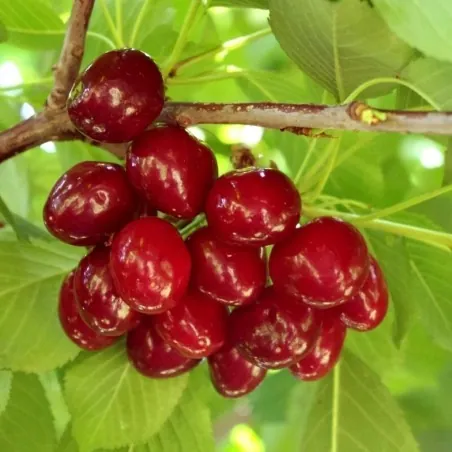
Prunus avium, commonly called wild cherry, sweet cherry, bird cherry, or gean, is a species of cherry native to Europe, western Turkey, northwestern Africa, and western Asia, from the British Isles south to Morocco
Prunus avium, commonly called wild cherry, sweet cherry, bird cherry, or gean, is a species of cherry native to Europe, western Turkey, northwestern Africa, and western Asia, from the British Isles south to Morocco and Tunisia, north to the Trondheimsfjord region in Norway and east to the Caucasus and northern Iran, with a small disjunct population in the western Himalaya.[3][4] This species, in the rose family (Rosaceae), has a diploid set of sixteen chromosomes (2n=16).[5] All parts of the plant except for the ripe fruit are slightly toxic, containing cyanogenic glycosides.
Nomenclature
The early history of its classification is somewhat confused. In the first edition of Species Plantarum (1753), Linnaeus treated it as only a variety, Prunus cerasus var. avium, citing Gaspard Bauhin's Pinax theatri botanici (1596) as a synonym;[clarification needed] his description, Cerasus racemosa hortensis ("Cherry with racemes, of gardens")[clarification needed] shows it was described from a cultivated plant.[6] Linnaeus then changed from a variety to a species Prunus avium in the second edition of his Flora Suecica in 1755.[7]
Sweet cherry was known historically as Gean or Mazzard (also 'massard'), until recently, both were largely obsolete names in modern English.
The name "wild cherry" is also commonly applied to other species of Prunus growing in their native habitats, particularly to the North American species Prunus serotina.
Prunus avium means "bird cherry" in the Latin language.[4] In English "bird cherry" often refers to Prunus padus.
Mazzard
More recently[when?] 'Mazzard' has been used to refer to a selected self-fertile cultivar that comes true from seed, and which is used as a seedling rootstock for fruiting cultivars.[9][10] This term is still used particularly for the varieties of P. avium grown in North Devon and cultivated there, particularly in the orchards at Landkey.
Description and ecology
Prunus avium is a deciduous tree growing to 15–32 m (50-100 ft) tall, with a trunk up to 1.5 m (5 ft) in diameter. Young trees show strong apical dominance with a straight trunk and symmetrical conical crown, becoming rounded to irregular on old trees. The bark is smooth purplish-brown with prominent horizontal grey-brown lenticels on young trees, becoming thick dark blackish-brown and fissured on old trees. The leaves are alternate, simple ovoid-acute, 7–14 cm (3–6 in) long and 4–7 cm (2–3 in) broad, glabrous matt or sub-shiny green above, variably finely downy beneath, with a serrated margin and an acuminate tip, with a green or reddish petiole 2–3.5 cm (0.8-1.4 in) long bearing two to five small red glands. The tip of each serrated edge of the leaves also bear small red glands.[11] In autumn, the leaves turn orange, pink or red before falling. The flowers are produced in early spring at the same time as the new leaves, borne in corymbs of two to six together, each flower pendent on a 2–5 cm (0.8-2 in) peduncle, 2.5–3.5 cm (1-1.4 in) in diameter, with five pure white petals, yellowish stamens, and a superior ovary; they are hermaphroditic, and pollinated by bees. The fruit is a drupe 1–2 cm (0.4-0.8 in) in diameter (larger in some cultivated selections), bright red to dark purple when mature in midsummer, edible, variably sweet to somewhat astringent and bitter to eat fresh. Each fruit contains a single hard-shelled stone 8–12 mm long, 7–10 mm wide and 6–8 mm thick, grooved along the flattest edge; the seed (kernel) inside the stone is 6–8 mm long.
The fruit are readily eaten by numerous kinds of birds and mammals, which digest the fruit flesh and disperse the seeds in their droppings. Some rodents, and a few birds (notably the Hawfinch), also crack open the stones to eat the kernel inside. All parts of the plant except for the ripe fruit are slightly toxic, containing cyanogenic glycosides.
See also List of Lepidoptera that feed on Prunus
The leaves provide food for some animals, including Lepidoptera such as the case-bearer moth Coleophora anatipennella.
The tree exudes a gum from wounds in the bark, by which it seals the wounds to exclude insects and fungal infections.
Fruit
Some eighteenth and nineteenth century botanical authors[who?] assumed a western Asia origin for the species based on the writings of Pliny; however, archaeological finds of seeds from prehistoric Europe contradict this view. Wild cherries have been an item of human food for several thousands of years. The stones have been found in deposits at Bronze Age settlements throughout Europe, including in Britain.[9] In one dated example, wild cherry macrofossils were found in a core sample from the detritus beneath a dwelling at an Early and Middle Bronze Age pile-dwelling site on and in the shore of a former lake at Desenzano del Garda or Lonato, near the southern shore of Lake Garda, Italy. The date is estimated at Early Bronze Age IA, carbon dated there to 2077 BC plus or minus 10 years. The natural forest was largely cleared at that time.[16]
By 800 BC, cherries were being actively cultivated in Asia Minor, and soon after in Greece.[9]
As the main ancestor of the cultivated cherry, the sweet cherry is one of the two cherry species which supply most of the world's commercial cultivars of edible cherry (the other is the sour cherry Prunus cerasus, mainly used for cooking; a few other species have had a very small input).[9] Various cherry cultivars are now grown worldwide wherever the climate is suitable; the number of cultivars is now very large.[9] The species has also escaped from cultivation and become naturalised in some temperate regions, including southwestern Canada, Japan, New Zealand, and the northeast and northwest of the United States.
Ornamental
It is often cultivated as a flowering tree. Because of the size of the tree, it is often used in parkland, and less often as a street or garden tree. The double-flowered form, 'Plena', is commonly found, rather than the wild single-flowered forms.
Two interspecific hybrids, P. x schmittii (P. avium x P. canescens) and P. x fontenesiana (P. avium x P. mahaleb) are also grown as ornamental trees.
Timber
The hard, reddish-brown wood (cherry wood) is valued as a hardwood for woodturning, and making cabinets and musical instruments.[15] Cherry wood is also used for smoking foods, particularly meats, in North America, as it lends a distinct and pleasant flavor to the product.[citation needed]
Other uses
The gum from bark wounds is aromatic and can be chewed as a substitute for chewing gum.
Medicine can be prepared from the stalks of the drupes that is astringent, antitussive, and diuretic.
A green dye can also be prepared from the plant.
Contribution to other species
Prunus avium is thought to be one of the parent species of Prunus cerasus (sour cherry) by way of ancient crosses between it and Prunus fruticosa (dwarf cherry) in the areas where the two species overlap. All three species can breed with each other. Prunus cerasus is now a species in its own right having developed beyond a hybrid and stabilised.
Czy jesteś pewien, że chcesz zgłosić ten komentarz?
Zgłoszenie wysłane
Twój komentarz został wysłany i będzie widoczny po zatwierdzeniu przez moderatora.
Twoje zgłoszenie nie może zostać wysłane
Napisz swoją opinię
Recenzja została wysłana
Twój komentarz został dodany i będzie widoczny jak tylko zatwierdzi go moderator.
Twoja recenzja nie może być wysłana
🌍 Wysyłka na cały świat z UE
Wysyłamy na cały świat z Unii Europejskiej za pośrednictwem zarejestrowanej poczty lotniczej z wymaganym podpisem przy odbiorze.
📦 Śledzenie zamówienia
Aby znaleźć swój numer śledzenia, zaloguj się na swoje konto i przejdź do: Historia zamówień > Szczegóły. Twój numer śledzenia znajduje się bezpośrednio w szczegółach zamówienia.
Będziesz otrzymywać powiadomienia e-mail na każdym etapie zamówienia.
Jeśli nie widzisz tych wiadomości, sprawdź folder Spam/Wiadomości śmieci lub skontaktuj się ze swoim dostawcą e-mail. Alternatywnie poszukaj w Internecie informacji, jak odblokować wiadomości e-mail od nadawcy.
NASZ SERWIS E-MAIL DZIAŁA — Jeśli nie otrzymujesz wiadomości e-mail, prawdopodobnie jest to problem z Twoim dostawcą poczty lub ustawieniami.
📧 Jak zapewnić, aby e-maile z naszego sklepu internetowego zawsze trafiały do Twojej skrzynki odbiorczej
Aby zapobiec oznaczaniu naszych wiadomości jako spam, dodaj nasz adres e-mail do swoich kontaktów:
Otwórz Gmail (lub innego dostawcę) i znajdź e-mail od nas (xxxxxxxxxxxx@xxx.com).
Najedź kursorem na nazwę lub adres e-mail nadawcy.
Kliknij ikonę „Dodaj do kontaktów” (ikonka małej osoby).
Nie możemy Ci pomóc, jeśli Twoje ustawienia nie są skonfigurowane w ten sposób. Skontaktuj się ze swoim dostawcą e-mail, aby uzyskać pomoc.
Alternatywnie utwórz filtr w Gmailu:
Otwórz Gmail i przejdź do Ustawienia > Zobacz wszystkie ustawienia.
Przejdź do karty Filtry i zablokowane adresy.
Kliknij Utwórz nowy filtr i wpisz nasz adres e-mail.
Zaznacz Nigdy nie wysyłaj do spamu i kliknij Utwórz filtr.
📍 Śledź swoją paczkę
Twój numer śledzenia znajduje się w szczegółach zamówienia. Możesz śledzić swoje zamówienie za pośrednictwem następujących platform:
Podczas składania zamówienia zawsze podawaj ważny numer telefonu komórkowego z numerem kierunkowym kraju (np. +48 601 234 567).
NIE zamawiaj do skrytek pocztowych (P.O. Boxes) ani jeśli nie możesz być w domu, aby podpisać odbiór paczki. Paczek nie można zostawiać u sąsiadów.
Jeśli paczka wysłana do skrytki pocztowej zaginie lub nie zostanie doręczona, zwrot pieniędzy nie zostanie przyznany.
⚖️ Odpowiedzialność klienta za zgodność z prawem
Klient jest odpowiedzialny za upewnienie się, że produkt może być legalnie importowany do jego kraju, w tym za przestrzeganie wszystkich przepisów importowych, uzyskanie niezbędnych zezwoleń oraz opłacenie obowiązujących ceł, podatków i innych opłat. Przed złożeniem zamówienia sprawdź lokalne przepisy.
🔄 Paczki zagubione, zwrócone i ponowna wysyłka
Klienci z Brazylii i Meksyku: Nie możemy zwrócić pieniędzy za paczki zagubione lub zniszczone przez urząd celny.
Jeśli Twoja paczka zostanie zwrócona, zwrócimy tylko koszt produktu — koszty wysyłki nie podlegają zwrotowi.
Opłatę za zwrot (2 €) oraz wszelkie koszty ponownej wysyłki musi pokryć klient.
🚚 Dostawa przesyłki
Przesyłki polecone wymagają podpisu.
Jeśli śledzenie pokazuje, że paczka nadal znajduje się w placówce początkowej, oznacza to, że jest w drodze — skontaktuj się ze swoim lokalnym urzędem pocztowym, aby uzyskać aktualne informacje.
Niestety, ani my, ani poczta, za pośrednictwem której wysłano zamówienie, nie możemy pomóc w ustaleniu, gdzie dokładnie znajduje się paczka. Gdy zobaczysz, że paczka jest w Twoim kraju, MUSISZ skontaktować się ze swoją pocztą, podając numer śledzenia.
⏱️ Opcje dostawy i szacowany czas
Opcja dostawy
Czas przetwarzania
Uwagi
Priority Delivery
Wysyłka w ciągu 1–7 dni roboczych
Priorytetowe przetwarzanie; możliwe opóźnienia w okresie świątecznym (3–10 dni)
Secured Delivery
Wysyłka w ciągu 1–7 dni roboczych
Dostępne dla zamówień do 150 €; zwrot pieniędzy w przypadku zagubienia
Standard Delivery
Wysyłka w ciągu 7–10 dni roboczych
Bardziej ekonomiczna; możliwe opóźnienia w okresie świątecznym (7–14 dni)
Szacowany czas dostawy:
Wewnątrz UE: 3–20 dni
Reszta świata: 5–30 dni
Uwaga: Czas dostawy zależy od Twojej lokalizacji i lokalnego systemu pocztowego. COVID-19 lub sezony świąteczne mogą powodować dodatkowe opóźnienia.
💰 Koszty wysyłki
Koszty wysyłki i obsługi są obliczane automatycznie podczas składania zamówienia na podstawie wagi paczki i miejsca przeznaczenia.
⏰ Godziny przetwarzania zamówień
Nie przetwarzamy ani nie wysyłamy zamówień w soboty i niedziele.
💳 Opcje płatności
Chcielibyśmy poinformować o ważnej zmianie dotyczącej opłat za płatności. Niestety, ze względu na wyjątkowo wysokie opłaty transakcyjne nakładane przez PayPal, jesteśmy zmuszeni doliczać dopłatę do płatności dokonywanych za pośrednictwem ich serwisu.
Mamy jednak dla Ciebie rozwiązanie! Możesz uniknąć tych astronomicznych opłat, wybierając jedną z naszych alternatywnych metod płatności z PROWIZJĄ 0%:
✅ Płatność kartą kredytową/debetową – 0% prowizji
✅ Przelew bankowy – 0% prowizji
Przelew bankowy (SEPA / IBAN / SWIFT-BIC): W opisie płatności podaj numer referencyjny zamówienia. Zamówienia nieopłacone w ciągu 4 dni zostaną automatycznie anulowane.
PayPal: Płatności są akceptowane wyłącznie w euro. Prosimy o wybranie euro podczas finalizacji zakupu.
Płatność kartą: Akceptujemy karty Visa, MasterCard, American Express, CB, Diners Club, Discover, China UnionPay, JCB i Discover.
⚠️ Opłaty transakcyjne
Klienci są odpowiedzialni za wszelkie bankowe lub transakcyjne opłaty PayPal.
📝 Uwagi końcowe
Przed złożeniem zamówienia zawsze sprawdzaj naszą stronę internetową pod kątem specjalnych ogłoszeń, harmonogramów świątecznych lub określonych warunków wysyłki.