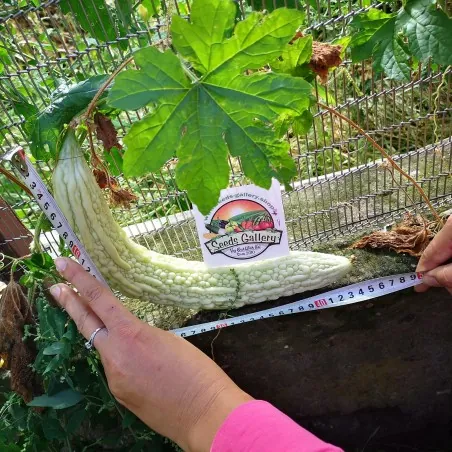
This is the biggest Bitter Melon that exists, it reaches a length of over 45 centimeters and a width of 6 centimeters! After several years, we managed to extract the largest fruits and
This is the biggest Bitter Melon that exists, it reaches a length of over 45 centimeters and a width of 6 centimeters! After several years, we managed to extract the largest fruits and store and sow those seeds, finally for the third year in a row we get the same fruits that are really huge!
If the Balsam Pear did not exist a pharmaceutical company would invent it. In fact, there have been some ten studies published this past year about it, the latest as of this writing in February 2008 in the Journal of Food Biochemistry about its potential in diabetes treatment.
A very common, bitter vegetable in Asian cuisine, the Balsam Pear, Momordica charantia, is a natural drug store for diabetics and others. It’s not a pear at all but a fruiting gourd and vine that smells like an old, well-used gym shoe. Don’t say you weren’t warned.
The warty gourd is edible when green (and cooked) but turns toxic when orange ripe. It then splits characteristically into three parts, revealing red arils (fleshy seed covers). The ripe seeds inside the arils and orange flesh of the gourd are toxic and can make one violently lose fluids from both ends, and induce abortions. The red arils around the seeds, however, are edible. And notice this: The arils are 96% lycopene, which gives them their color. Just remember to spit out the seed from each aril.
M. charantia is found Connecticut south to Florida, west to Texas, also Puerto Rico and the Hawaiian Islands. Incidentally, the bitter melon has twice the potassium of bananas and is also rich in vitamin A and C.
The Latin genus name, Momordica, (mo-MOR-dee-ka) means “to bite,” and refers to the jagged edges of the leaves, which appear as if they have been bitten. Charantia (char-AN-tee-ah) the species’ name, comes from Greek meaning beautiful flower. It’s native to tropical regions of the world though no one knows where it came from originally. Gray’s four-inch thick Manual of Botany, started in 1850 and revised in 1950, makes no mention of M. charantia in the United States but it is currently a serious crop weed in Florida and to 21 other crops around the world, bananas to soybeans. It’s a late comer to Florida or Gray was in the dark about it. In the Amazon, and as far away as India, it is used very much by local populations for food and medicine. Apparently a dynamic chemical factory, the M. charantia is being tested for treatment against cancer — leukemia in particular — AIDS, as an analgesic, and to moderate insulin resistance. It is often called the vegetable insulin. It does not increase insulin secretion but “speeds up carbohydrate use of the cells by affecting membrane lipids.” Seems like the smelly gym shoe hanging on the fence has a great future. But, it is not for everyone: Don’t eat the vegetable if you’re hypoglycemic or pregnant. In diabetics it can lower blood sugar too effectively. It also reduces fertility in men and women. And, it contains vicine. That can cause favism in people who have a variant glucose-6-phosphate dehydrogenase. (I presume if you don’t know what that is you don’t have it. Favism is a severe reaction to fava beans and or their pollen. Occurs most often in Mediterranean men.)
Cultivated versions of the M. charantia, also called Bitter Gourd or Wild Balsam Apple, are found in most Asian markets, and they, too, smell like an old gym shoe. The odor, thankfully, almost all goes away when cooked and the bitterness moderates, but does not go away. If you are not yet brave enough to pick your own, you can buy some or grow it yourself. There are many varieties and numerous recipes are on the Internet. The M. charantia is indeed bitter. Some cut up the vegetable and soak it in water, or salted water and or blanch it to reduce the bitterness.
While I have never seen an Oriental family picking M. charantia off local fences here in Florida, I have seen many Hispanic families doing so. Dr. Julia Morton, a plant professor in south Florida, says besides the green fruit, the young leaves when cooked and drained are also edible and nutritious, with iron, phosphorous, calcium and vitamin C. I have never managed to get past the locker room bouquet to toss ‘em in a pot, and the fruit is just too bitter for me to enjoy. The ripe fruit pulp has been used as a soap substitute, which should give you some idea of the flavor. In India and Africa the cooked leaves are canned like spinach. The fragrant flowers can be used as seasoning when cooking.
Incidentally, if you have a glut of green Bitter Gourds, you can slice them, partially boil them with salted water, then dry them, sun or otherwise. They will last for several months. You can then fry them and use as you like. Also, drinking the fresh bitter juice is recommended by some naturopaths. That ain’t going to be easy, it’s really bitter…. much easier to tell someone to do it than do it yourself.
REMEMBER: No part of the Momordica charantia is ever to be eaten raw, except for the red arils (and remember to spit the seeds out.) No part, other than the arils, is ever to be eaten when ripe, which is when it is turning from green to yellow to orange. Do not eat the yellow or orange fruit raw or cooked. It is toxic. Also, the green fruit is suspected in the poisoning of dogs and pigs.
Relatives: Momordica balsamina, which has longer spines on the fruit and can ripen to red, grows only in St. Lucie County in Florida and only a smattering of places in the southern U.S. M. balsamina fruit can be pickled or after soaking used as a cooked vegetable. Young shoots and tendrils are boiled as a green. The seeds are eaten. Momordica cochinchinensis produces a huge round fruit that is red when ripe. Young fruit boiled, not as bitter as M. charantia. Momordica dioica, small and roundish, is more esteemed than the rest. It is not bitter but sweet. Fruits, shoots, leaves and roots are boiled for food. There are also at least seven commercial cultivars of the Momordica gourds
IDENTIFICATION: Momordica charantia: A slender, climbing annual vine to 18 feet with long-stalked leaves and yellow flowers where the leaf meets the stem. Young fruit emerald green turning to orange when ripe. At maturity, fruit splits into three irregular parts that curl backwards showing many reddish-brown or white seeds encased in scarlet arils.
TIME OF YEAR: Fruit, summer and fall in warm climates, fall in northern climes.
ENVIRONMENT: Love to climb, found in hammocks, disturbed sites, turf and ornamental landscapes, and citrus groves . It seems to be the most common vine on chain link fences in Florida.
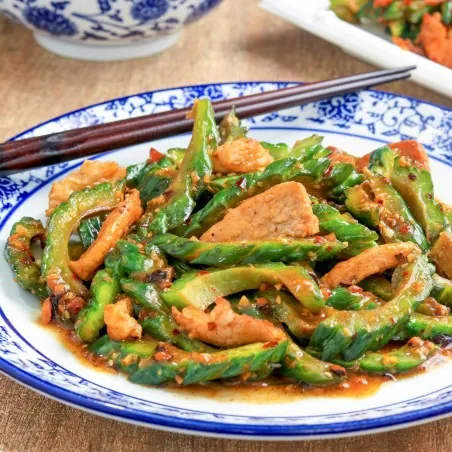
METHOD OF PREPARATION: None of it ripe except the arils. Boiled green fruit (including seeds) leaves and shoots, boiled twice. Or, cut open and remove seeds and fiber and parboil. Ripe parts toxic are too bitter to eat. (An adult can swallow hole two ripe seed and not have much distress.) Young leaves and shoots are boiled and eaten as a potherb. Flowers used as seasoning.
HERB BLURB
Herbalists say the charantia has long been used to treat diabetes and a host of other ailments from arthritis to jaundice.
A jelentésed beküldve, és egy moderátor megvizsgálja.
Jelentésed beküldése nem lehetséges
Vélemény elküldve
A hozzászólásodat elküldtük és elérhető lesz, amint egy moderátor jóváhagyja.
Véleményed nem lehet elküldeni
🌍 Celosvětová doprava z EU
Odesíláme do celého světa z Evropské unie doporučenou leteckou poštou s nutností podpisu při převzetí.
📦 Sledování vaší objednávky
Chcete-li najít své sledovací číslo, přihlaste se ke svému účtu a přejděte na: Historie objednávek > Podrobnosti. Vaše sledovací číslo se nachází přímo v podrobnostech objednávky.
O každé fázi vaší objednávky budete informováni e-mailem.
Pokud tyto zprávy nevidíte, zkontrolujte prosím složku Spam/Nevyžádaná pošta nebo kontaktujte svého poskytovatele e-mailu. Případně vyhledejte online, jak odblokovat e-maily odesílatele.
NÁŠ E-MAILOVÝ SERVIS FUNGUJE — Pokud e-maily nedostáváte, je to pravděpodobně problém vašeho poskytovatele e-mailu nebo nastavení.
📧 Jak zajistit, aby e-maily z našeho e-shopu vždy skončily ve vaší doručené poště
Abyste zabránili označování našich e-mailů jako spam, přidejte si naši e-mailovou adresu do svých kontaktů:
Otevřete Gmail (nebo jiného poskytovatele) a najděte e-mail od nás (xxxxxxxxxxxx@xxx.com).
Najeďte myší na jméno nebo e-mailovou adresu odesílatele.
Klikněte na ikonu "Přidat do kontaktů" (ikona postavy).
Pokud vaše nastavení nebude takové, nemůžeme vám pomoci. O pomoc požádejte svého poskytovatele e-mailu.
Případně vytvořte filtr v Gmailu:
Otevřete Gmail a přejděte na Nastavení > Zobrazit všechna nastavení.
Přejděte na kartu Filtry a zablokované adresy.
Klikněte na Vytvořit nový filtr a zadejte naši e-mailovou adresu.
Zaškrtněte Nikdy neposílat do složky Spam a klikněte na Vytvořit filtr.
📍 Sledování zásilky
Vaše sledovací číslo se nachází v podrobnostech vaší objednávky. Svou objednávku můžete sledovat prostřednictvím následujících platforem:
Při objednávce vždy uveďte platné mobilní číslo s předvolbou země (např. +420 123 456 789).
NEOBJEDNÁVEJTE na poštovní přihrádky (P.O. Boxy) nebo pokud nemůžete být doma a zásilku podepsat. Zásilky nelze nechat u sousedů.
Pokud se zásilka zaslaná do P.O. Boxu ztratí nebo nebude doručena, nebude poskytnuta žádná náhrada.
⚖️ Odpovědnost zákazníka za dodržování právních předpisů
Zákazník je odpovědný za zajištění toho, aby byl produkt legální pro dovoz do jeho země, včetně dodržování všech dovozních předpisů, získání nezbytných povolení a zaplacení příslušných cel, daní a dalších poplatků. Před objednáním si prosím ověřte místní zákony.
🔄 Ztracené, vrácené a znovu zaslané zásilky
Zákazníci z Brazílie a Mexika: Nemůžeme vrátit peníze za zásilky ztracené nebo zničené celními orgány.
Pokud se vaše zásilka vrátí, vrátíme vám pouze náklady na produkt — náklady na dopravu se nevracejí.
Poštovné za vrácení (2 €) a veškeré náklady na opětovné zaslání musí uhradit zákazník.
🚚 Doručení zásilky
Doporučené zásilky vyžadují podpis.
Pokud sledování ukazuje, že zásilka je stále na výchozí poště, je na cestě — kontaktujte svou místní poštu pro aktuální informace.
Bohužel ani my, ani pošta, přes kterou byla vaše objednávka odeslána, vám nemůžeme pomoci s otázkou, kde přesně se vaše objednávka nachází. Jakmile uvidíte, že je zásilka ve vaší zemi, MUSÍTE kontaktovat svou poštu se sledovacím číslem.
⏱️ Možnosti doručení a odhadované časy
Možnost doručení
Čas zpracování
Poznámky
Priority Delivery
Odeslání do 1–7 pracovních dnů
Prioritní zpracování objednávky; během svátků možná zpoždění (3–10 dní)
Secured Delivery
Odeslání do 1–7 pracovních dnů
Dostupné pro objednávky do 150 €; vrácení peněz v případě ztráty
Standard Delivery
Odeslání do 7–10 pracovních dnů
Ekonomičtější; během svátků možná zpoždění (7–14 dní)
Odhadované dodací lhůty:
V rámci EU: 3–20 dní
Celosvětově: 5–30 dní
Poznámka: Dodací lhůty závisí na vaší lokalitě a místním poštovním systému. COVID-19 nebo svátky mohou způsobit další zpoždění.
💰 Náklady na dopravu
Poštovné a balné se vypočítá automaticky při dokončení objednávky na základě hmotnosti zásilky a místa určení.
⏰ Doba zpracování objednávek
O víkendech (v sobotu a v neděli) objednávky nezpracováváme ani neodesíláme.
💳 Možnosti platby
Rádi bychom vás informovali o důležité změně týkající se poplatků za platby. Bohužel vzhledem k výjimečně vysokým transakčním poplatkům účtovaným společností PayPal jsme nuceni u plateb provedených prostřednictvím jejich služby uplatnit příplatek.
Máme však pro vás řešení! Těmto astronomickým poplatkům se můžete vyhnout výběrem jedné z našich alternativních platebních metod s NULOVOU PROVIZÍ:
✅ Platba kreditní/debetní kartou – 0 % poplatek
✅ Bankovní převod – 0 % poplatek
Bankovní převod (SEPA / IBAN / SWIFT-BIC): Do popisu platby uveďte referenční číslo objednávky. Objednávky bez platby do 4 dnů budou automaticky zrušeny.
PayPal: Platby jsou přijímány pouze v eurech. Při platbě zvolte měnu Euro.
Platba kartou: Přijímáme karty Visa, MasterCard, American Express, CB, Diners Club, Discover, China UnionPay, JCB a Discover.
⚠️ Transakční poplatky
Zákazníci jsou zodpovědní za veškeré bankovní poplatky nebo transakční poplatky PayPal.
📝 Závěrečné poznámky
Před odesláním objednávky si vždy zkontrolujte naše webové stránky, zda neobsahují zvláštní upozornění, rozpisy svátků nebo konkrétní dodací podmínky.


Hozzászólások (0)
A megfogalmazott véleményedet nem lehet elküldeni
Hozzászólás jelentése
Jelentés elküldve
Jelentésed beküldése nem lehetséges