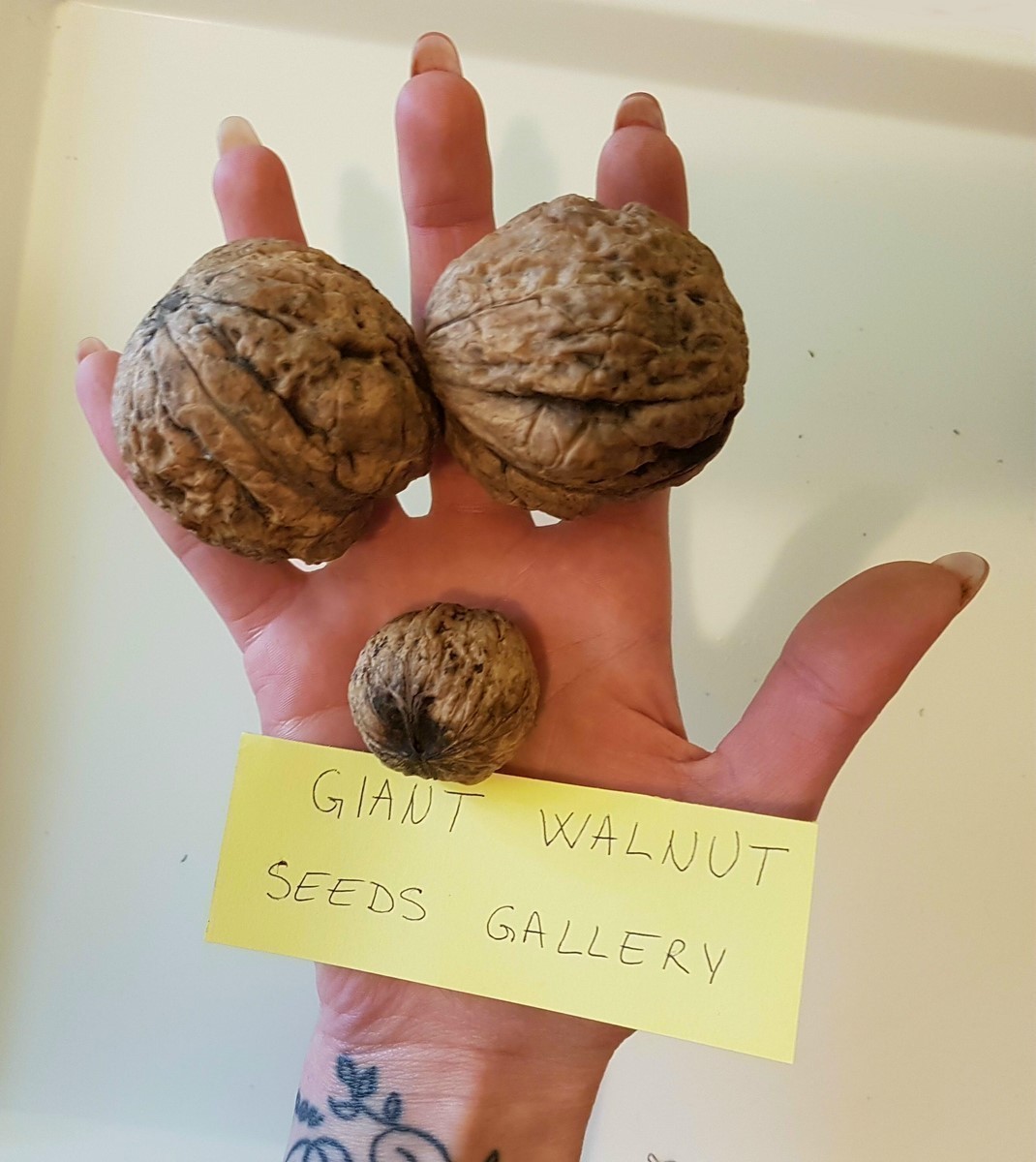
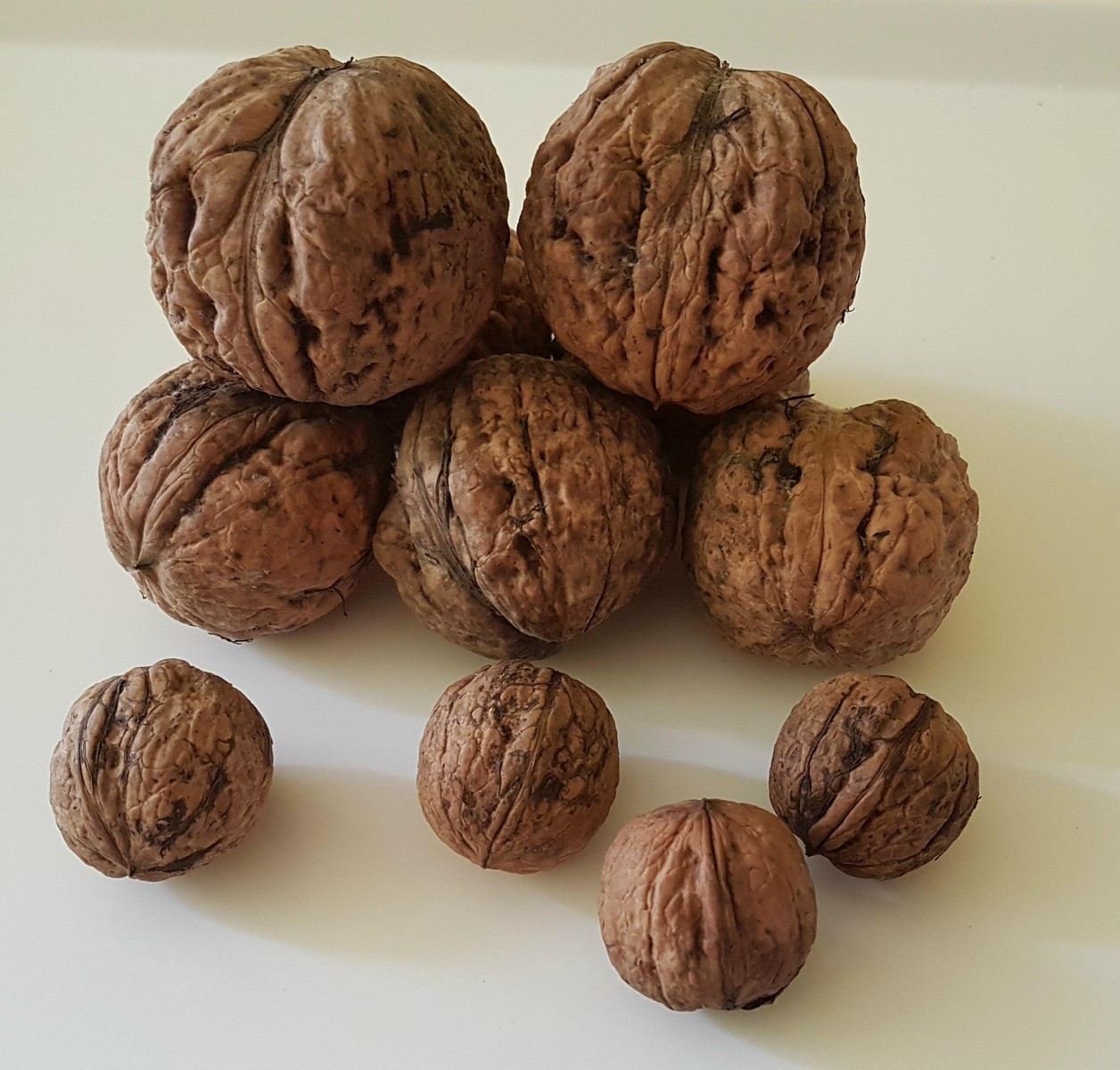
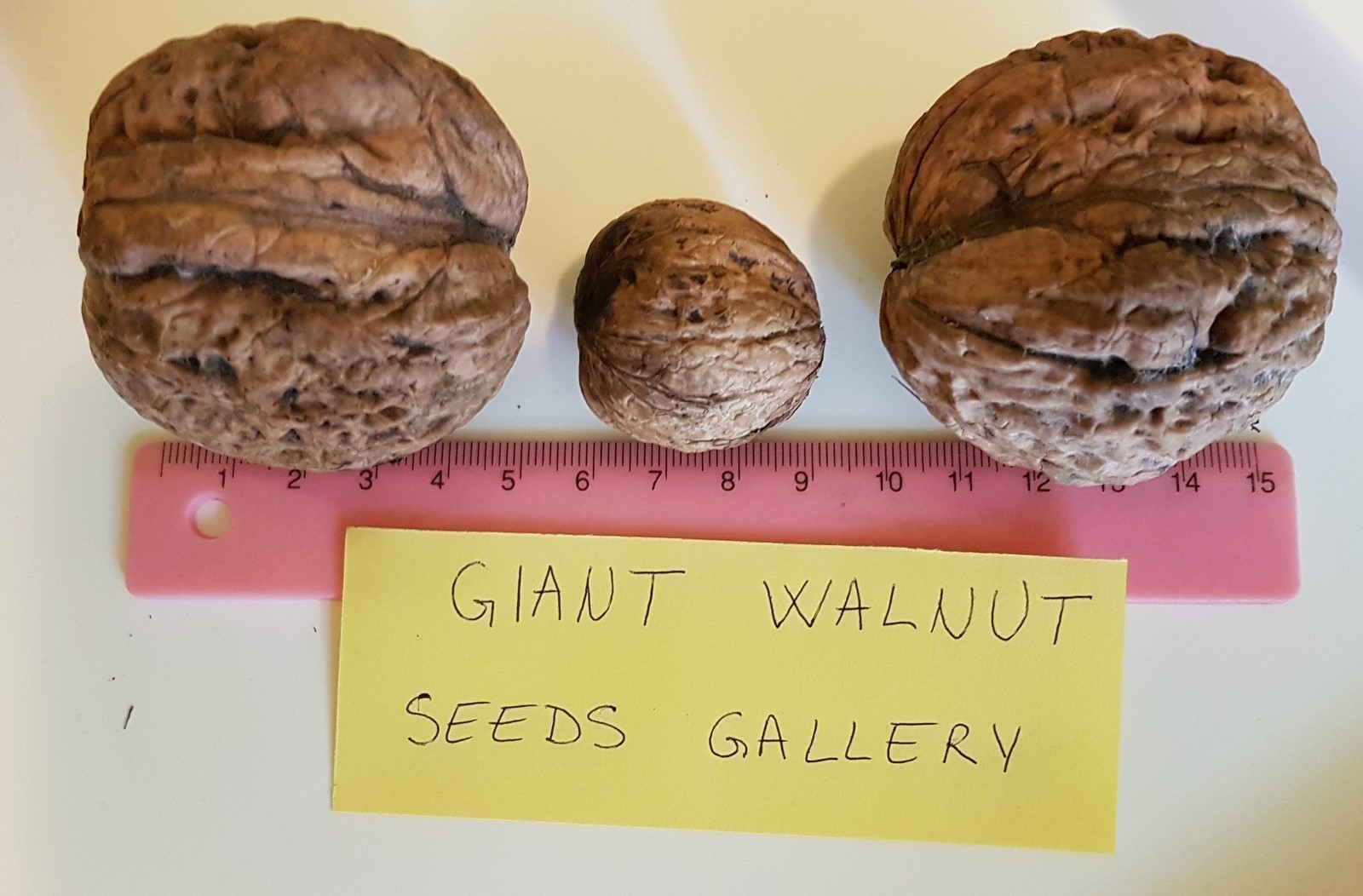
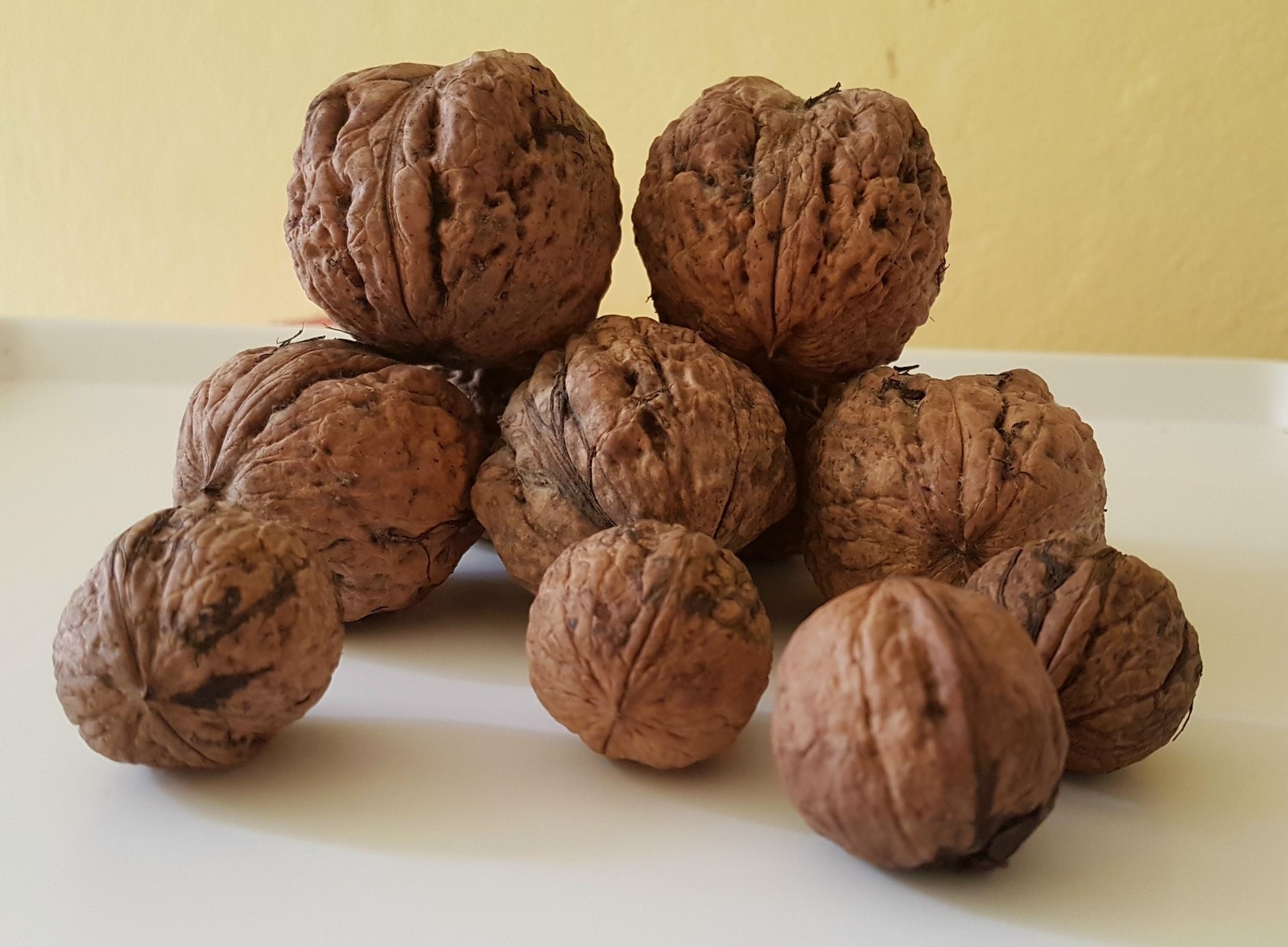
This walnut is 3 - 4 times bigger than any other!!! A walnut is the nut of any tree of the genus Juglans (Family Juglandaceae), particularly the Persian or English walnut
This walnut is 3 - 4 times bigger than any other!!!
A walnut is the nut of any tree of the genus Juglans (Family Juglandaceae), particularly the Persian or English walnut, Juglans regia. Technically a walnut is the seed of a drupe or drupaceous nut, and thus not a true botanical nut. It is used for food after being processed while green for pickled walnuts or after full ripening for its nutmeat. Nutmeat of the eastern black walnut from the Juglans nigra is less commercially available, as are butternut nutmeats from Juglans cinerea. The walnut is nutrient-dense with protein and essential fatty acids.
Walnuts are rounded, single-seeded stone fruits of the walnut tree commonly used for the meat after fully ripening. Following full ripening, the removal of the husk reveals the wrinkly walnut shell, which is usually commercially found in two segments (three-segment shells can also form). During the ripening process, the husk will become brittle and the shell hard. The shell encloses the kernel or meat, which is usually made up of two halves separated by a partition. The seed kernels – commonly available as shelled walnuts – are enclosed in a brown seed coat which contains antioxidants. The antioxidants protect the oil-rich seed from atmospheric oxygen, thereby preventing rancidity.
Walnuts are late to grow leaves, typically not until more than halfway through the spring. They secrete chemicals into the soil to prevent competing vegetation from growing. Because of this, flowers or vegetable gardens should not be planted close to them.
Food use
Walnut meats are available in two forms; in their shells or shelled. The meats can be as large as halves or any smaller portions that may happen during processing, candied or as an ingredient in other foodstuffs. Pickled walnuts that are the whole fruit can be savory or sweet depending on the preserving solution. Walnut butters can be homemade or purchased in both raw and roasted forms. All walnuts can be eaten on their own (raw, toasted or pickled) or as part of a mix such as muesli, or as an ingredient of a dish. For example, walnut pie is prepared using walnuts as a main ingredient. Walnut Whip, coffee and walnut cake, and pickled walnuts are more examples. Walnuts are also popular in brownie recipes and as ice cream toppings.
Walnut oil is available commercially and is chiefly used as a food ingredient particularly in salad dressings. It has a low smoke point, which limits its use for frying.
Walnut is the main ingredient of Fesenjan, a khoresh (stew) in Iranian cuisine.
Nutritional value
Walnuts without shells are 4% water, 15% protein, 65% fat, and 14% carbohydrates, including 7% dietary fiber (table).
In a 100 gram serving, walnuts provide 2,740 kilojoules (654 kcal) and rich content (more than 19% of the Daily Value or DV) of several dietary minerals, particularly manganese at 163% DV, and B vitamins (table).
While English walnuts are the most commonly consumed, their nutrient density and profile are generally similar to those of black walnuts.
Unlike most nuts that are high in monounsaturated fatty acids, walnut oil is composed largely of polyunsaturated fatty acids (72% of total fats), particularly alpha-linolenic acid (14%) and linoleic acid (58%), although it does contain oleic acid as 13% of total fats.
Health claims
Having evaluated the scientific literature on the potential health value of consuming walnuts, the US Food and Drug Administration (FDA) provided guidance described as a Qualified Health Claim to manufacturers for labeling of food and dietary supplement products, stating: "Supportive but not conclusive research shows that eating 1.5 ounces per day of walnuts, as part of a low saturated fat and low cholesterol diet and not resulting in increased caloric intake, may reduce the risk of coronary heart disease."
One manufacturer of walnut products received an FDA Warning Letter for making unsubstantiated claims in the prevention, mitigation, and treatment of disease, causing the products to be misbranded as "drugs", and so violating regulations of the Federal Food, Drug, and Cosmetic Act in Title 21 of the US Code of Federal Regulations.
Folk medicine
Walnuts have been listed as one of the 38 substances used to prepare Bach flower remedies,[13] a kind of traditional medicine promoted for its possible effect on health. However, according to Cancer Research UK, "there is no scientific evidence to prove that flower remedies can control, cure or prevent any type of disease, including cancer".
Inks and dyes
The husks of the black walnut Juglans nigra were once used to make an ink for writing and drawing, having been used by artists including Leonardo da Vinci and Rembrandt.
Walnut husk pigments are used as a brown dye for fabric[16] as once applied in classical Rome and medieval Europe for dyeing hair.
Cleaning
The United States Army once used ground walnut shells for the cleaning of aviation parts because of low cost and non-abrasive qualities. However, an investigation of a fatal Boeing CH-47 Chinook helicopter crash (September 11, 1982, in Mannheim, Germany) revealed that walnut grit clogged an oil port, leading to the accident and the discontinuation of walnut shells as a cleaning agent.
Chemical analysis
Walnut hulls contain polyphenols that stain hands and can cause skin irritation. Seven phenolic compounds, including ferulic acid, vanillic acid, coumaric acid, syringic acid, myricetin, juglone, were identified in walnut husks. Juglone, the predominant phenolic, was found in concentrations of 2-4% fresh weight.
Walnuts also contain the ellagitannin pedunculagin.[20] Regiolone has been isolated with juglone, betulinic acid and sitosterol from the stem bark of J. regia.
Uses in Chinese culture
In China, pairs of walnuts have traditionally been rotated and played with in the palm of the hand, both as a means to stimulate blood circulation and as a status symbol. Individual and pairs of large, old, symmetrically shaped, and sometimes intricately carved walnuts are valued highly and have recently been used as an investment, with some of them fetching tens of thousands of dollars.
Pairs of walnuts are sometimes sold in their green husks for a form of gambling known as du he tao.
Types
The two most common major species of walnuts are grown for their seeds – the Persian or English walnut and the black walnut. The English walnut (J. regia) originated in Persia, and the black walnut (J. nigra) is native to eastern North America. The black walnut is of high flavor, but due to its hard shell and poor hulling characteristics it is not grown commercially for nut production. Numerous walnut cultivars have been developed commercially, which are nearly all hybrids of the English walnut.
Other species include J. californica, the California black walnut (often used as a root stock for commercial breeding of J. regia), J. cinerea (butternuts), and J. major, the Arizona walnut. Other sources list J. californica californica as native to southern California, and Juglans californica hindsii, or just J. hindsii, as native to northern California; in at least one case these are given as "geographic variants" instead of subspecies (Botanica).
Production
In 2013, worldwide production of walnuts was 3.458 million tonnes, with China contributing 49% of the world total (table).[3] Other major producers were (in the order of decreasing harvest): Iran, United States, Turkey and Ukraine.
The average worldwide walnut yield was about 3.5 tonnes per hectare in 2013.[3] Eastern European countries had the highest yield, with Slovenia and Romania each harvesting about 22 tonnes per hectare.
The United States is the world's largest exporter of walnuts, followed by Turkey.[4] The Central Valley of California produces 99 percent of United States commercial English walnuts.
Storage
Walnuts, like other tree nuts, must be processed and stored properly. Poor storage makes walnuts susceptible to insect and fungal mold infestations; the latter produces aflatoxin – a potent carcinogen. A mold-infested walnut batch should be entirely discarded.
The ideal temperature for longest possible storage of walnuts is in the −3 to 0 °C (27 to 32 °F) and low humidity – for industrial and home storage. However, such refrigeration technologies are unavailable in developing countries where walnuts are produced in large quantities; there, walnuts are best stored below 25 °C (77 °F) and low humidity. Temperatures above 30 °C (86 °F), and humidities above 70 percent can lead to rapid and high spoilage losses. Above 75 percent humidity threshold, fungal molds that release dangerous aflatoxin can form.
Uw beoordelingswaardering kan niet worden verzonden
Rapporteer reactie
Bent u zeker dat u deze opmerking wil rapporteren?
Melding verzonden
Uw opmerking is ingediend en zal door een beheerder worden behandeld.
Uw opmerking kan niet worden verzonden
Beoordeling verstuurd
Uw beoordeling is toegevoegd en wordt beschikbaar zodra deze is goedgekeurd.
Uw beoordeling kan niet worden verzonden
🌍 Livrare în toată lumea din UE
Expediem în toată lumea din Uniunea Europeană prin poștă aeriană recomandată, cu semnătură obligatorie la livrare.
📦 Urmărirea comenzii dumneavoastră
Pentru a găsi numărul de urmărire, conectați-vă la contul dumneavoastră și accesați: Istoric comenzi > Detalii. Numărul de urmărire se află direct în detaliile comenzii.
Veți primi notificări prin e-mail pentru fiecare etapă a comenzii dumneavoastră.
Dacă nu vedeți aceste mesaje, vă rugăm să verificați folderul Spam/Junk sau să contactați furnizorul dumneavoastră de e-mail. Alternativ, căutați online cum să deblocați e-mailurile de la expeditor.
SERVICIUL NOSTRU DE E-MAIL FUNCȚIONEAZĂ — Dacă nu primiți e-mailuri, este probabil o problemă cu furnizorul dumneavoastră de e-mail sau cu setările dumneavoastră.
📧 Cum să vă asigurați că e-mailurile de la magazinul nostru online ajung întotdeauna în Inbox
Pentru a preveni marcarea e-mailurilor noastre ca spam, adăugați adresa noastră de e-mail în contactele dumneavoastră:
Deschideți Gmail (sau orice alt furnizor) și găsiți un e-mail de la noi (xxxxxxxxxxxx@xxx.com).
Treceți mouse-ul peste numele sau adresa de e-mail a expeditorului.
Faceți clic pe pictograma "Adaugă în contacte" (pictograma cu persoana mică).
Nu vă putem ajuta dacă setările dumneavoastră nu sunt așa. Contactați furnizorul de e-mail pentru asistență.
Alternativ, creați un filtru în Gmail:
Deschideți Gmail și accesați Setări > Vezi toate setările.
Mergeți la fila Filtre și adrese blocate.
Faceți clic pe Creați un filtru nou și introduceți adresa noastră de e-mail.
Bifați Nu se trimite niciodată în Spam și faceți clic pe Creați filtru.
📍 Urmăriți-vă pachetul
Numărul de urmărire se află în detaliile comenzii dumneavoastră. Vă puteți urmări comanda prin următoarele platforme:
Posta.hr (pentru numere de urmărire de tip RGxxxxxxHR)
⚠️ Notificări importante
Plata la livrare (ramburs) NU este disponibilă.
Când comandați, furnizați întotdeauna un număr de telefon mobil valid cu prefixul țării (de ex. +40 712 345 678).
NU comandați la căsuțe poștale (P.O. Boxes) sau dacă nu puteți fi acasă pentru a semna pentru pachet. Pachetele nu pot fi lăsate la vecini.
Dacă un pachet trimis la o căsuță poștală este pierdut sau nelivrat, nu se va acorda nicio rambursare.
⚖️ Responsabilitatea clientului pentru conformitatea legală
Clientul este responsabil să se asigure că produsul este legal pentru import în țara sa, inclusiv respectarea tuturor reglementărilor de import, obținerea permiselor necesare și plata taxelor vamale aplicabile, a impozitelor și a altor taxe. Vă rugăm să verificați legile locale înainte de a comanda.
🔄 Pachete pierdute, returnate și reexpediate
Clienți din Brazilia și Mexic: Nu putem rambursa pachetele pierdute sau distruse de vamă.
Dacă pachetul dumneavoastră este returnat, vom rambursa doar costul produsului — costurile de transport sunt nerambursabile.
Taxa poștală de returnare (2 €) și orice costuri de reexpediere trebuie acoperite de client.
🚚 Livrarea transportului
Expedierile recomandate necesită semnătură.
Dacă urmărirea arată că pachetul este încă la oficiul poștal de origine, acesta este în tranzit — contactați oficiul poștal local pentru actualizări.
Din păcate, nici noi, nici oficiul poștal prin care a fost trimisă comanda dumneavoastră nu vă putem ajuta cu întrebarea unde se află exact comanda dumneavoastră. Când vedeți că pachetul este în țara dumneavoastră, TREBUIE să contactați oficiul poștal cu numărul de urmărire.
⏱️ Opțiuni de livrare și timp estimat
Opțiune de livrare
Timp de procesare
Note
Priority Delivery
Se expediază în 1–7 zile lucrătoare
Prioritizează procesarea comenzii; posibile întârzieri în timpul sărbătorilor (3–10 zile)
Secured Delivery
Se expediază în 1–7 zile lucrătoare
Disponibil pentru comenzi de până la 150 €; rambursare în caz de pierdere
Standard Delivery
Se expediază în 7–10 zile lucrătoare
Mai economic; posibile întârzieri în timpul sărbătorilor (7–14 zile)
Timp estimat de livrare:
În interiorul UE: 3–20 zile
În restul lumii: 5–30 zile
Notă: Timpul de livrare depinde de locația dumneavoastră și de sistemul poștal local. COVID-19 sau perioadele de sărbători pot cauza întârzieri suplimentare.
💰 Costuri de livrare
Taxele de transport și manipulare sunt calculate automat la finalizarea comenzii pe baza greutății coletului și a destinației.
⏰ Programul de procesare a comenzilor
Nu procesăm și nu expediem comenzi sâmbăta sau duminica.
💳 Opțiuni de plată
Dorim să vă informăm despre o modificare importantă privind taxele de plată. Din păcate, din cauza comisioanelor de tranzacție excepțional de mari impuse de PayPal, suntem forțați să aplicăm o suprataxă pentru plățile efectuate prin serviciul lor.
Cu toate acestea, avem o soluție pentru dumneavoastră! Puteți evita aceste taxe astronomice alegând una dintre metodele noastre alternative de plată cu COMISION ZERO:
✅ Plată cu cardul de credit/debit – comision 0%
✅ Transfer bancar – comision 0%
Transfer bancar (SEPA / IBAN / SWIFT-BIC): Includeți referința comenzii dumneavoastră în descrierea plății. Comenzile fără plată în termen de 4 zile vor fi anulate automat.
PayPal: Plățile sunt acceptate numai în euro. Vă rugăm să selectați euro în timpul procesului de plată.
Plata cu cardul: Acceptăm Visa, MasterCard, American Express, CB, Diners Club, Discover, China UnionPay, JCB și Discover.
⚠️ Comisioane de tranzacție
Clienții sunt responsabili pentru orice comisioane bancare sau taxe de tranzacție PayPal.
📝 Note finale
Înainte de a plasa comanda, verificați întotdeauna site-ul nostru pentru anunțuri speciale, programe de sărbători sau condiții specifice de livrare.


Commentaar (0)
Uw beoordelingswaardering kan niet worden verzonden
Rapporteer reactie
Melding verzonden
Uw opmerking kan niet worden verzonden