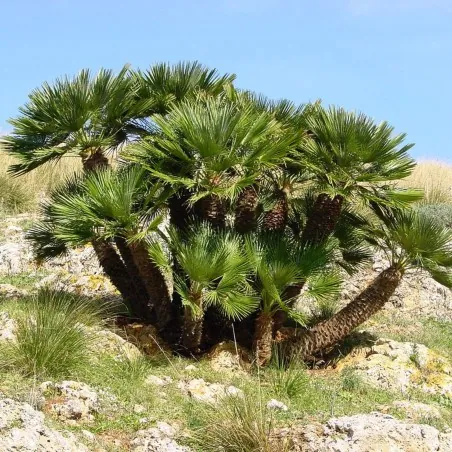
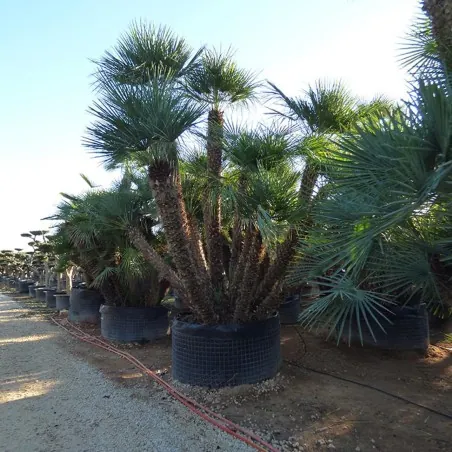
European fan palm, Mediterranean dwarf palm Seeds (Chamaerops humilis)
Price for Package of 3 seeds.
Chamaerops is a genus of flowering plants in the palm family Arecaceae. The only currently fully accepted species is Chamaerops humilis, variously called European fan palm, or the Mediterranean dwarf
European fan palm, Mediterranean dwarf palm Seeds (Chamaerops humilis)
Price for Package of 3 seeds.
Chamaerops is a genus of flowering plants in the palm family Arecaceae. The only currently fully accepted species is Chamaerops humilis, variously called European fan palm, or the Mediterranean dwarf palm. It is one of the more cold-hardy palms used in landscaping in temperate climates.
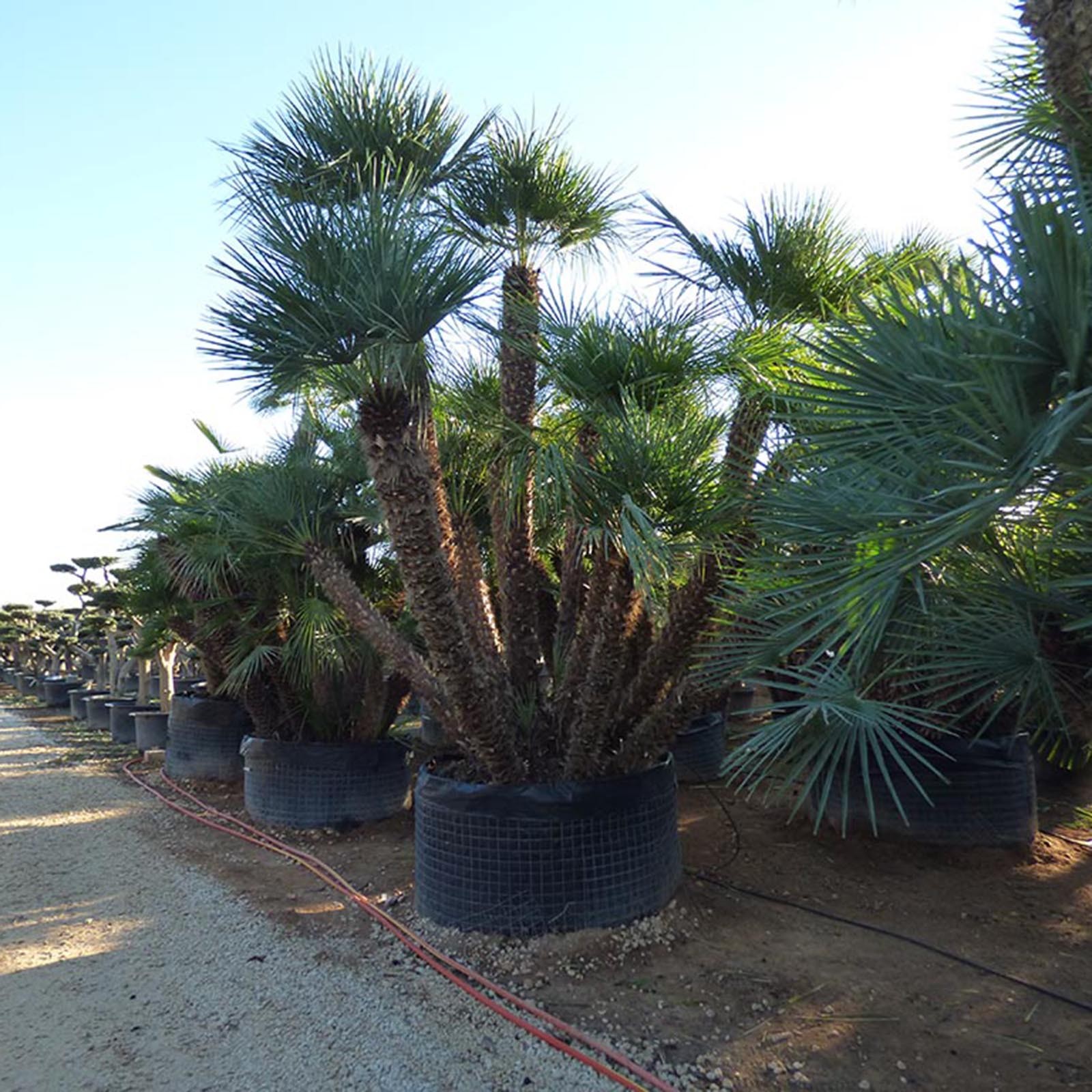
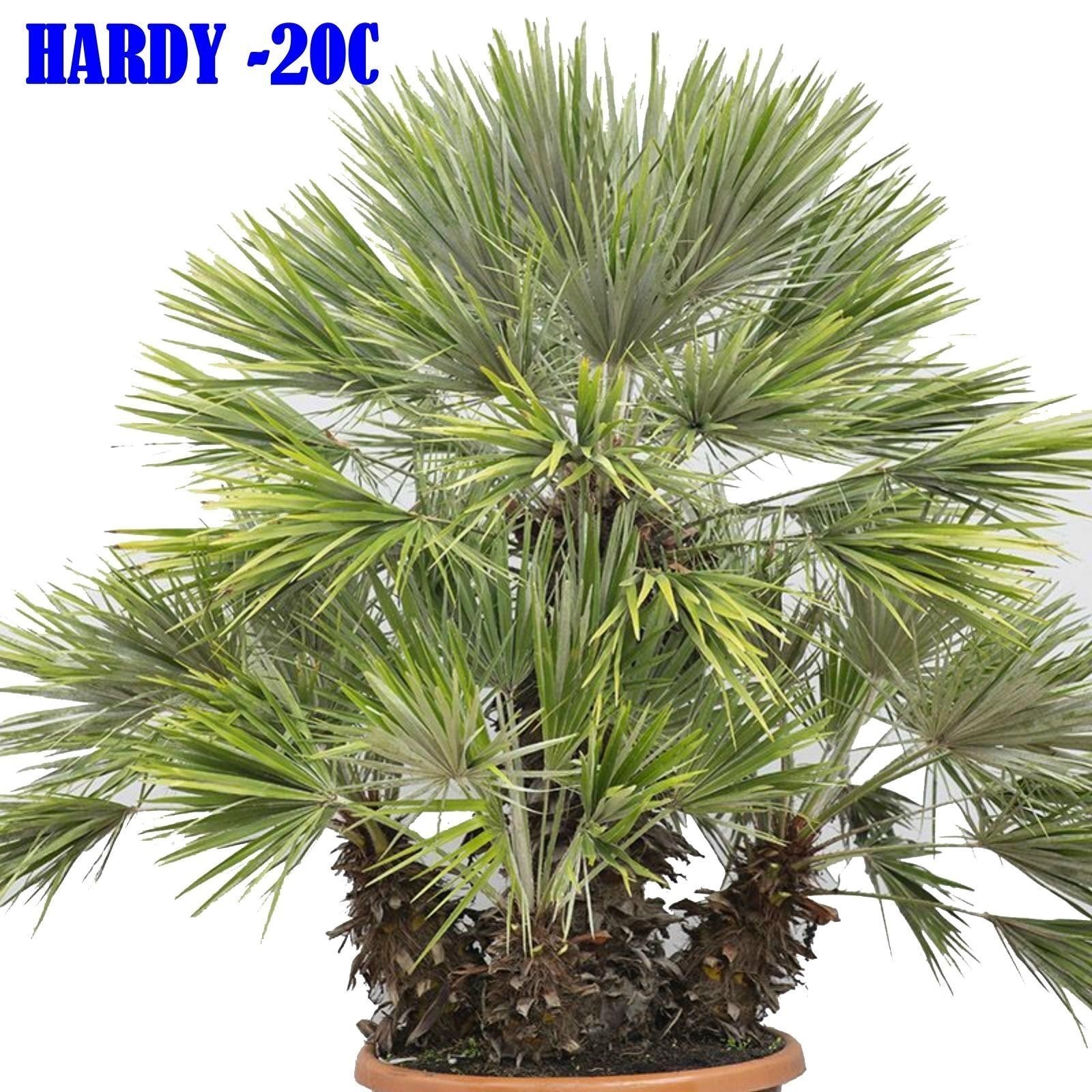
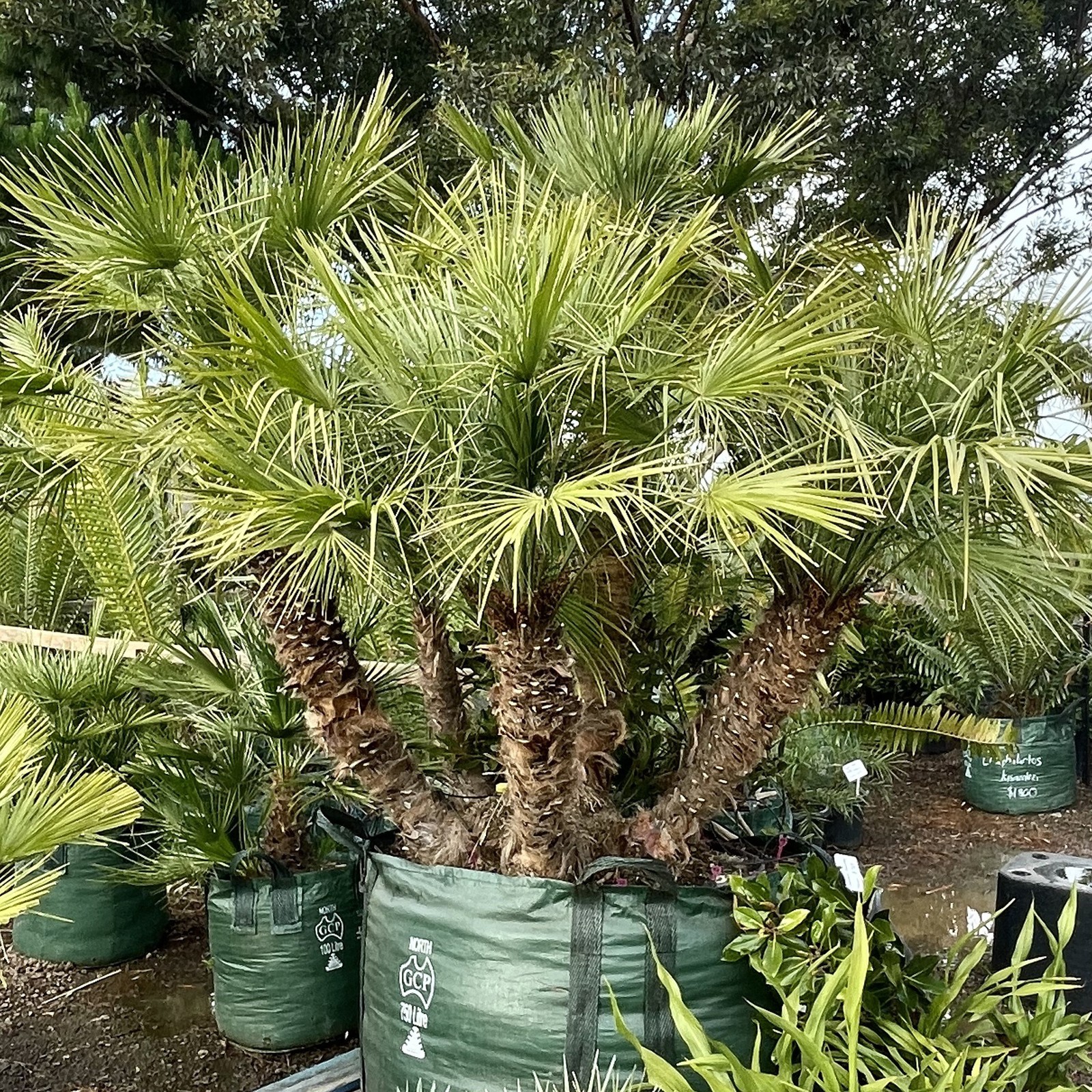
Chamaerops humilis is a shrub-like clumping palm, with several stems growing from a single base. It has an underground rhizome which produces shoots with palmate, sclerophyllous leaves.
The stems grow slowly and often tightly together, eventually reaching 2–5 m (10–20 ft) tall with a trunk diameter of 20–25 cm (8–10 in). It is a fan palm (Arecaceae tribe Corypheae), and as such, has leaves with petioles terminating in rounded fans of 10–20 leaflets. Each leaf is up to 1.5 m (5 ft) long, with leaflets 50–80 cm (20–30 in) long. The petioles are armed with numerous sharp, needle-like spines; these may protect the stem growing point from browsing animals.
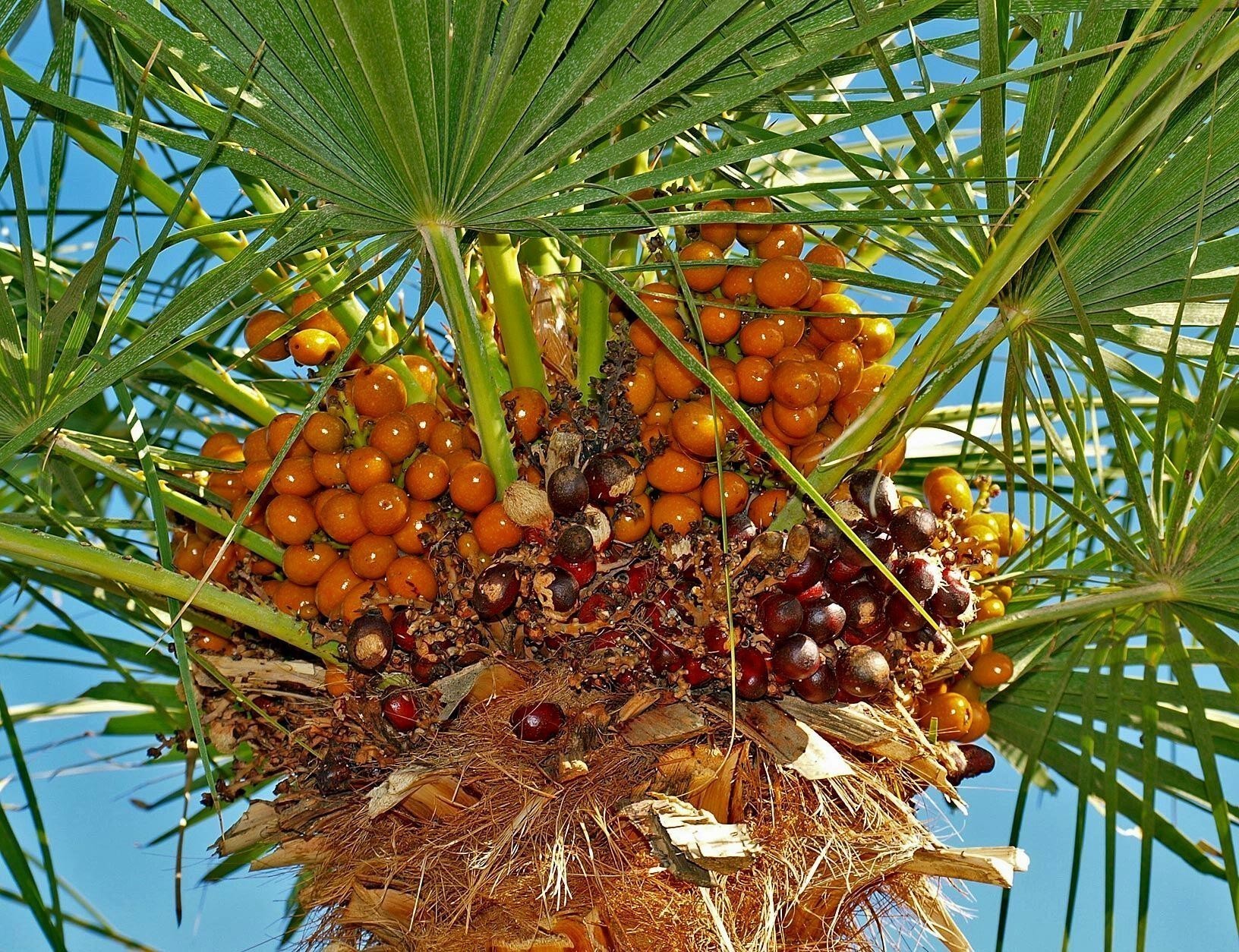
The flowers are borne in dense, short inflorescences at the tops of the stems. The plants usually, but not invariably, are dioecious with male and female flowers on separate plants. The prophyll covers the flowers on the inflorescence until the sexual phase (anthesis) and then splits open apically into two triangular lobes. The number of flowers per inflorescence is highly variable for both male and female plants, depending on the size of the inflorescence. Female flowers are tri-ovulate.[6] Unripe fruits are bright green, turning to dull yellow to brown as they ripen during autumn (September–November). The seed (usually 0.6–0.8 g or 1⁄50–3⁄100 oz) contains a small cylindrical embryo, which is surrounded by several layers, from inner to outer as follows:
a nutritious endosperm,
a wide woody layer or endocarp,
a fleshy and fibrous mesocarp (the pulp), and
the thin outer layer or exocarp.
Taxonomy
Apart from the fully accepted Chamaerops humilis there currently are a few species of unresolved status plus tens of species synonymised with Chamaerops humilis.
The species Chamaerops humilis itself has three accepted varieties as follows:
Chamaerops humilis var. argentea André (syn. C. h. var. cerifera) – "Atlas mountain palm" of Northwest Africa. Leaves glaucous.
Chamaerops humilis var. epondraes – Northwest Africa. Leaves glaucous.
Chamaerops humilis var. humilis – Southwest Europe. Leaves green.
There also are at least three cultivars (C. humilis var. humilis 'Nana', C. humilis 'Vulcano', C. humilis 'Stella'). C. humilis 'Vulcano' is a compact, thornless cultivar. May be silvery, but less so than argentea. The leaves tend to be thicker, and the appearance of the plant is bushier than var. humilis or var. argentea.
The genus Chamaerops is closely related to the genus Trachycarpus. The genera differ in that Trachycarpus lacks the clumping habit only forms single stems without basal suckers), the spiny leaf stems (spineless in Trachycarpus), and in small details of the flower anatomy.
Distribution
Chamaerops humilis is one of only two palm species native to southern Europe, the other being Phoenix theophrasti. It is mainly found in southwestern Europe (Malta, Sicily, over all the Mediterranean coast of Spain and Portugal, central and southern Italy, some parts of the southern Mediterranean coast of France and Monaco, as well as northwest Africa (Morocco, Algeria, Tunisia). It is the northernmost naturally occurring palm in the world, with the northernmost standing at Hyères-les-Palmiers, at 43° 07′ N.
Cultivation
Chamaerops humilis is valued in gardening and landscaping in many parts of the world. It is very drought-tolerant once established.
It is hardy to −12 °C (10 °F), but does prefer hot summers.
It is a very slow-growing plant. The blue form of the species, native to high elevations of the Atlas Mountains, has recently been introduced into the trade and early reports indicate that it may be −12 °C (−22 °F) or more degrees hardier than the green form.
It has gained the Royal Horticultural Society's Award of Garden Merit.
Ecology and interactions with animals
Chamaerops humilis flowers in spring, typically from April to May. The plant also may be partly anemophilous, that is to say, wind-pollinated, but it is at least partly entomophilous, that is to say dependent on pollination by insects. Only one insect species is known to pollinate it, namely a specific weevil, Derelomus chamaeropsis in the family Curculionidae.[13] The nature of the relationship with the weevil is a version of nursery pollination mutualism with the weevil; the form this takes is that once pollinating weevils have found a satisfactory plant, whether male or female, they usually stay on the same plant until the end of its anthesis, finding shelter, egg-laying sites, and food in the inflorescences.
At anthesis, as is common in Angiosperms, both male and female Chamaerops humilis plants attract their pollinators with chemical compounds, but an unusual feature is that their scents are released by the leaves, and not by the flowers.[15] Towards the end of anthesis, weevils leave the plant and seek a new host plant, again either male or female.
Larval development of the weevil Derelomus chamaeropsis occurs within rachises of inflorescences of male plants during autumn and winter. At the beginning of the next flowering period, adult weevils emerge from the dry and brittle stems of old inflorescences of the previous year of male plants only. Those that hatch in female plants die without concluding their development. This is because the palmettos are adapted to prevent the pollinating weevils from destroying the female inflorescences with their burden of seed. Weevils have been shown to lay eggs within female inflorescences, but as soon as seeds start to develop, eggs or larvae fail to continue their life cycle. On the other hand, male inflorescences have completed their function after pollination, so it is advantageous to the plant's reproduction for the weevils to complete their life cycles and shelter in the male inflorescences, thereby remaining available for pollination when they emerge in the following season.
The ripe pulp of C. humilis has several important functions.
When ripened, the pulp smells strongly of rancid butter[18] and thus acts as a foraging cue for nocturnal frugivores that commonly are fundamentally carnivorous mammals such as badgers and foxes.
The pulp inhibits germination, ensuring that the seed does not germinate until has been dispersed.
The pulp also acts as a chemical or physical barrier against invertebrate seed predators, typically beetles, and in particular weevils.
Because of the combination of such functions in the pulp, the palm both benefits and suffers adverse consequences when carnivores feed on the fruit and thereby remove the pulp. On the one hand, the seeds that carnivores swallow, germinate more frequently than seeds in entire fruit. On the other hand, ingested seeds are more frequently destroyed by invertebrate pests than non-ingested seeds. However, because of the mobility of carnivores, their dispersal service is important to the palmetto, given the severe fragmentation and isolation of most populations across the increasingly densely populated Mediterranean basin.
Uses and threats
Chamaerops humilis has a wide distribution in uncultivated land, and it is adapted to regimes of frequent burning, which it survives largely by re-sprouting from underground rhizomes and from fire-damaged stems. Such factors make the species ecologically important in preventing erosion and desertification and in providing shelter and food to many species of animals.
Apart from its material benefits, this palmetto is of emotional value as a charismatic component of the "garrigues" and "macchias" of the Mediterranean coastline.
The leaves of the adult plants have been used to make brooms and for weaving mats, carrier baskets, and similar articles. For finer work the young, unopened leaves are treated with sulphur to soften them softer and provide supple fibre.
The husk, known in southern Spain as "higa", is edible before it becomes too tough to eat as it matures. Because of their bitterness and high tannin content, the fruit are not used for human food, but in traditional medicine they have been used as an astringent.[19]
Urbanization and other human activities are making such rapid inroads into the natural habitat of palmetto that they are raising concerns about its future and that of its environment. Accordingly there is an increase in regulations to protect both its stands and those of associated Mediterranean endemics.
Another conservation problem is that particularly in the northernmost parts of its natural range, Chamaerops humilis is seriously threatened by an introduced South American moth Paysandisia archon.[9][20] Also, this Mediterranean native palm is affected by the introduction of related ornamental species because of the concurrent introduction of seed predators (such as Coccotrypes dactyliperda and Dactylotrypes longicollis) that feed on both the introduced and native palms.
Uw beoordelingswaardering kan niet worden verzonden
Rapporteer reactie
Bent u zeker dat u deze opmerking wil rapporteren?
Melding verzonden
Uw opmerking is ingediend en zal door een beheerder worden behandeld.
Uw opmerking kan niet worden verzonden
Schrijf uw recensie
Beoordeling verstuurd
Uw beoordeling is toegevoegd en wordt beschikbaar zodra deze is goedgekeurd.
Uw beoordeling kan niet worden verzonden
🌍 Wereldwijde verzending vanuit de EU
Wij verzenden wereldwijd vanuit de Europese Unie via aangetekende luchtpost met handtekening voor ontvangst bij levering.
📦 Uw bestelling volgen
Om uw trackingnummer te vinden, logt u in op uw account en gaat u naar: Bestelgeschiedenis > Details. Uw trackingnummer bevindt zich direct in de bestelgegevens.
U ontvangt e-mailmeldingen voor elke fase van uw bestelling.
Als u deze berichten niet ziet, controleer dan uw map Spam/Ongewenste e-mail of neem contact op met uw e-mailprovider. Zoek anders online naar hoe u e-mails van afzenders kunt deblokkeren.
ONZE E-MAILSERVICE WERKT — Als u geen e-mails ontvangt, ligt dit waarschijnlijk aan uw e-mailprovider of instellingen.
📧 Hoe u ervoor zorgt dat e-mails van onze webshop altijd in uw inbox terechtkomen
Om te voorkomen dat onze e-mails als spam worden gemarkeerd, voegt u ons e-mailadres toe aan uw contacten:
Open Gmail (of een andere provider) en zoek een e-mail van ons (xxxxxxxxxxxx@xxx.com).
Beweeg de muis over de naam of het e-mailadres van de afzender.
Klik op het icoon "Toevoegen aan contacten" (het poppetje).
We kunnen u niet helpen als uw instellingen niet zo staan. Neem contact op met uw e-mailprovider voor hulp.
Als alternatief kunt u een filter maken in Gmail:
Open Gmail en ga naar Instellingen > Alle instellingen bekijken.
Ga naar het tabblad Filters en geblokkeerde adressen.
Klik op Nieuw filter maken en voer ons e-mailadres in.
Vink Nooit naar Spam verzenden aan en klik op Filter maken.
📍 Uw pakket volgen
Uw trackingnummer staat in uw bestelgegevens. U kunt uw bestelling volgen via de volgende platforms:
Geef bij het bestellen altijd een geldig mobiel nummer op met landnummer (bijv. +31 6 1234 5678).
Bestel NIET naar postbussen (P.O. Boxes) of als u niet thuis kunt zijn om voor het pakket te tekenen. Pakketten kunnen niet bij de buren worden afgegeven.
Als een pakket dat naar een postbus is verzonden verloren gaat of niet wordt bezorgd, vindt er geen terugbetaling plaats.
⚖️ Verantwoordelijkheid van de klant voor wettelijke naleving
De klant is verantwoordelijk om ervoor te zorgen dat het product legaal in zijn land mag worden geïmporteerd, inclusief naleving van alle importvoorschriften, het verkrijgen van de nodige vergunningen en de betaling van toepasselijke douanerechten, belastingen en andere kosten. Controleer uw lokale wetgeving voordat u bestelt.
🔄 Verloren, geretourneerde en opnieuw verzonden pakketten
Klanten uit Brazilië en Mexico: We kunnen geen pakketten terugbetalen die door de douane zijn verloren of vernietigd.
Als uw pakket wordt geretourneerd, betalen we alleen de productkosten terug — verzendkosten worden niet gerestitueerd.
Retourkosten (€2) en eventuele kosten voor opnieuw verzenden zijn voor rekening van de klant.
🚚 Levering van de zending
Aangetekende zendingen vereisen een handtekening.
Als de tracking aangeeft dat het pakket nog op het postkantoor van herkomst is, is het onderweg — neem contact op met uw lokale postkantoor voor updates.
Helaas kunnen wij, noch het postkantoor waardoor uw bestelling is verzonden, u helpen met de vraag waar uw bestelling zich precies bevindt. Wanneer u ziet dat het pakket in uw land is, MOET u contact opnemen met uw postkantoor met het trackingnummer.
⏱️ Leveringsopties & geschatte tijden
Leveringsoptie
Verwerkingstijd
Opmerkingen
Priority Delivery
Verzonden binnen 1–7 werkdagen
Prioriteit bij orderverwerking; vertragingen mogelijk tijdens feestdagen (3–10 dagen)
Secured Delivery
Verzonden binnen 1–7 werkdagen
Beschikbaar voor bestellingen tot €150; terugbetaling bij verlies
Standard Delivery
Verzonden binnen 7–10 werkdagen
Voordeliger; vertragingen mogelijk tijdens feestdagen (7–14 dagen)
Geschatte levertijden:
Binnen de EU: 3–20 dagen
Wereldwijd: 5–30 dagen
Opmerking: Levertijden zijn afhankelijk van uw locatie en het lokale postsysteem. COVID-19 of feestdagen kunnen extra vertraging veroorzaken.
💰 Verzendkosten
Verzend- en administratiekosten worden automatisch berekend bij het afrekenen op basis van het gewicht van het pakket en de bestemming.
⏰ Verwerkingstijden
Wij verwerken of verzenden geen bestellingen op zaterdag of zondag.
💳 Betalingsmogelijkheden
Wij willen u informeren over een belangrijke wijziging met betrekking tot de betalingskosten. Helaas zijn wij, vanwege de uitzonderlijk hoge transactiekosten die PayPal in rekening brengt, genoodzaakt een toeslag toe te passen voor betalingen die via hun service worden gedaan.
We hebben echter een oplossing voor u! U kunt deze astronomische kosten vermijden door te kiezen voor een van onze alternatieve betaalmethoden met NUL COMMISSIE:
✅ Creditcard/Betaalpas betaling – 0% Kosten
✅ Bankoverschrijving – 0% Kosten
Bankoverschrijving (SEPA / IBAN / SWIFT-BIC): Vermeld uw bestelreferentie in de betalingsomschrijving. Bestellingen zonder betaling binnen 4 dagen worden automatisch geannuleerd.
PayPal: Betalingen worden alleen in Euro geaccepteerd. Selecteer Euro tijdens het afrekenen.
Kaartbetaling: Wij accepteren Visa, MasterCard, American Express, CB, Diners Club, Discover, China UnionPay, JCB en Discover.
⚠️ Transactiekosten
Klanten zijn verantwoordelijk voor eventuele bank- of PayPal-transactiekosten.
📝 Slotopmerkingen
Controleer voor het plaatsen van uw bestelling altijd onze website voor speciale mededelingen, vakantieschema's of specifieke verzendvoorwaarden.