Citrullus colocynthis, with many common names including colocynth, bitter apple, bitter cucumber, desert gourd,[citation needed] egusi, vine of Sodom, or wild gourd, is a desert viny plant native to the
Citrullus colocynthis, with many common names including colocynth, bitter apple, bitter cucumber, desert gourd,[citation needed] egusi, vine of Sodom, or wild gourd, is a desert viny plant native to the Mediterranean Basin and Asia, especially Turkey (especially in regions such as İzmir), and Nubia.
It resembles a common watermelon vine, but bears small, hard fruits with a bitter pulp. It originally bore the scientific name Colocynthis citrullus.
Origin, distribution, and ecology
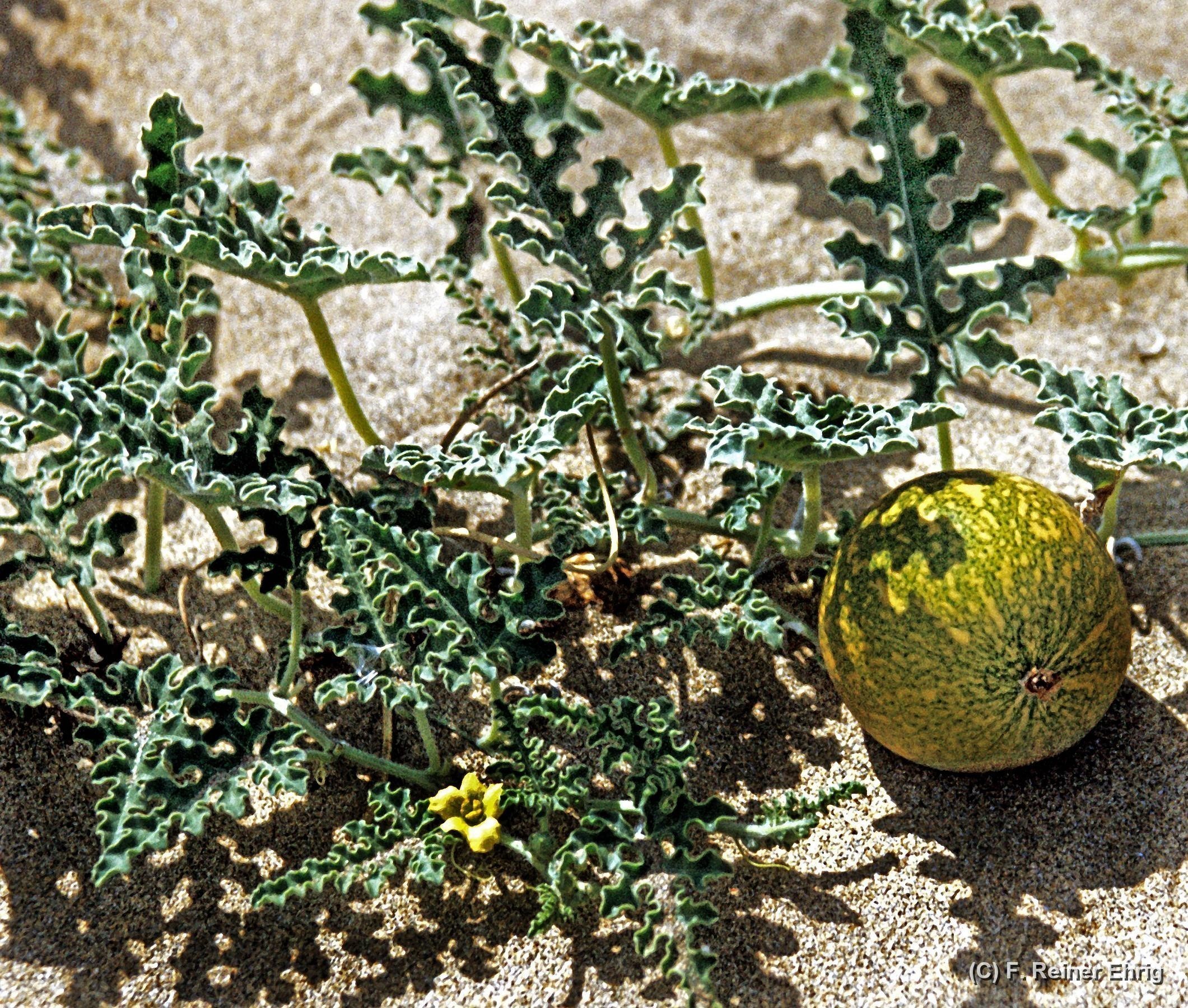
colocynthis is a desert viny plant that grows in sandy, arid soils. It is native to the Mediterranean Basin and Asia, and is distributed among the west coast of northern Africa, eastward through the Sahara, Egypt until India, and reaches also the north coast of the Mediterranean and the Caspian Seas. It grows also in southern European countries as in Spain and on the islands of the Grecian archipelago. On the island of Cyprus, it is cultivated on a small scale; it has been an income source since the 14th century and is still exported today. It is an annual or a perennial plant (in wild) in Indian arid zones and has a great survival rate under extreme xeric conditions.[4] In fact, it can tolerate annual precipitation of 250 to 1500 mm and an annual temperature of 14.8 to 27.8 °C. It grows from sea level up to 1500 meters above sea level on sandy loam, subdesert soils, and sandy sea coasts with a pH range between 5.0 and 7.8.
Characteristics and morphology
Roots and stems
The roots are large, fleshy, and perennial, leading to a high survival rate due to the long tap root. The vine-like stems spread in all directions for a few meters looking for something over which to climb. If present, shrubs and herbs are preferred and climbed by means of axiliary branching tendrils.[4]
Leaves
Very similar to watermelon, the leaves are palmate and angular with three to seven divided lobes.
Flowers
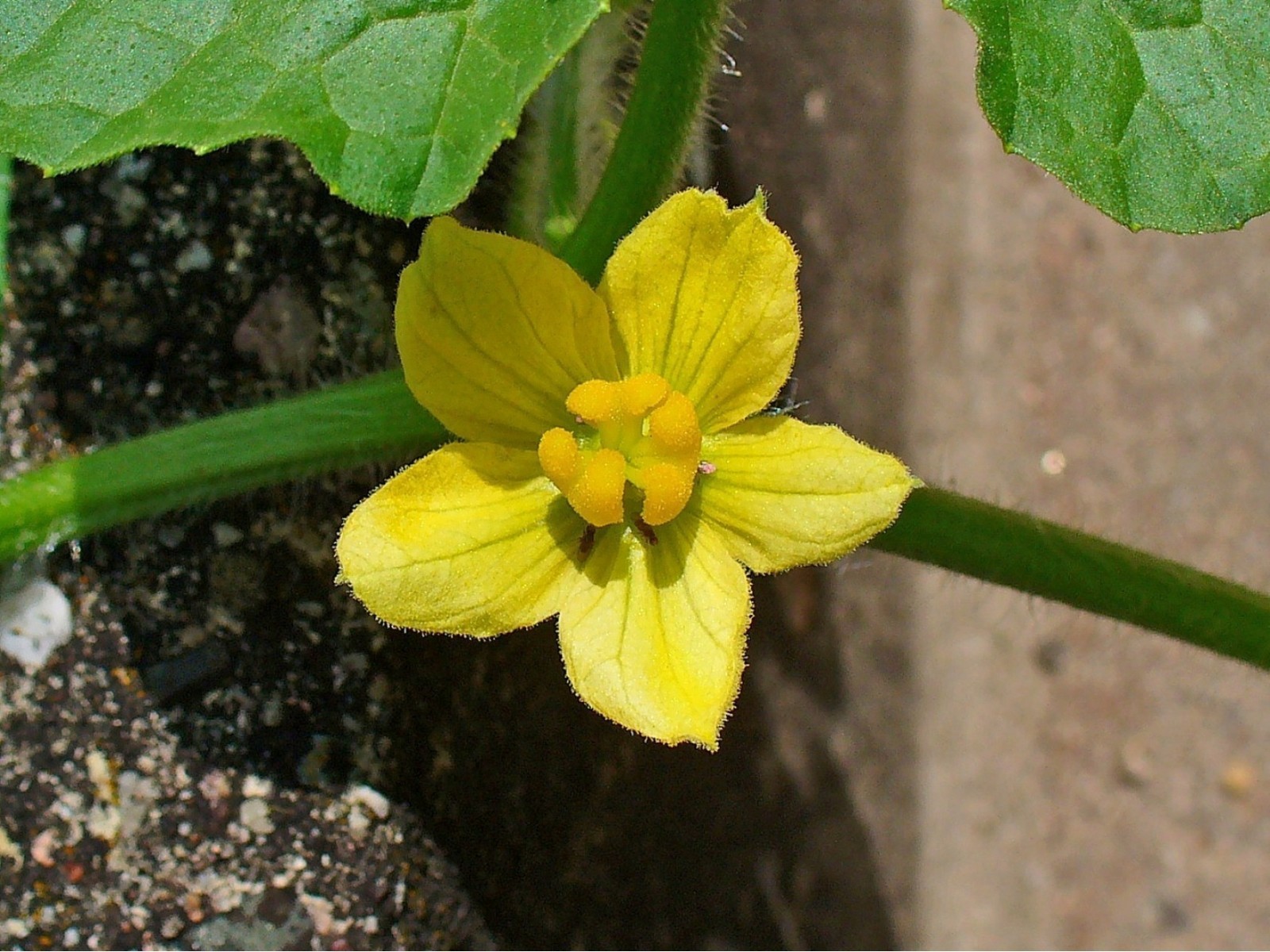
The flowers are yellow and solitary in the axes of leaves and are borne by yellow-greenish peduncles. Each has a subcampanulated five-lobed corolla and a five-parted calyx. They are monoecious, so the male (stamens) and the female reproductive parts (pistils and ovary) are borne in different flowers on the same plant. The male flowers’ calyx is shorter than the corolla. They have five stamens, four of which are coupled and one is single with monadelphous anther. The female flowers have three staminoids and a three-carpel ovary. The two sexes are distinguishable by observing the globular and hairy inferior ovary of the female flowers.[4]
Fruits
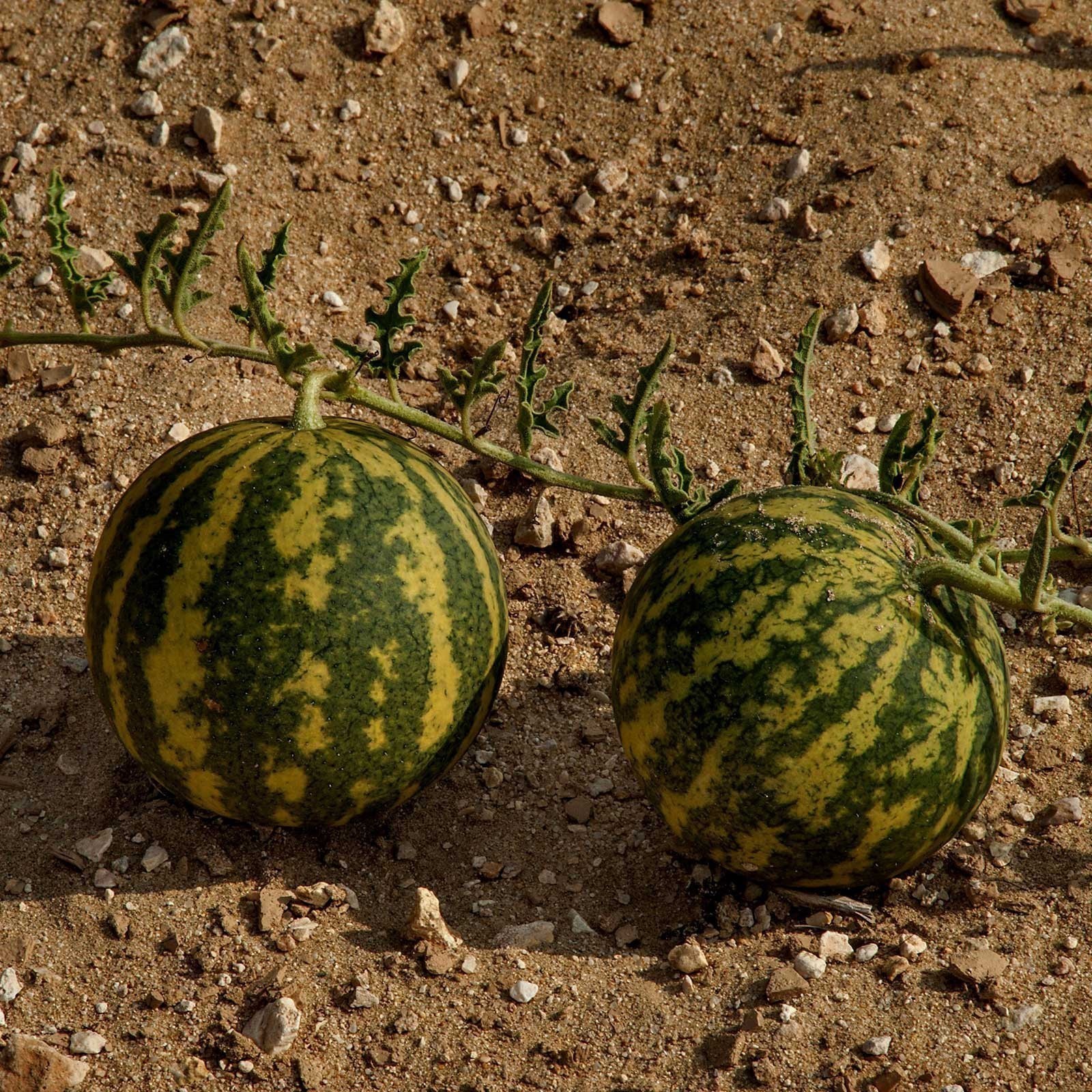
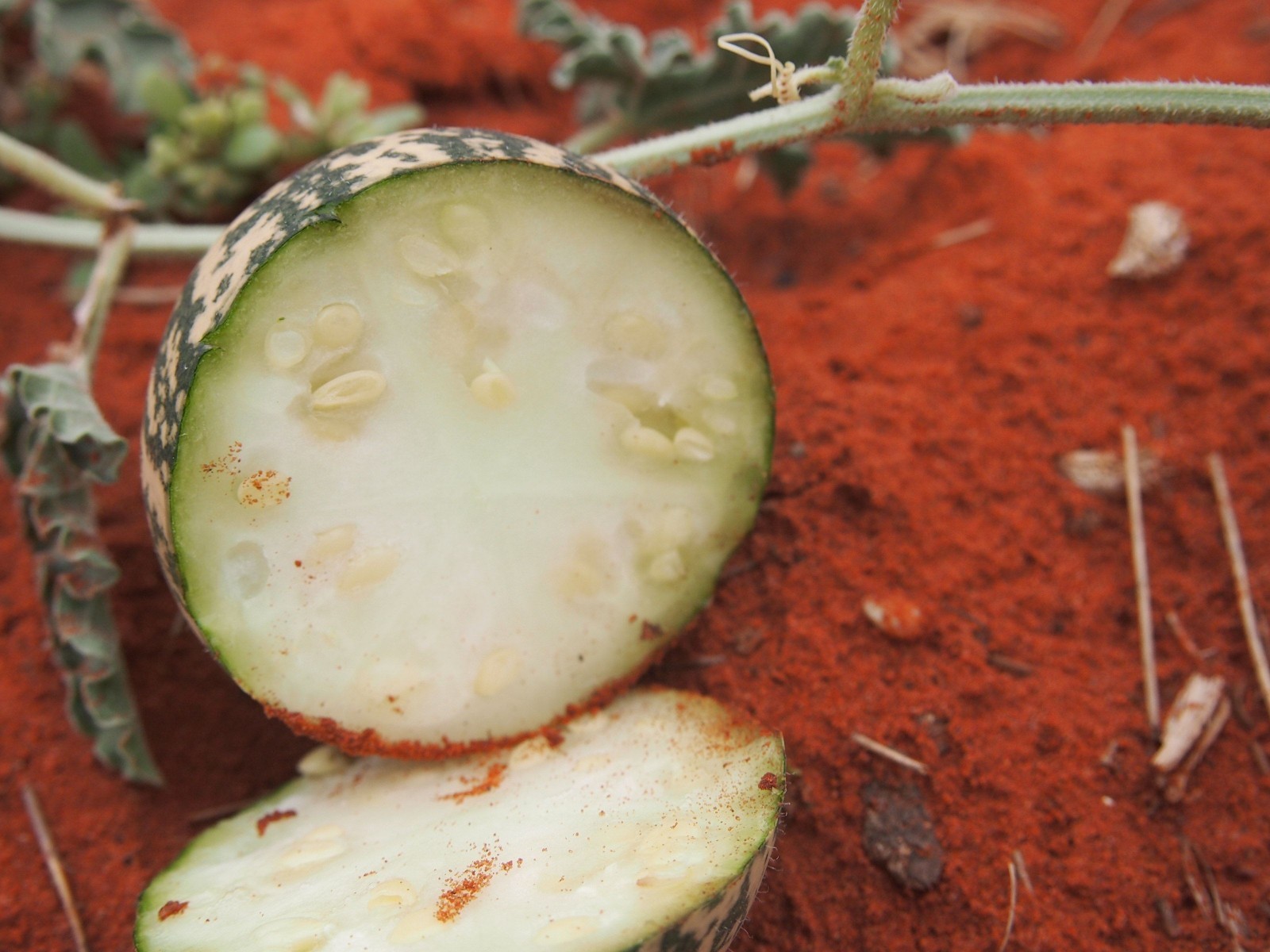
The fruit is smooth, spheric with a 5– to 10-cm-diameter and extremely bitter taste. The calyx englobe the yellow-green fruit which becomes marble (yellow stripes) at maturity. The mesocarp is filled with a soft, dry, and spongy white pulp, in which the seeds are embedded. Each of the three carpels bears six seeds. Each plant produces 15 to 30 fruits.[5]
Seeds
The seeds are grey and 5 mm long by 3 mm wide. They are edible but similarly bitter, nutty-flavored, and rich in fat and protein. They are eaten whole or used as an oilseed. The oil content of the seeds is 17–19% (w/w), consisting of 67–73% linoleic acid, 10–16% oleic acid, 5–8% stearic acid, and 9–12% palmitic acid. The oil yield is about 400 l/hectare.[6] In addition, the seeds contain a high amount of arginine, tryptophan, and the sulfur-containing amino acids.[7]
Cultivation
colocynthis, a perennial plant, can propagate both by generative and vegetative means. However, seed germination is poor due to the extreme xeric conditions, so vegetative propagation is more common and successful in nature. In the Indian arid zone, growth takes place between January and October, but the most favorable period for the vegetative growth is during summer, which coincides with the rainy season. Growth declines as soon as the rains and the temperature decrease and almost stops during the cold and dry months of December and January. Colocynth prefers sandy soils and is a good example of good water management which may be useful also on research to better understand how desert plants react to water stress.[8][9] To enhance production, an organic fertilizer can be applied.[10] Colocynth is also commonly cultivated together with cassava (intercropping) in Nigeria.
Cultivated colocynth suffers of climatic stress and diseases such as cucumber mosaic virus, melon mosaic virus, Fusarium wilt, etc. as any other crop. To improve it, a relatively new protocol for regeneration has been developed with the aim of incorporating disease and stress resistance to increase yield potential and security avoiding interspecific hybridization barriers.[11]
Uses
colocynthis can be eaten or elaborated for further uses in medicine and as energy source, e.g. oilseed and biofuel. The characteristic small seed of the colocynth have been found in several early archeological sites in northern Africa and the Near East, specifically at Neolithic Armant, Nagada in Egypt; at sites dating from 3800 BC to Roman times in Libya; and the prepottery Neolithic levels of the Nahal Hemar caves in Israel.[12] Zohary and Hopf speculate, "these finds indicate that the wild colocynth was very probably used by humans prior to its domestication."[12]
Traditional medicine and research
Colocynth has been widely used in traditional medicine for centuries.[13] In premodern medicine, it was an ingredient in the electuary called confectio hamech, or diacatholicon, and other laxative pills.[14]
In Arabia the colocynth had numerous uses in traditional medicine, such as a laxative, diuretic, or for insect bites.[15] The powder of colocynth was sometimes used externally with aloes, unguents, or bandages.[14] Troches made of colocynth were called "troches of alhandal" used as an emetic.[14]
In traditional veterinary medicine, colocynth sap was used to treat skin eruptions in camels[15].
Culinary uses
The desert Bedouin are said to make a type of bread from the ground seeds. Some confusion exists between this species and the closely related watermelon (Citrullus lanatus (Thunb)), whose seeds may be used in much the same way. In particular, the name "egusi" may refer to either or both plants (or more generically to other cucurbits) in their capacity as seed crops, or for a soup made from these seeds and popular in West Africa. The seed flour is rich in micronutrients, and could therefore be used in food formulations especially in regions with low milk consumption, such as West Africa.[7]
Practical uses
The oil obtained from the seeds (47%) can be used for soap production.[5] The production is not very time- and energy-consuming due to the ability of colocynth to grow on poor soils with just a little moisture and organic fertilizer. The fruits are harvested still unripe by hand, the rind is removed by peeling and the inner pulp filled with seeds is dried in the sun or in ovens. The seeds yield is about 6.7-10 t/ha, which means that for an oil profit of 31-47%, oil yields may reach up to 3 t/ha.[5][16]
Oleic and linoleic acids isolated from C. colocynthis petroleum ether extracts show larvicidal activity against mosquitoes.[17]
Dangers
Ingestion may cause irritation of the mucous membranes in the gastrointestinal tract, bloody diarrhea, or kidney damage. The ill effects are caused by cytotoxic and antimitotic cucurbitacins. The active substances pass into urine and breast milk and can lead to abortions in pregnant women. Other symptoms of poisoning include ulcers, wall perforation, peritonitis, kidney bleeding and bladder inflammation. Often brain hyperemia, delirium and collapse occur. Death may occur as a result of respiratory arrest. Cross-fertilization of colocynth with watermelon or zucchini sometimes leads to cases of poisoning. Cases of poisoning have also been observed in animals that consumed the fruits. The intake of just 3 g of colocynth and be fatal. Exposure of the skin to the active substances may cause blistering.
Aprecierea ta pentru recenzie nu a putut fi trimisa
Reclama un comentariu
Sigur doresti sa raportezi acest comentariu?
Raport trimis
Comentariul tau a fost inregistrat si va fi examinat de un moderator.
Reclamatia tau nu a putut fi trimisa
Recenzia a fost trimisa
Comentariul dumeavoastra a fost inregistrat si va fi vizibil de indata ce va fi aprobat de un moderator.
Recenzia ta nu a putut fi trimisa
🌍 Wysyłka na cały świat z UE
Wysyłamy na cały świat z Unii Europejskiej za pośrednictwem zarejestrowanej poczty lotniczej z wymaganym podpisem przy odbiorze.
📦 Śledzenie zamówienia
Aby znaleźć swój numer śledzenia, zaloguj się na swoje konto i przejdź do: Historia zamówień > Szczegóły. Twój numer śledzenia znajduje się bezpośrednio w szczegółach zamówienia.
Będziesz otrzymywać powiadomienia e-mail na każdym etapie zamówienia.
Jeśli nie widzisz tych wiadomości, sprawdź folder Spam/Wiadomości śmieci lub skontaktuj się ze swoim dostawcą e-mail. Alternatywnie poszukaj w Internecie informacji, jak odblokować wiadomości e-mail od nadawcy.
NASZ SERWIS E-MAIL DZIAŁA — Jeśli nie otrzymujesz wiadomości e-mail, prawdopodobnie jest to problem z Twoim dostawcą poczty lub ustawieniami.
📧 Jak zapewnić, aby e-maile z naszego sklepu internetowego zawsze trafiały do Twojej skrzynki odbiorczej
Aby zapobiec oznaczaniu naszych wiadomości jako spam, dodaj nasz adres e-mail do swoich kontaktów:
Otwórz Gmail (lub innego dostawcę) i znajdź e-mail od nas (xxxxxxxxxxxx@xxx.com).
Najedź kursorem na nazwę lub adres e-mail nadawcy.
Kliknij ikonę „Dodaj do kontaktów” (ikonka małej osoby).
Nie możemy Ci pomóc, jeśli Twoje ustawienia nie są skonfigurowane w ten sposób. Skontaktuj się ze swoim dostawcą e-mail, aby uzyskać pomoc.
Alternatywnie utwórz filtr w Gmailu:
Otwórz Gmail i przejdź do Ustawienia > Zobacz wszystkie ustawienia.
Przejdź do karty Filtry i zablokowane adresy.
Kliknij Utwórz nowy filtr i wpisz nasz adres e-mail.
Zaznacz Nigdy nie wysyłaj do spamu i kliknij Utwórz filtr.
📍 Śledź swoją paczkę
Twój numer śledzenia znajduje się w szczegółach zamówienia. Możesz śledzić swoje zamówienie za pośrednictwem następujących platform:
Podczas składania zamówienia zawsze podawaj ważny numer telefonu komórkowego z numerem kierunkowym kraju (np. +48 601 234 567).
NIE zamawiaj do skrytek pocztowych (P.O. Boxes) ani jeśli nie możesz być w domu, aby podpisać odbiór paczki. Paczek nie można zostawiać u sąsiadów.
Jeśli paczka wysłana do skrytki pocztowej zaginie lub nie zostanie doręczona, zwrot pieniędzy nie zostanie przyznany.
⚖️ Odpowiedzialność klienta za zgodność z prawem
Klient jest odpowiedzialny za upewnienie się, że produkt może być legalnie importowany do jego kraju, w tym za przestrzeganie wszystkich przepisów importowych, uzyskanie niezbędnych zezwoleń oraz opłacenie obowiązujących ceł, podatków i innych opłat. Przed złożeniem zamówienia sprawdź lokalne przepisy.
🔄 Paczki zagubione, zwrócone i ponowna wysyłka
Klienci z Brazylii i Meksyku: Nie możemy zwrócić pieniędzy za paczki zagubione lub zniszczone przez urząd celny.
Jeśli Twoja paczka zostanie zwrócona, zwrócimy tylko koszt produktu — koszty wysyłki nie podlegają zwrotowi.
Opłatę za zwrot (2 €) oraz wszelkie koszty ponownej wysyłki musi pokryć klient.
🚚 Dostawa przesyłki
Przesyłki polecone wymagają podpisu.
Jeśli śledzenie pokazuje, że paczka nadal znajduje się w placówce początkowej, oznacza to, że jest w drodze — skontaktuj się ze swoim lokalnym urzędem pocztowym, aby uzyskać aktualne informacje.
Niestety, ani my, ani poczta, za pośrednictwem której wysłano zamówienie, nie możemy pomóc w ustaleniu, gdzie dokładnie znajduje się paczka. Gdy zobaczysz, że paczka jest w Twoim kraju, MUSISZ skontaktować się ze swoją pocztą, podając numer śledzenia.
⏱️ Opcje dostawy i szacowany czas
Opcja dostawy
Czas przetwarzania
Uwagi
Priority Delivery
Wysyłka w ciągu 1–7 dni roboczych
Priorytetowe przetwarzanie; możliwe opóźnienia w okresie świątecznym (3–10 dni)
Secured Delivery
Wysyłka w ciągu 1–7 dni roboczych
Dostępne dla zamówień do 150 €; zwrot pieniędzy w przypadku zagubienia
Standard Delivery
Wysyłka w ciągu 7–10 dni roboczych
Bardziej ekonomiczna; możliwe opóźnienia w okresie świątecznym (7–14 dni)
Szacowany czas dostawy:
Wewnątrz UE: 3–20 dni
Reszta świata: 5–30 dni
Uwaga: Czas dostawy zależy od Twojej lokalizacji i lokalnego systemu pocztowego. COVID-19 lub sezony świąteczne mogą powodować dodatkowe opóźnienia.
💰 Koszty wysyłki
Koszty wysyłki i obsługi są obliczane automatycznie podczas składania zamówienia na podstawie wagi paczki i miejsca przeznaczenia.
⏰ Godziny przetwarzania zamówień
Nie przetwarzamy ani nie wysyłamy zamówień w soboty i niedziele.
💳 Opcje płatności
Chcielibyśmy poinformować o ważnej zmianie dotyczącej opłat za płatności. Niestety, ze względu na wyjątkowo wysokie opłaty transakcyjne nakładane przez PayPal, jesteśmy zmuszeni doliczać dopłatę do płatności dokonywanych za pośrednictwem ich serwisu.
Mamy jednak dla Ciebie rozwiązanie! Możesz uniknąć tych astronomicznych opłat, wybierając jedną z naszych alternatywnych metod płatności z PROWIZJĄ 0%:
✅ Płatność kartą kredytową/debetową – 0% prowizji
✅ Przelew bankowy – 0% prowizji
Przelew bankowy (SEPA / IBAN / SWIFT-BIC): W opisie płatności podaj numer referencyjny zamówienia. Zamówienia nieopłacone w ciągu 4 dni zostaną automatycznie anulowane.
PayPal: Płatności są akceptowane wyłącznie w euro. Prosimy o wybranie euro podczas finalizacji zakupu.
Płatność kartą: Akceptujemy karty Visa, MasterCard, American Express, CB, Diners Club, Discover, China UnionPay, JCB i Discover.
⚠️ Opłaty transakcyjne
Klienci są odpowiedzialni za wszelkie bankowe lub transakcyjne opłaty PayPal.
📝 Uwagi końcowe
Przed złożeniem zamówienia zawsze sprawdzaj naszą stronę internetową pod kątem specjalnych ogłoszeń, harmonogramów świątecznych lub określonych warunków wysyłki.



Comentarii (0)
Aprecierea ta pentru recenzie nu a putut fi trimisa
Reclama un comentariu
Raport trimis
Reclamatia tau nu a putut fi trimisa