Cyperus papyrus (papyrus sedge, paper reed, Indian matting plant, Nile grass) is a species of aquatic flowering plant belonging to the sedge family Cyperaceae. It is a tender herbaceous perennial, native to Africa, and forms tall stands of reed-like swamp vegetation in shallow water. Papyrus sedge
Cyperus papyrus (papyrus sedge, paper reed, Indian matting plant, Nile grass) is a species of aquatic flowering plant belonging to the sedge family Cyperaceae. It is a tender herbaceous perennial, native to Africa, and forms tall stands of reed-like swamp vegetation in shallow water.
Papyrus sedge (and its close relatives) has a very long history of use by humans, notably by the Ancient Egyptians—it is the source of papyrus paper, one of the first types of paper ever made. Parts of the plant can be eaten, and the highly buoyant stems can be made into boats. It is now often cultivated as an ornamental plant.
In nature, it grows in full sun, in flooded swamps, and on lake margins throughout Africa, Madagascar, and the Mediterranean countries.
C. papyrus and the dwarf cultivar C. papyrus 'Nanus'[3] have gained the Royal Horticultural Society's Award of Garden Merit.
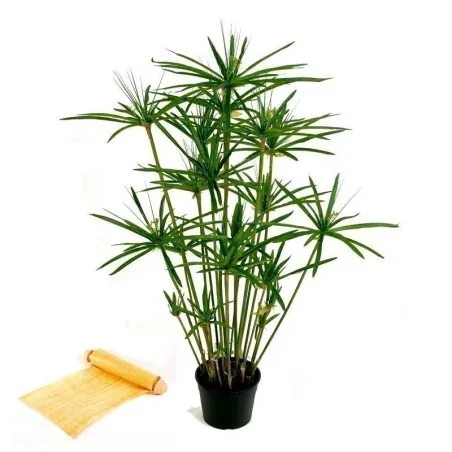
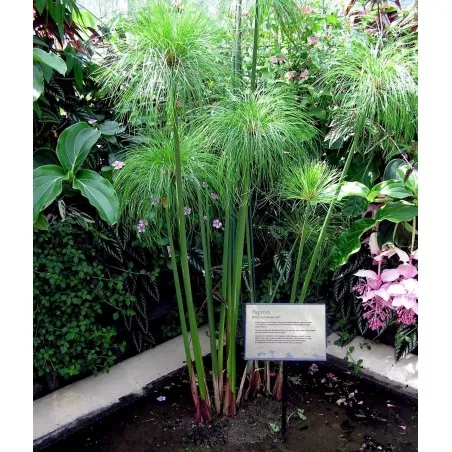
This tall, robust, leafless aquatic plant can grow 4 to 5 m (13 to 16 ft) high. It forms a grass-like clump of triangular green stems that rise up from thick, woody rhizomes. Each stem is topped by a dense cluster of thin, bright green, thread-like stems around 10 to 30 cm (4 to 10 in) in length, resembling a feather duster when the plant is young. Greenish-brown flower clusters eventually appear at the ends of the rays, giving way to brown, nut-like fruits.
The younger parts of the rhizome are covered by red-brown, papery, triangular scales, which also cover the base of the culms. Botanically, these represent reduced leaves, so strictly it is not quite correct to call this plant fully "leafless".
Cultivation
The papyrus plant is relatively easy to grow from seed, though in Egypt, it is more common to split the rootstock, and grows quite fast once established.
Uses
In Ancient Egypt, papyrus was used for various of purposes such as baskets, sandals, blankets, medicine, incense, and boats. The woody root was used to create bowls and different utensils, and was also burned for fuel. Egyptians made efficient use of the entire plant. Papyrus was an important, "Gift of the Nile" which is still preserved and perpetuated in the Egyptian culture.
Papyrus in history
Egyptians used the plant (which they called aaru) for many purposes, most famously for making papyrus. Its name in Greek and in English is widely believed to have come from Egyptian. Cyperus papyrus is now used mainly for decoration, as it is nearly extinct in its native habitat in the Nile Delta, where in ancient times it was widely cultivated. Theophrastus' History of Plants (Book iv. 10) states that it grew in Syria, and according to Pliny's Natural History, it was also a native plant of the Niger River and the Euphrates.
Aside from papyrus, several other members of the genus Cyperus may also have been involved in the multiple uses Egyptians found for the plant. Its flowering heads were linked to make garlands for the gods in gratitude. The pith of young shoots was eaten both cooked and raw. Its woody root made bowls and other utensils and was burned for fuel. From the stems were made reed boats (seen in bas-reliefs of the Fourth Dynasty showing men cutting papyrus to build a boat; similar boats are still made in southern Sudan), sails, mats, cloth, cordage, and sandals. Theophrastus states that King Antigonus made the rigging of his fleet of papyrus, an old practice illustrated by the ship's cable, wherewith the doors were fastened when Odysseus slew the suitors in his hall (Odyssey xxi. 390).
The "rush" or "reed" basket in which the Biblical figure Moses was abandoned may have been made from papyrus.
The adventurer Thor Heyerdahl built two boats from papyrus, Ra and Ra II, in an attempt to demonstrate that ancient African or Mediterranean people could have reached America. He succeeded in sailing Ra II from Morocco to Barbados. Fishermen in the Okavango Delta use small sections of the stem as floats for their nets.
Ecology
Papyrus can be found in tropical rain forests,[where?] tolerating annual temperatures of 20 to 30 °C (68 to 86 °F) and a pH of 6.0 to 8.5. Papyrus flowers in late summer, and prefers full sun to partly shady conditions. Like most tropical plants, it is sensitive to frost. In the United States, it has become invasive in Florida and has escaped from cultivation in Louisiana, California, and Hawaii.
Papyrus sedge forms vast stands in swamps, shallow lakes, and along stream banks throughout the wetter parts of Africa, but it has become rare in the Nile Delta. In deeper waters, it is the chief constituent of the floating, tangled masses of vegetation known as sudd. It also occurs in Madagascar, and some Mediterranean areas such as Sicily and the Levant.
The "feather-duster" flowering heads make ideal nesting sites for many social species of birds. As in most sedges, pollination is by wind, not insects, and the mature fruits after release are distributed by water.
Papyrus is a C4 sedge that forms highly productive monotypic stands over large areas of wetland in Africa.
ATTENTION !!!
SEEDS ARE VERY SMALL, UNPACKING AT THE WHITE PAPER !!!
Aprecierea ta pentru recenzie nu a putut fi trimisa
Reclama un comentariu
Sigur doresti sa raportezi acest comentariu?
Raport trimis
Comentariul tau a fost inregistrat si va fi examinat de un moderator.
Reclamatia tau nu a putut fi trimisa
Recenzia a fost trimisa
Comentariul dumeavoastra a fost inregistrat si va fi vizibil de indata ce va fi aprobat de un moderator.
Recenzia ta nu a putut fi trimisa
🌍 Wysyłka na cały świat z UE
Wysyłamy na cały świat z Unii Europejskiej za pośrednictwem zarejestrowanej poczty lotniczej z wymaganym podpisem przy odbiorze.
📦 Śledzenie zamówienia
Aby znaleźć swój numer śledzenia, zaloguj się na swoje konto i przejdź do: Historia zamówień > Szczegóły. Twój numer śledzenia znajduje się bezpośrednio w szczegółach zamówienia.
Będziesz otrzymywać powiadomienia e-mail na każdym etapie zamówienia.
Jeśli nie widzisz tych wiadomości, sprawdź folder Spam/Wiadomości śmieci lub skontaktuj się ze swoim dostawcą e-mail. Alternatywnie poszukaj w Internecie informacji, jak odblokować wiadomości e-mail od nadawcy.
NASZ SERWIS E-MAIL DZIAŁA — Jeśli nie otrzymujesz wiadomości e-mail, prawdopodobnie jest to problem z Twoim dostawcą poczty lub ustawieniami.
📧 Jak zapewnić, aby e-maile z naszego sklepu internetowego zawsze trafiały do Twojej skrzynki odbiorczej
Aby zapobiec oznaczaniu naszych wiadomości jako spam, dodaj nasz adres e-mail do swoich kontaktów:
Otwórz Gmail (lub innego dostawcę) i znajdź e-mail od nas (xxxxxxxxxxxx@xxx.com).
Najedź kursorem na nazwę lub adres e-mail nadawcy.
Kliknij ikonę „Dodaj do kontaktów” (ikonka małej osoby).
Nie możemy Ci pomóc, jeśli Twoje ustawienia nie są skonfigurowane w ten sposób. Skontaktuj się ze swoim dostawcą e-mail, aby uzyskać pomoc.
Alternatywnie utwórz filtr w Gmailu:
Otwórz Gmail i przejdź do Ustawienia > Zobacz wszystkie ustawienia.
Przejdź do karty Filtry i zablokowane adresy.
Kliknij Utwórz nowy filtr i wpisz nasz adres e-mail.
Zaznacz Nigdy nie wysyłaj do spamu i kliknij Utwórz filtr.
📍 Śledź swoją paczkę
Twój numer śledzenia znajduje się w szczegółach zamówienia. Możesz śledzić swoje zamówienie za pośrednictwem następujących platform:
Podczas składania zamówienia zawsze podawaj ważny numer telefonu komórkowego z numerem kierunkowym kraju (np. +48 601 234 567).
NIE zamawiaj do skrytek pocztowych (P.O. Boxes) ani jeśli nie możesz być w domu, aby podpisać odbiór paczki. Paczek nie można zostawiać u sąsiadów.
Jeśli paczka wysłana do skrytki pocztowej zaginie lub nie zostanie doręczona, zwrot pieniędzy nie zostanie przyznany.
⚖️ Odpowiedzialność klienta za zgodność z prawem
Klient jest odpowiedzialny za upewnienie się, że produkt może być legalnie importowany do jego kraju, w tym za przestrzeganie wszystkich przepisów importowych, uzyskanie niezbędnych zezwoleń oraz opłacenie obowiązujących ceł, podatków i innych opłat. Przed złożeniem zamówienia sprawdź lokalne przepisy.
🔄 Paczki zagubione, zwrócone i ponowna wysyłka
Klienci z Brazylii i Meksyku: Nie możemy zwrócić pieniędzy za paczki zagubione lub zniszczone przez urząd celny.
Jeśli Twoja paczka zostanie zwrócona, zwrócimy tylko koszt produktu — koszty wysyłki nie podlegają zwrotowi.
Opłatę za zwrot (2 €) oraz wszelkie koszty ponownej wysyłki musi pokryć klient.
🚚 Dostawa przesyłki
Przesyłki polecone wymagają podpisu.
Jeśli śledzenie pokazuje, że paczka nadal znajduje się w placówce początkowej, oznacza to, że jest w drodze — skontaktuj się ze swoim lokalnym urzędem pocztowym, aby uzyskać aktualne informacje.
Niestety, ani my, ani poczta, za pośrednictwem której wysłano zamówienie, nie możemy pomóc w ustaleniu, gdzie dokładnie znajduje się paczka. Gdy zobaczysz, że paczka jest w Twoim kraju, MUSISZ skontaktować się ze swoją pocztą, podając numer śledzenia.
⏱️ Opcje dostawy i szacowany czas
Opcja dostawy
Czas przetwarzania
Uwagi
Priority Delivery
Wysyłka w ciągu 1–7 dni roboczych
Priorytetowe przetwarzanie; możliwe opóźnienia w okresie świątecznym (3–10 dni)
Secured Delivery
Wysyłka w ciągu 1–7 dni roboczych
Dostępne dla zamówień do 150 €; zwrot pieniędzy w przypadku zagubienia
Standard Delivery
Wysyłka w ciągu 7–10 dni roboczych
Bardziej ekonomiczna; możliwe opóźnienia w okresie świątecznym (7–14 dni)
Szacowany czas dostawy:
Wewnątrz UE: 3–20 dni
Reszta świata: 5–30 dni
Uwaga: Czas dostawy zależy od Twojej lokalizacji i lokalnego systemu pocztowego. COVID-19 lub sezony świąteczne mogą powodować dodatkowe opóźnienia.
💰 Koszty wysyłki
Koszty wysyłki i obsługi są obliczane automatycznie podczas składania zamówienia na podstawie wagi paczki i miejsca przeznaczenia.
⏰ Godziny przetwarzania zamówień
Nie przetwarzamy ani nie wysyłamy zamówień w soboty i niedziele.
💳 Opcje płatności
Chcielibyśmy poinformować o ważnej zmianie dotyczącej opłat za płatności. Niestety, ze względu na wyjątkowo wysokie opłaty transakcyjne nakładane przez PayPal, jesteśmy zmuszeni doliczać dopłatę do płatności dokonywanych za pośrednictwem ich serwisu.
Mamy jednak dla Ciebie rozwiązanie! Możesz uniknąć tych astronomicznych opłat, wybierając jedną z naszych alternatywnych metod płatności z PROWIZJĄ 0%:
✅ Płatność kartą kredytową/debetową – 0% prowizji
✅ Przelew bankowy – 0% prowizji
Przelew bankowy (SEPA / IBAN / SWIFT-BIC): W opisie płatności podaj numer referencyjny zamówienia. Zamówienia nieopłacone w ciągu 4 dni zostaną automatycznie anulowane.
PayPal: Płatności są akceptowane wyłącznie w euro. Prosimy o wybranie euro podczas finalizacji zakupu.
Płatność kartą: Akceptujemy karty Visa, MasterCard, American Express, CB, Diners Club, Discover, China UnionPay, JCB i Discover.
⚠️ Opłaty transakcyjne
Klienci są odpowiedzialni za wszelkie bankowe lub transakcyjne opłaty PayPal.
📝 Uwagi końcowe
Przed złożeniem zamówienia zawsze sprawdzaj naszą stronę internetową pod kątem specjalnych ogłoszeń, harmonogramów świątecznych lub określonych warunków wysyłki.


Comentarii (0)
Aprecierea ta pentru recenzie nu a putut fi trimisa
Reclama un comentariu
Raport trimis
Reclamatia tau nu a putut fi trimisa