Lansium parasiticum, also known as langsat (/ˈlɑːŋsɑːt/) or lanzones, is a species of tree in the Mahogany family. The plant, which originates from western Southeast Asia, bears edible fruit. It is the provincial flower for the Indonesian province of South Sumatra.
Lansium parasiticum, also known as langsat (/ˈlɑːŋsɑːt/) or lanzones, is a species of tree in the Mahogany family. The plant, which originates from western Southeast Asia, bears edible fruit. It is the provincial flower for the Indonesian province of South Sumatra.
The tree is average sized, reaching 30 metres (98 ft) in height and 75 centimetres (30 in) in diameter. Seedling trees 30 years old planted at 8 x 8 meter spacing can have a height of 10 meters and diameter of 25 cm. The trunk grows in an irregular manner, with its buttress roots showing above ground. The tree's bark is a greyish colour, with light and dark spots. Its resin is thick and milk coloured.
The pinnately compound leaves are odd numbered, with thin hair, and 6 to 9 buds at intervals. The buds are long and elliptical, approximately 9 to 21 centimetres (3.5 to 8.3 in) by 5 to 10 centimetres (2.0 to 3.9 in) in size. The upper edge shines, and the leaves themselves have pointed bases and tips. The stems of the buds measure 5 to 12 millimetres (0.20 to 0.47 in).
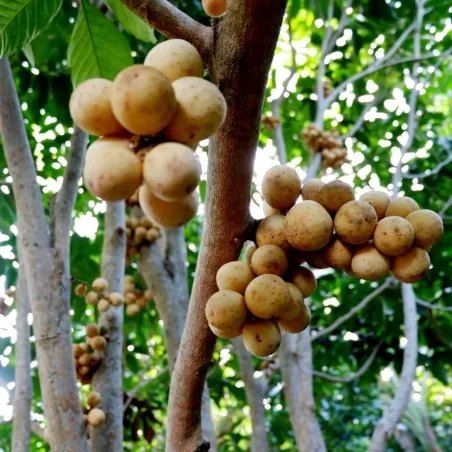
The flowers are located in inflorescences that grow and hang from large branches or the trunk; the bunches may number up to 5 in one place. They are often branched at their base, measure 10 to 30 centimetres (3.9 to 11.8 in) in size, and have short fur.[3] The flowers are small, with short stems, and have two genders. The sheathe is shaped like a five lobed cup and is coloured a greenish-yellow. The corona is egg-shaped and hard, measuring 2 to 3 millimetres (0.079 to 0.118 in) by 4 to 5 millimetres (0.16 to 0.20 in). There is one stamen, measuring 2 millimetres (0.079 in) in length. The top of the stamen is round. The pistil is short and thick.
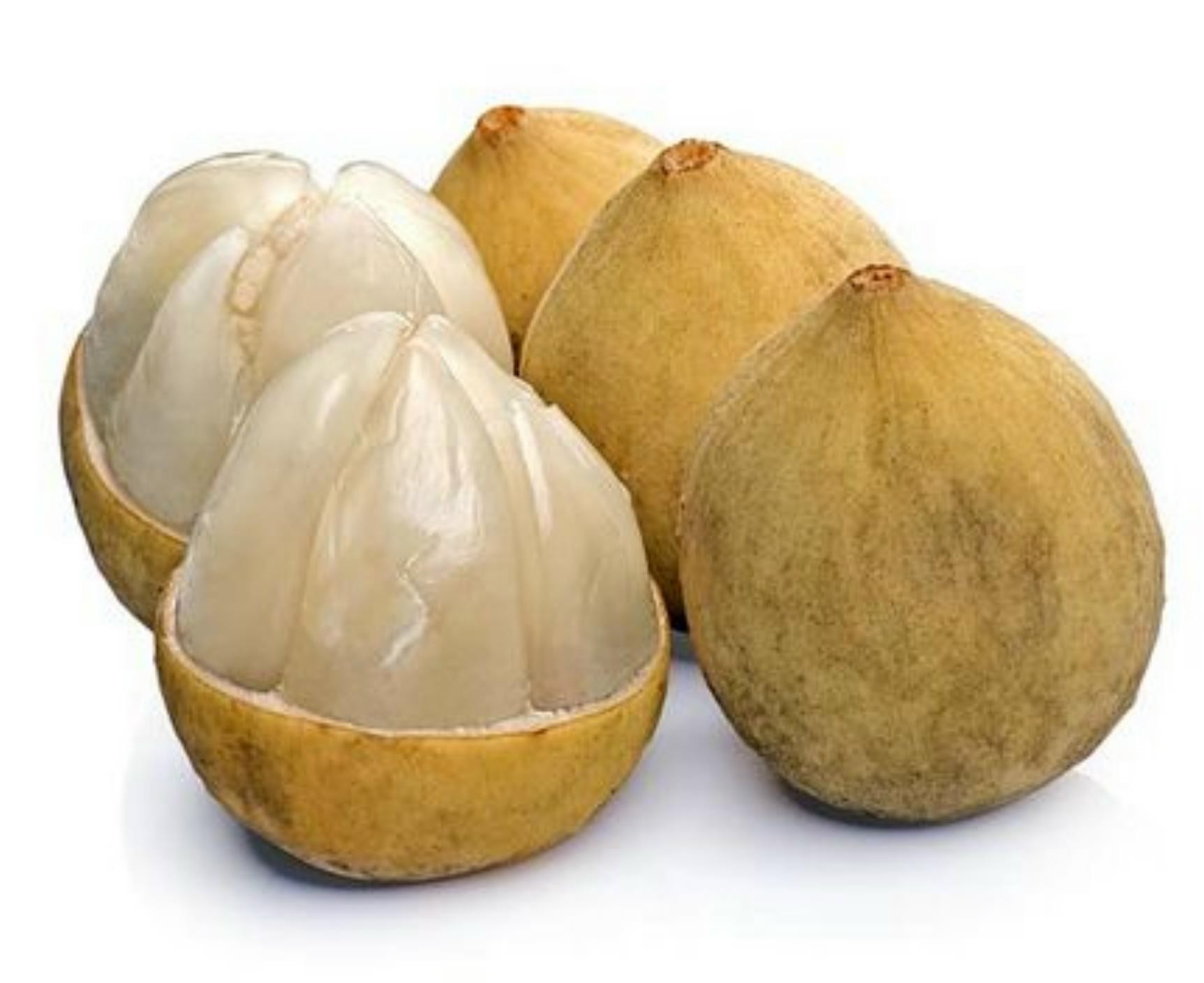
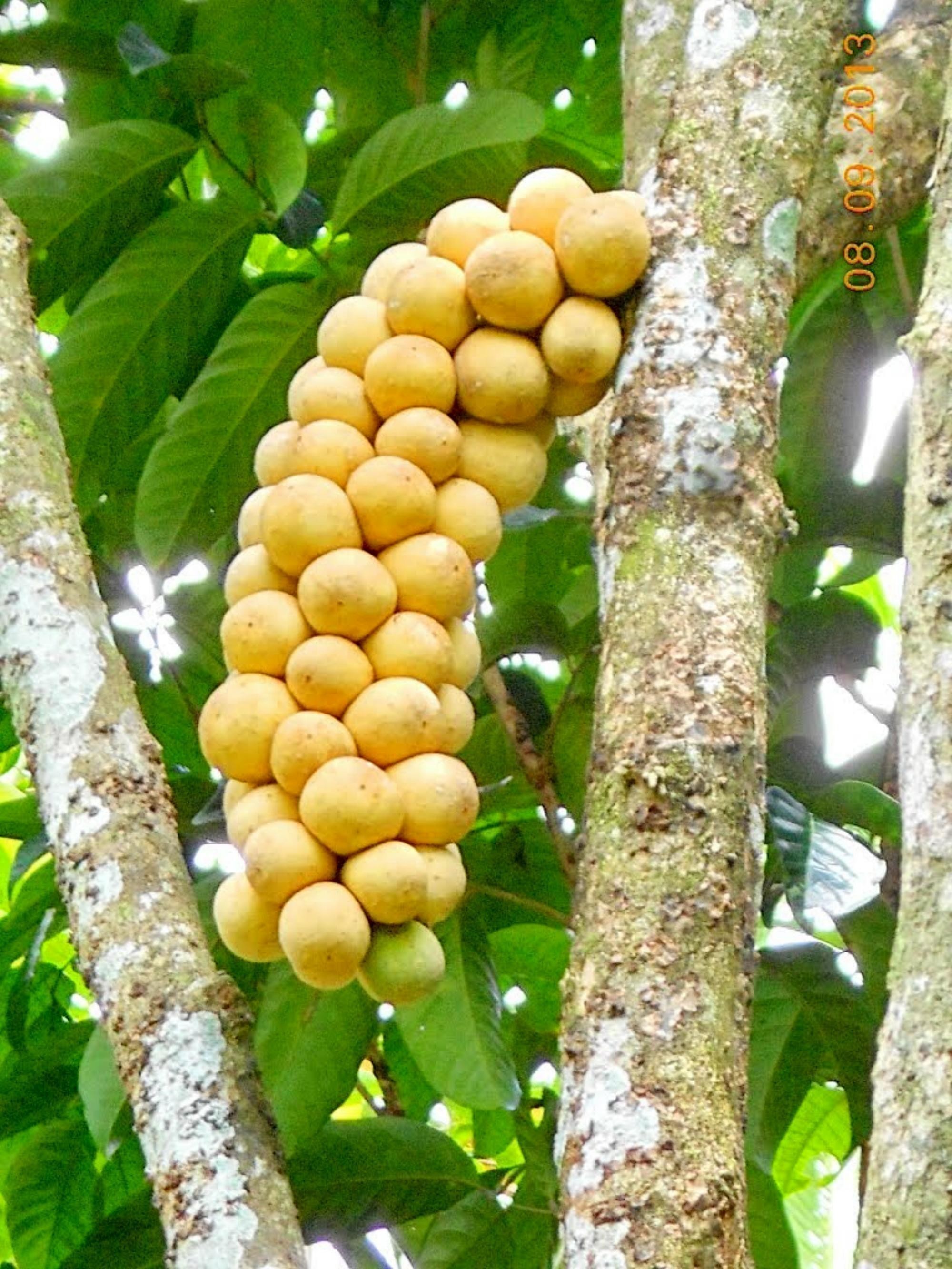
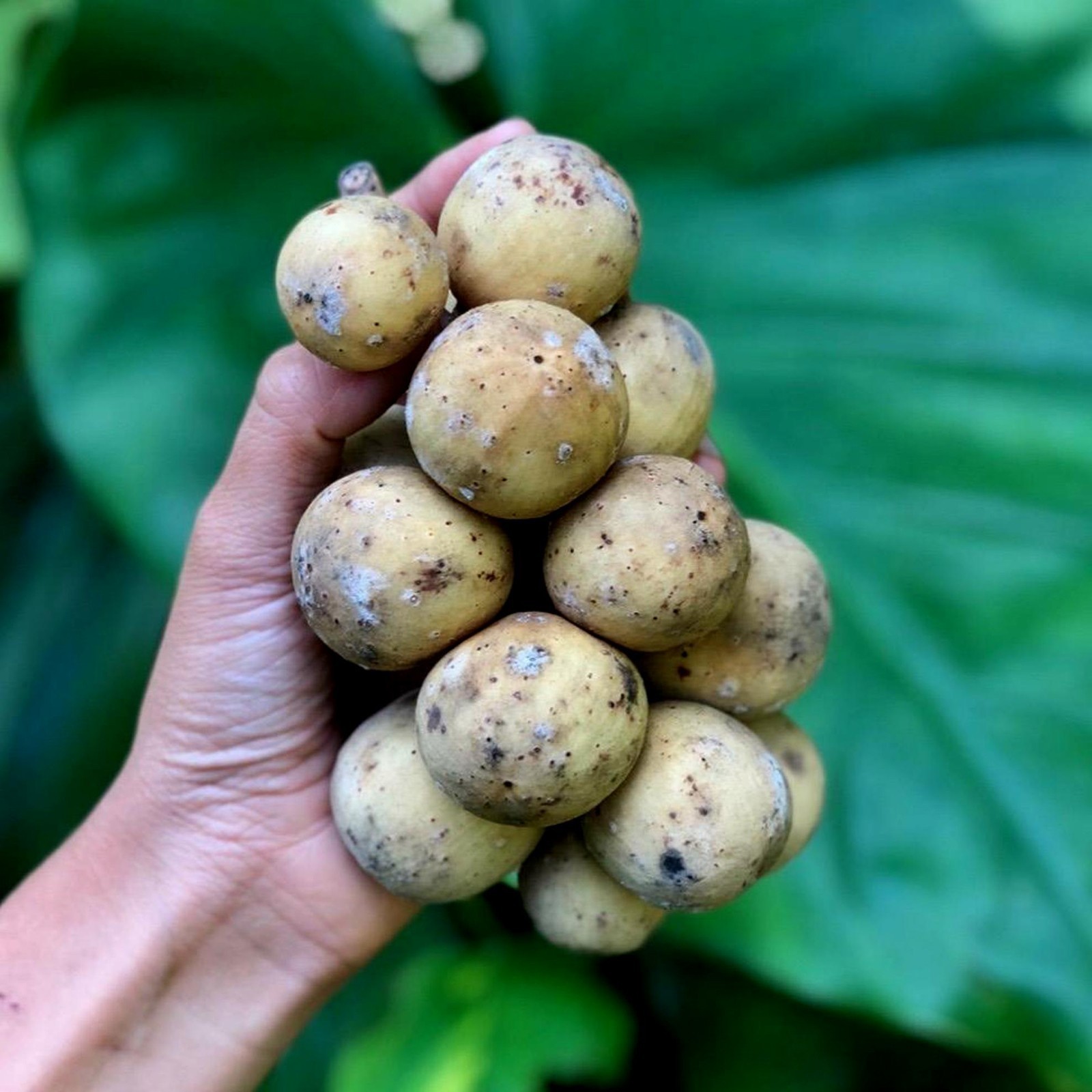
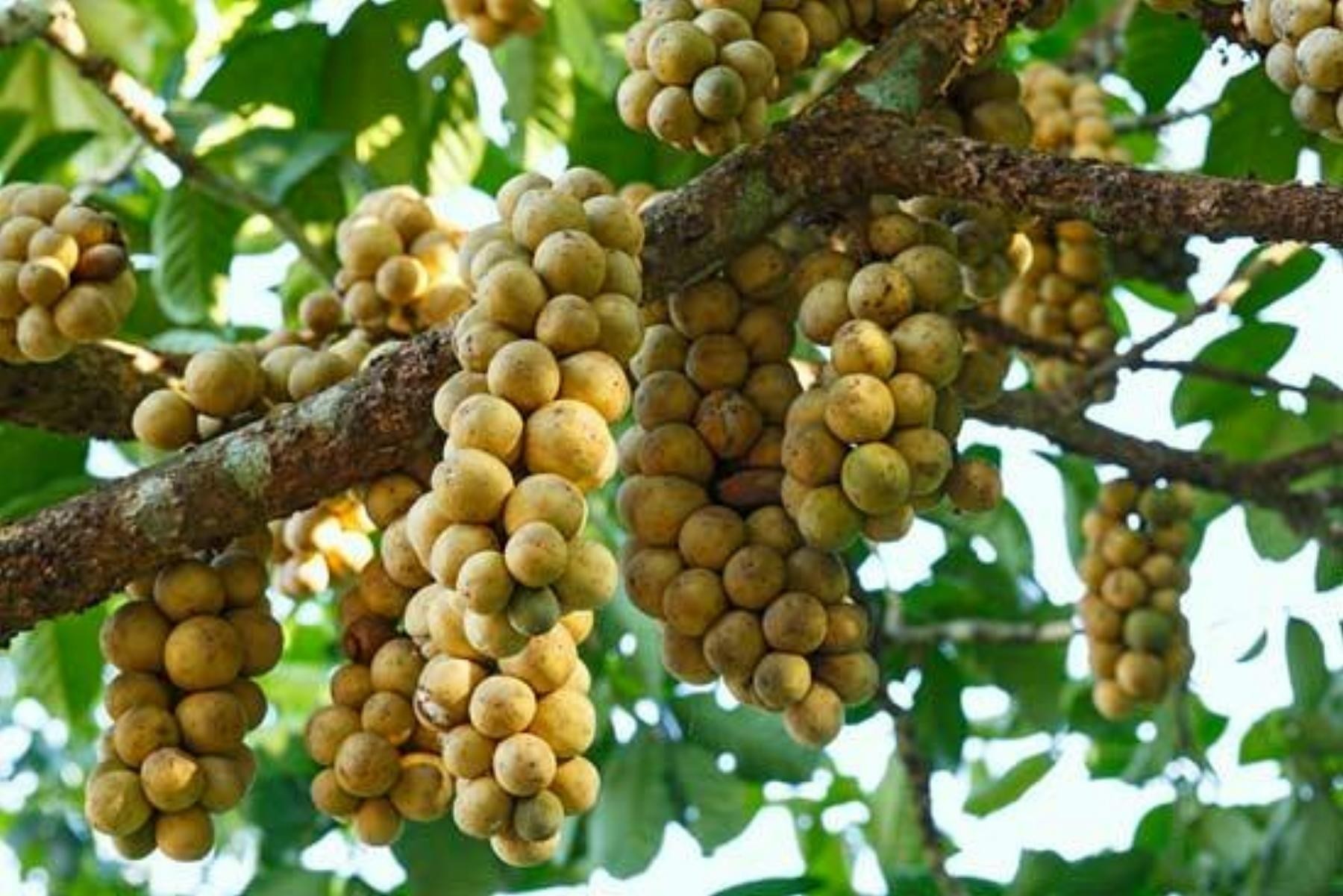
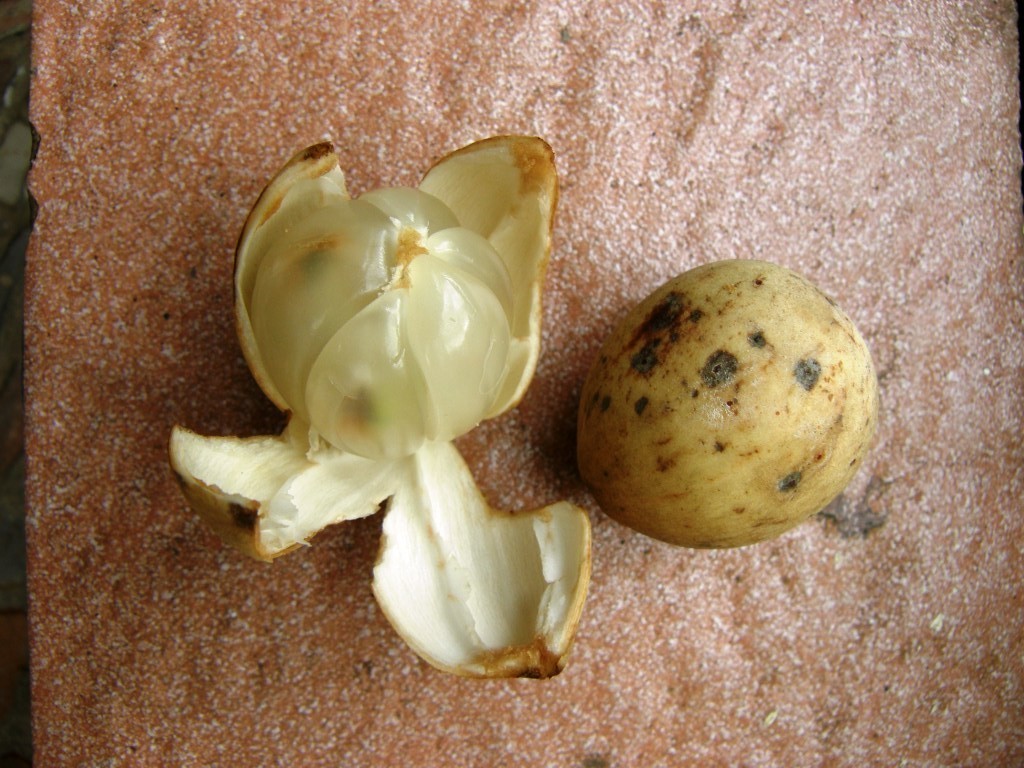
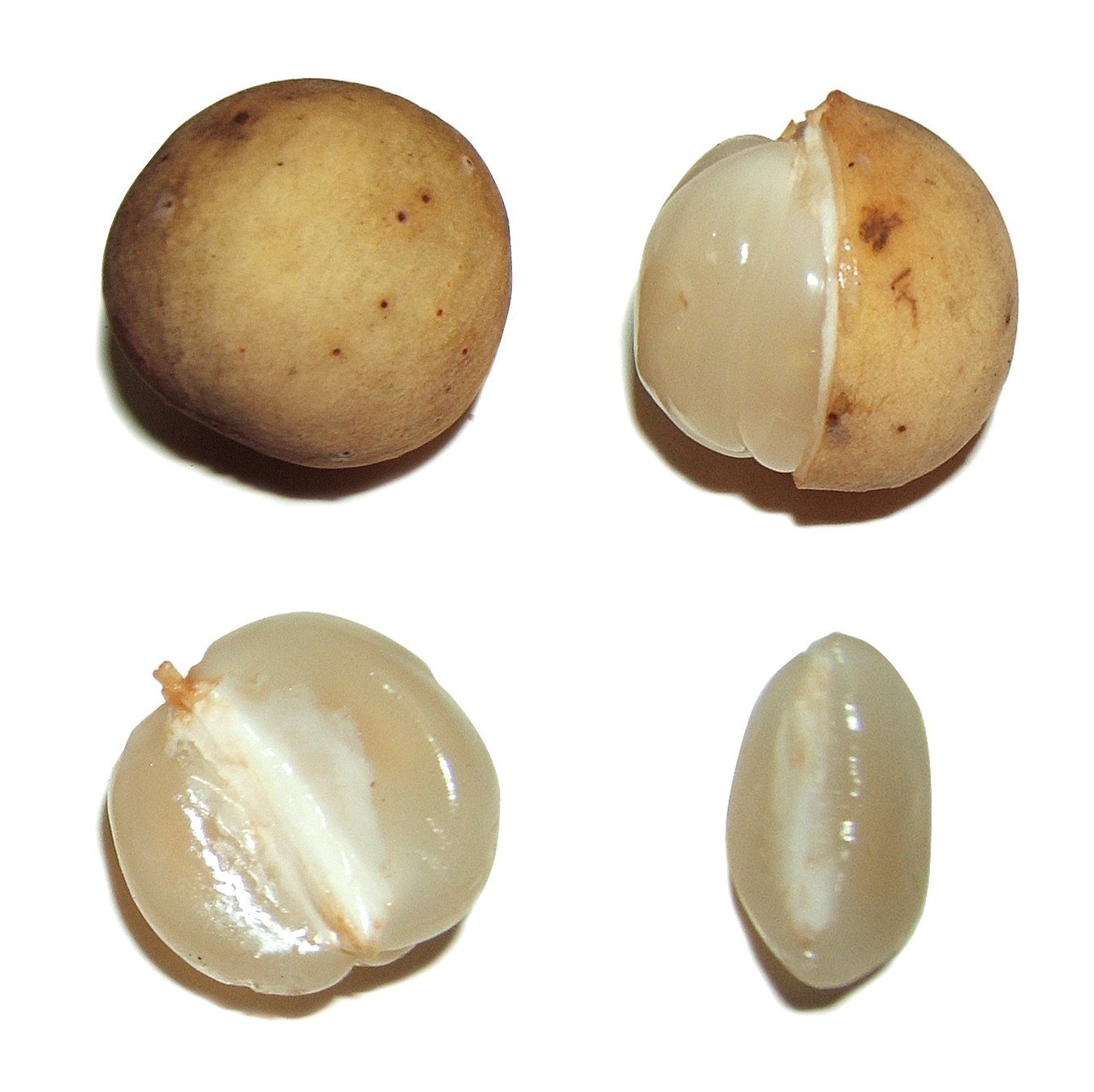
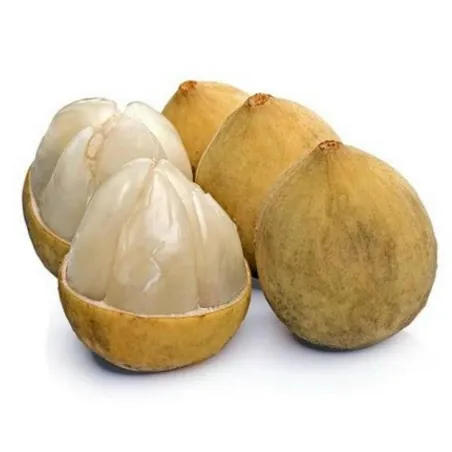
The fruit can be elliptical, ovoid or round, measuring 2 to 7 centimetres (0.79 to 2.76 in) by 1.5 to 5 centimetres (0.59 to 1.97 in) in size. Fruits look much like small potatoes and are borne in clusters similar to grapes. The larger fruits are on the variety known as duku. It is covered by thin, yellow hair giving a slightly fuzzy aspect. The skin thickness varies with the varieties, from 2 millimetres (0.079 in) to approximately 6 millimetres (0.24 in). The fruit contains 1 to 3 seeds, flat, and bitter tasting; the seeds are covered with a thick, clear-white aril that tastes sweet and sour.[2] The taste has been likened to a combination of grape and grapefruit and is considered excellent by most. The sweet juicy flesh contains sucrose, fructose, and glucose.[4] For consumption, cultivars with small or undeveloped seeds and thick aril are preferred.
Uses
L. parasiticum is cultivated mainly for its fruit, which can be eaten raw. The fruit can also be bottled in syrup. The wood is hard, thick, heavy, and resilient, allowing it to be used in the construction of rural houses.
Some parts of the plant are used in making traditional medicine. The bitter seeds can be pounded and mixed with water to make a deworming and ulcer medication. The bark is used to treat dysentery and malaria; the powdered bark can also be used to treat scorpion stings. The fruit's skin is used to treat diarrhea, and in the Philippines the dried skin is burned as a mosquito repellent.
The skin, especially of the langsat variety, can be dried and burned as incense.
The greatest producers of Lansium parasiticum are Malaysia, Thailand, the Philippines and Indonesia. The production is mostly for internal consumption, although some is exported to Singapore and Hong Kong.
Cultivars
There are numerous cultivars of L. parasiticum. Overall, there are two main groups of cultivars, those named duku and those named langsat. There are also mixed duku-langsat varieties.
Those called duku generally have a large crown, thick with bright green leaves, with short bunches of few fruit. The individual fruit are large, generally round, and have somewhat thick skin that does not release sap when cooked. The seeds are small, with thick flesh, a sweet scent, and a sweet or sour alin.
Meanwhile, the variant commonly known as langsat generally has thinner trees, with a less dense crown consisting of dark green leaves and stiff branches. The bunches are longer, and each bunch holds between 15 and 25 large, egg-shaped fruit. The skin is thin and releases a white sap when cooked. The flesh is watery and tastes sweet and sour.[2][7] Unlike duku, langsat fruit does not last long after being picked. Three days after being picked, the skin blackens; this does not affect the fruit's taste.
L. domesticum var. aquaeum is distinguished by its hairy leaves, as well as the tightly packed dark yellow fruit on its bunches. The fruit tends to be small, with thin skin and little sap; the skin is difficult to remove. To be eaten, the fruit is bitten and the flesh sucked through the hole created,[2] or rubbed until the skin breaks and the seeds are retrieved. In Indonesia the fruit has several names, including kokosan, pisitan, pijetan, and bijitan.[7] The seeds are relatively large, with thin, sour flesh.
Ecology
L. parasiticum grows well in mixed agroforests. The plant, especially the duku variant, prefers damp, shaded areas. It can be grown in the same agroforest as durian, petai, and jengkol, as well as wood-producing trees.
L. parasiticum is grown from low grounds up to heights of 600 metres (2,000 ft) above sea level, in areas with an average rainfall of 1,500 to 2,500 millimetres (59 to 98 in) a year. The plant can grow and blossom in latosol, yellow podzol, and alluvium.[11] The plant prefers slightly acidic soil with good drainage and rich in mulch. The langsat variant is hardier, and can weather dry seasons with a little shade and water.[2] The plant cannot handle floods.
L. parasiticum generally bears fruit once a year. This period can vary between areas, but blooming is generally after the beginning of the rainy season and fruit production some four months later.
Distribution
Lansium parasiticum was originally native to Southeast Asia. It grows wild in Sumatra forests where a wide and longest river in Indonesia lay across the southern part of Sumatra. The river rises and floods the forest lands for a few months, when it subsides, the flood leaves plenty of fallen leaves and twigs enriching and moistening a large area of the forest bed, resulting in ideal conditions for the plant to grow naturally. Local people will come and harvest it as natural forest produce. They climb up the tree with ripe fruits (after observing it), holding with their hands on the smaller branches and shaking it. Mature fruits will fall easily down to the ground. They will then collect it and transport it on a small boat on a nearby river to the villages and sell it. In a good year a 20-year-old tree can produce 100 kg of fruits, however fruiting is often uneven.
Agriculturally, the tree is grown throughout the entire Southeast asian region, ranging from Southern India to the Philippines for its fruit. In the Philippines, where it is locally referred to as the lanzones or langsa, the plant is grown mostly on the southern parts of the island of Luzon, especially in Paete, Laguna, due to the species' narrow range of conditions favorable to its survival. It is also found in abundance on Northern Mindanao particularly in places as Butuan, Cagayan de Oro, and Camiguin. The Camiguin variety is especially sweet and succulent.
In Indonesia, Langsat is very popular fruit in West Kalimantan (Pontianak, Indonesia), Sulawesi and South Sumatra (also called 'Duku'). In Sarawak, northern Borneo, the name Duku is reserved for the larger-sized varieties of Langsat, near the size of golf balls, claimed sweeter and with less sap in the peel. A variety called Dokong exported to mainland Malaysia from Thailand (this variety is called 'Longkong' Thai: ลองกอง in Thailand) grows tighter in the clusters, giving it a faceted shape, and is preferred by many over the standard Langsat.
Within mainland Asia, the tree is cultivated in Thailand (Thai: ลางสาด, langsat), Cambodia, Vietnam, India, and Malaysia. Outside the region, it has also been successfully transplanted and introduced to Hawaii and Surinam. It grows well in the wetter areas (120 inches/3 meters or more annual rainfall) of Costa Rica, where it is still very rare, having been introduced decades ago by the United Fruit Company. A major hindrance to its acceptance seems to be that it is very slow in bearing, said to take 12 years or more from seed. However, air layering from mature trees, as well as grafting, are said to work well and produce much faster.
Η βαθμολόγηση της κριτικής δεν μπορεί να αποσταλεί
Αναφορά σχολίου
Είστε σίγουρος ότι θέλετε να αναφέρετε αυτό το σχόλιο;
Αναφορά αποστάλθηκε
Η αναφορά σας υποβλήθηκε και θα εξεταστεί από συντονιστή.
Η αναφορά σου δεν μπορεί να σταλεί
Κριτική αποστάλθηκε
Το σχόλιό σας υποβλήθηκε και θα είναι διαθέσιμο μόλις το εγκρίνει ένας συντονιστής.
Η κριτική σου δεν μπορεί να σταλεί
🌍 Αποστολή σε όλο τον κόσμο από την ΕΕ
Αποστέλλουμε σε όλο τον κόσμο από την Ευρωπαϊκή Ένωση μέσω συστημένης αεροπορικής αλληλογραφίας με υποχρεωτική υπογραφή κατά την παράδοση.
📦 Παρακολούθηση της παραγγελίας σας
Για να βρείτε τον αριθμό παρακολούθησης, συνδεθείτε στον λογαριασμό σας και μεταβείτε στο: Ιστορικό παραγγελιών > Λεπτομέρειες. Ο αριθμός παρακολούθησης βρίσκεται απευθείας στις λεπτομέρειες της παραγγελίας σας.
Θα λαμβάνετε ειδοποιήσεις μέσω email για κάθε στάδιο της παραγγελίας σας.
Εάν δεν βλέπετε αυτά τα μηνύματα, ελέγξτε τον φάκελο Ανεπιθύμητα (Spam) ή επικοινωνήστε με τον πάροχο email σας. Εναλλακτικά, αναζητήστε στο διαδίκτυο πώς να ξεμπλοκάρετε τα email του αποστολέα.
Η ΥΠΗΡΕΣΙΑ EMAIL ΜΑΣ ΛΕΙΤΟΥΡΓΕΙ — Εάν δεν λαμβάνετε email, είναι πιθανό να φταίει ο πάροχος email σας ή οι ρυθμίσεις σας.
📧 Πώς να διασφαλίσετε ότι τα email από το ηλεκτρονικό μας κατάστημα φτάνουν πάντα στα εισερχόμενά σας
Για να αποτρέψετε τον χαρακτηρισμό των email μας ως ανεπιθύμητα, προσθέστε τη διεύθυνση email μας στις επαφές σας:
Ανοίξτε το Gmail (ή οποιονδήποτε άλλο πάροχο) και βρείτε ένα email από εμάς (xxxxxxxxxxxx@xxx.com).
Περάστε το ποντίκι πάνω από το όνομα ή τη διεύθυνση email του αποστολέα.
Κάντε κλικ στο εικονίδιο "Προσθήκη στις επαφές" (το εικονίδιο με το ανθρωπάκι).
Δεν μπορούμε να σας βοηθήσουμε εάν οι ρυθμίσεις σας δεν είναι έτσι. Επικοινωνήστε με τον πάροχο email σας για βοήθεια.
Εναλλακτικά, δημιουργήστε ένα φίλτρο στο Gmail:
Ανοίξτε το Gmail και μεταβείτε στις Ρυθμίσεις > Δείτε όλες τις ρυθμίσεις.
Μεταβείτε στην καρτέλα Φίλτρα και αποκλεισμένες διευθύνσεις.
Κάντε κλικ στο Δημιουργία νέου φίλτρου και εισαγάγετε τη διεύθυνση email μας.
Επιλέξτε Να μην αποστέλλεται ποτέ στα Ανεπιθύμητα και κάντε κλικ στο Δημιουργία φίλτρου.
📍 Παρακολουθήστε το δέμα σας
Ο αριθμός παρακολούθησης βρίσκεται στις λεπτομέρειες της παραγγελίας σας. Μπορείτε να παρακολουθήσετε την παραγγελία σας μέσω των παρακάτω πλατφορμών:
Posta.hr (για αριθμούς παρακολούθησης όπως RGxxxxxxHR)
⚠️ Σημαντικές σημειώσεις
Η αντικαταβολή ΔΕΝ είναι διαθέσιμη.
Κατά την παραγγελία, παρέχετε πάντα έναν έγκυρο αριθμό κινητού τηλεφώνου με τον κωδικό χώρας (π.χ. +30 691 234 5678).
ΜΗΝ παραγγέλνετε σε Ταχυδρομικές Θυρίδες (P.O. Boxes) ή εάν δεν μπορείτε να είστε σπίτι για να υπογράψετε για το δέμα. Τα δέματα δεν μπορούν να αφεθούν σε γείτονες.
Εάν ένα δέμα που στάλθηκε σε Ταχυδρομική Θυρίδα χαθεί ή δεν παραδοθεί, δεν θα γίνει επιστροφή χρημάτων.
⚖️ Ευθύνη πελάτη για νομική συμμόρφωση
Ο πελάτης είναι υπεύθυνος να διασφαλίσει ότι το προϊόν είναι νόμιμο για εισαγωγή στη χώρα του, συμπεριλαμβανομένης της συμμόρφωσης με όλους τους κανονισμούς εισαγωγής, της απόκτησης απαραίτητων αδειών και της πληρωμής ισχυόντων δασμών, φόρων και άλλων τελών. Ελέγξτε τους τοπικούς νόμους πριν παραγγείλετε.
Πελάτες από Βραζιλία & Μεξικό: Δεν μπορούμε να επιστρέψουμε χρήματα για δέματα που χάθηκαν ή καταστράφηκαν από το τελωνείο.
Εάν το δέμα σας επιστραφεί, θα επιστρέψουμε μόνο το κόστος του προϊόντος — τα έξοδα αποστολής δεν επιστρέφονται.
Τα έξοδα επιστροφής (2 €) και τυχόν έξοδα επαναποστολής επιβαρύνουν τον πελάτη.
🚚 Παράδοση αποστολής
Οι συστημένες αποστολές απαιτούν υπογραφή.
Εάν η παρακολούθηση δείχνει ότι το δέμα βρίσκεται ακόμα στο ταχυδρομείο προέλευσης, είναι υπό διαμετακόμιση — επικοινωνήστε με το τοπικό σας ταχυδρομείο για ενημερώσεις.
Δυστυχώς, ούτε εμείς ούτε το ταχυδρομείο μέσω του οποίου στάλθηκε η παραγγελία σας μπορούμε να σας βοηθήσουμε σχετικά με το πού ακριβώς βρίσκεται η παραγγελία σας. Όταν δείτε ότι το δέμα βρίσκεται στη χώρα σας, ΠΡΕΠΕΙ να επικοινωνήσετε με το ταχυδρομείο σας με τον αριθμό παρακολούθησης.
⏱️ Επιλογές παράδοσης και εκτιμώμενοι χρόνοι
Επιλογή Παράδοσης
Χρόνος Επεξεργασίας
Σημειώσεις
Priority Delivery
Αποστολή σε 1–7 εργάσιμες ημέρες
Προτεραιότητα στην επεξεργασία. καθυστερήσεις πιθανές στις γιορτές (3–10 ημέρες)
Secured Delivery
Αποστολή σε 1–7 εργάσιμες ημέρες
Διαθέσιμο για παραγγελίες έως 150 €. επιστροφή χρημάτων σε περίπτωση απώλειας
Standard Delivery
Αποστολή σε 7–10 εργάσιμες ημέρες
Πιο οικονομικό. καθυστερήσεις πιθανές στις γιορτές (7–14 ημέρες)
Εκτιμώμενοι χρόνοι παράδοσης:
Εντός ΕΕ: 3–20 ημέρες
Σε όλο τον κόσμο: 5–30 ημέρες
Σημείωση: Οι χρόνοι παράδοσης εξαρτώνται από την τοποθεσία σας και το τοπικό ταχυδρομικό σύστημα. Ο COVID-19 ή οι περίοδοι εορτών ενδέχεται να προκαλέσουν πρόσθετες καθυστερήσεις.
💰 Έξοδα αποστολής
Τα έξοδα αποστολής και διαχείρισης υπολογίζονται αυτόματα κατά την πληρωμή με βάση το βάρος του δέματος και τον προορισμό.
⏰ Ώρες επεξεργασίας παραγγελιών
Δεν επεξεργαζόμαστε ούτε αποστέλλουμε παραγγελίες τα Σάββατα ή τις Κυριακές.
💳 Επιλογές πληρωμής
Θα θέλαμε να σας ενημερώσουμε για μια σημαντική αλλαγή σχετικά με τις προμήθειες πληρωμής. Δυστυχώς, λόγω των εξαιρετικά υψηλών προμηθειών συναλλαγών που επιβάλλει το PayPal, είμαστε αναγκασμένοι να εφαρμόσουμε μια επιπλέον χρέωση για πληρωμές που πραγματοποιούνται μέσω της υπηρεσίας τους.
Ωστόσο, έχουμε μια λύση για εσάς! Μπορείτε να αποφύγετε αυτές τις αστρονομικές χρεώσεις επιλέγοντας μία από τις εναλλακτικές μεθόδους πληρωμής μας με ΜΗΔΕΝΙΚΗ ΠΡΟΜΗΘΕΙΑ:
✅ Πληρωμή με Πιστωτική/Χρεωστική Κάρτα – 0% Προμήθεια
✅ Τραπεζική Μεταφορά – 0% Προμήθεια
Τραπεζική Μεταφορά (SEPA / IBAN / SWIFT-BIC): Συμπεριλάβετε την αναφορά της παραγγελίας σας στην περιγραφή της πληρωμής. Παραγγελίες χωρίς πληρωμή εντός 4 ημερών θα ακυρώνονται αυτόματα.
PayPal: Οι πληρωμές γίνονται δεκτές μόνο σε ευρώ. Παρακαλούμε επιλέξτε ευρώ κατά την πληρωμή.
Πληρωμή με κάρτα: Δεχόμαστε Visa, MasterCard, American Express, CB, Diners Club, Discover, China UnionPay, JCB και Discover.
⚠️ Προμήθειες συναλλαγών
Οι πελάτες είναι υπεύθυνοι για τυχόν τραπεζικές προμήθειες ή προμήθειες του PayPal.
📝 Τελικές σημειώσεις
Πριν τοποθετήσετε την παραγγελία σας, ελέγχετε πάντα την ιστοσελίδα μας για ειδικές ειδοποιήσεις, προγράμματα αργιών ή συγκεκριμένους όρους αποστολής.

Σχόλια (0)
Η βαθμολόγηση της κριτικής δεν μπορεί να αποσταλεί
Αναφορά σχολίου
Αναφορά αποστάλθηκε
Η αναφορά σου δεν μπορεί να σταλεί