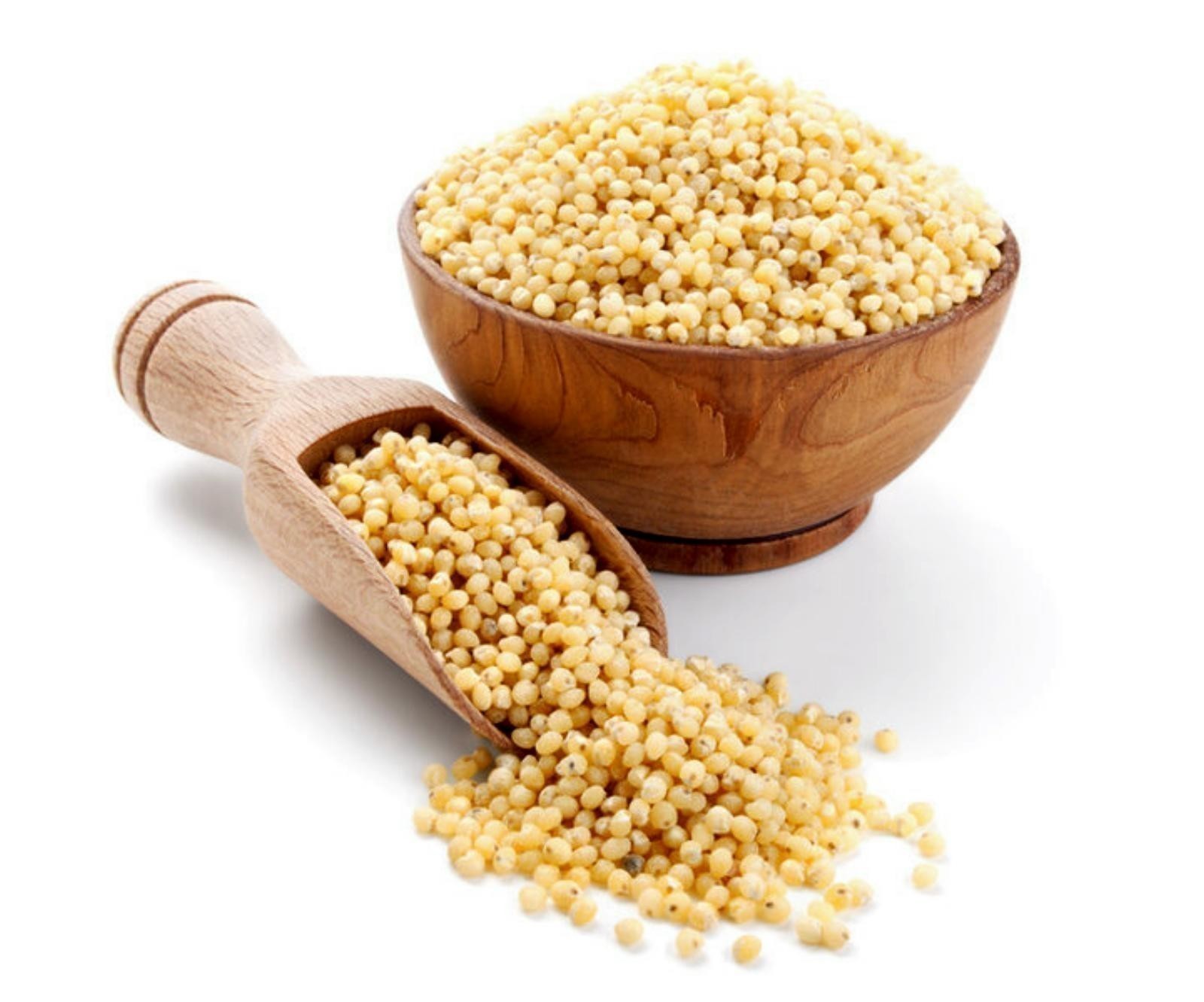
Panicum miliaceum, with many common names including proso millet, broomcorn millet, common millet, broomtail millet, hog millet, Kashfi millet red millet, and white millet, is a grass species used as a crop.
Panicum miliaceum, with many common names including proso millet, broomcorn millet, common millet, broomtail millet, hog millet, Kashfi millet red millet, and white millet, is a grass species used as a crop. Both the wild ancestor and location of the original domestication of proso millet are unknown, but it first appears as a crop in both Transcaucasia and China about 7,000 years ago, suggesting it may have been domesticated independently in each area. It is still extensively cultivated in India, Nepal, Russia, Ukraine, the Middle East, Turkey and Romania. In the United States, proso is mainly grown for birdseed. It is sold as health food, and due to its lack of gluten, it can be included in the diets of people who cannot tolerate wheat.
The name comes from the pan-Slavic general and generic name for millet (Russian, Serbian, Macedonian, Bulgarian: просо and Polish, Czech, Slovak, Slovenian, Croatian: proso).
Proso is well adapted to many soil and climatic conditions; it has a short growing season, and needs little water. The water requirement of proso is probably the lowest of any major cereal. It is an excellent crop for dryland and no-till farming. Proso millet is an annual grass whose plants reach an average height of 100 cm (4 feet.). Like corn, it has a C4 photosynthesis. The seedheads grow in bunches. The seeds are small (2–3 mm or 0.1 inch) and can be cream, yellow, orange-red, or brown in colour.
Proso is an annual grass like all other millets, but it is not closely related to pearl millet, foxtail millet, finger millet, or the barnyard millets.
History and domestication
Unlike the foxtail millet, the wild ancestor of the proso millet has not yet been satisfactorily identified. Weedy forms of this grain are found in central Asia, covering a widespread area from the Caspian Sea east to Xinjiang and Mongolia, and it may be that these semiarid areas harbor "genuinely wild P. miliaceum forms."[6] This millet has been reportedly found in Neolithic sites in Georgia (dated to the fifth and fourth millennia BC), in Germany (near Leipzig, Hadersleben) by Linear Pottery culture (Early LBK, Neolithikum 5500–4900 BCE),[7] as well as excavated Yangshao culture farming villages east in China.
Proso millet appears to have reached Europe not long after its appearance in Georgia, first appearing in east and central Europe; however, the grain needed a few thousand more years to cross into Italy, Greece, and Iran, and the earliest evidence for its cultivation in the Near East is a find in the ruins of Nimrud, Iraq dated to about 700 BC.
While proso millet is not a member of the Neolithic Near East crop assemblage, it arrived in Europe no later than the time these introductions did, and proso millet as an independent domestication could predate the arrival of the Near East grain crops.
Cultivation
Proso millet is a relatively low-demanding crop and diseases are not known; consequently, proso millet is often used in organic farming systems in Europe. In the United States it is often used as an intercrop. Thus, proso millet can help to avoid a summer fallow, and continuous crop rotation can be achieved. Its superficial root system and its resistance to atrazine residue make proso millet a good intercrop between two water- and pesticide-demanding crops. The stubbles of the last crop, by allowing more heat into the soil, result in a faster and earlier millet growth. While millet occupies the ground, because of its superficial root system, the soil can replenish its water content for the next crop. Later crops, for example, a winter wheat, can in turn benefit from the millet stubble, which act as snow accumulators.
Climate and soil requirements
Due to its C4 photosynthetic system, proso millet is thermophilic like maize. Therefore, shady locations of the field should be avoided. It is sensitive to cold temperatures lower than 10 to 13 degrees Celsius. Proso millet is highly drought-resistant, which makes it of interest to regions with low water availability and longer periods without rain. The soil should be light or medium-heavy. Due to its flat root systems, soil compaction must be avoided. Furthermore, proso millet does not tolerate soil wetness caused by dammed-up water
Seedbed and sowing
The seedbed should be finely crumbled as for sugar beet and rapeseed.[10] In Europe proso millet is sowed between mid-April and the end of May. 500g/are of seeds are required which comes up to 500 grains/m2. In organic farming this amount should be increased if a harrow weeder is used. For sowing, the usual sowing machines can be used similarly to how they are used for other crops like wheat. A distance between the rows of from 16 to 25 centimeters is recommended if the farmer uses an interrow cultivator. The sowing depth should be 1.5 up to 2 cm in optimal soil or 3 to 4 cm in dry soil. Rolling of the ground after sowing is helpful for further cultivation.[10] Cultivation in no-till farming systems is also possible and often practiced in the United States. Sowing then can be done two weeks later.
Field management
Only a few diseases and pests are known to attack proso millet, but they are not economically important. Weeds are a bigger problem. The critical phase is in juvenile development. The formation of the grains happens in the 3, up to 5, leaf stadium. After that, all nutrients should be available for the millet, so it is necessary to prevent the growth of weeds. In conventional farming, herbicides may be used. In organic farming it is possible to use harrow weeders and interrow cultivators, but special sowing parameters described in the chapter above are needed.[10] For good crop development, fertilization with 50 to 75 kg nitrogen per hectare is recommended.[11] Planting proso millet in a crop rotation after maize should be avoided due to its same weed spectrum. Because proso millet is an undemanding crop, it may be used at the end of the rotation.
Harvesting and post-harvest treatments
Harvest time is at the end of August until mid-September. Determining the best harvest date is not easy because all the grains do not ripen simultaneously. The grains on the top of the panicle ripen first while the grains in the lower parts need more time, making it necessary to compromise and harvest when the yield is highest.[10] Harvesting can be done with a conventional combine harvester with moisture content of the grains at about 15-20%. Usually proso millet is mowed at windrows first since the plants are not dry like wheat. There they can wither, which makes the threshing easier. Then the harvest is done with a pickup truck attached to a combine.[10] Possible yields are between 2.5 and 4.5 tons per hectare under optimal conditions. Studies in Germany showed that even higher yields can be attained.
Uses
Proso millet is one of the few types of millet not cultivated in Africa.[12] In the United States, former Soviet Union, and some South American countries, it is primarily grown for livestock feed. As a grain fodder, it is very deficient in lysine and needs complementation. Proso millet is also a poor fodder due to its low leaf:stem ratio and a possible irritant effect due to its hairy stem. Foxtail millet, having a higher leaf:stem ratio and less hairy stems, is preferred as fodder, particularly the variety called moha, which is a high-quality fodder.
In order to promote millet cultivation, other potential uses have been considered recently.[13] For example, starch derived from millets has been shown to be a good substrate for fermentation and malting with grains having similar starch contents as wheat grains.[13] A recently published study suggested that starch derived from proso millet can be converted to ethanol with an only moderately lower efficiency than starch derived from corn.[14] The development of varieties with highly fermentable characteristics could improve ethanol yield to that of highly fermentable corn.[14] Since proso millet is compatible with low-input agriculture, cultivation on marginal soils for biofuel production could represent an important new market, such as for farmers in the High Plains of the US.[14] The demand for more diverse and healthier cereal-based foods is increasing, particularly in affluent countries.[15] This could create new markets for proso millet products in human nutrition. Protein content in proso millet grains is comparable with that of wheat, but the share of essential amino acids (leucine, isoleucine and methionine) is substantially higher in proso millet.[15] In addition, health-promoting phenolic compounds contained in the grains are readily bioaccessible and their high calcium content favor bone strengthening and dental health.[15] Among the most commonly consumed products are ready-to-eat breakfast cereals made purely from millet flour [10][15] as well as a variety of noodles and bakery products, which are, however, often produced from mixtures with wheat flour to improve their sensory quality.
Uw beoordelingswaardering kan niet worden verzonden
Rapporteer reactie
Bent u zeker dat u deze opmerking wil rapporteren?
Melding verzonden
Uw opmerking is ingediend en zal door een beheerder worden behandeld.
Uw opmerking kan niet worden verzonden
Schrijf uw recensie
Beoordeling verstuurd
Uw beoordeling is toegevoegd en wordt beschikbaar zodra deze is goedgekeurd.
Uw beoordeling kan niet worden verzonden
🌍 Wereldwijde verzending vanuit de EU
Wij verzenden wereldwijd vanuit de Europese Unie via aangetekende luchtpost met handtekening voor ontvangst bij levering.
📦 Uw bestelling volgen
Om uw trackingnummer te vinden, logt u in op uw account en gaat u naar: Bestelgeschiedenis > Details. Uw trackingnummer bevindt zich direct in de bestelgegevens.
U ontvangt e-mailmeldingen voor elke fase van uw bestelling.
Als u deze berichten niet ziet, controleer dan uw map Spam/Ongewenste e-mail of neem contact op met uw e-mailprovider. Zoek anders online naar hoe u e-mails van afzenders kunt deblokkeren.
ONZE E-MAILSERVICE WERKT — Als u geen e-mails ontvangt, ligt dit waarschijnlijk aan uw e-mailprovider of instellingen.
📧 Hoe u ervoor zorgt dat e-mails van onze webshop altijd in uw inbox terechtkomen
Om te voorkomen dat onze e-mails als spam worden gemarkeerd, voegt u ons e-mailadres toe aan uw contacten:
Open Gmail (of een andere provider) en zoek een e-mail van ons (xxxxxxxxxxxx@xxx.com).
Beweeg de muis over de naam of het e-mailadres van de afzender.
Klik op het icoon "Toevoegen aan contacten" (het poppetje).
We kunnen u niet helpen als uw instellingen niet zo staan. Neem contact op met uw e-mailprovider voor hulp.
Als alternatief kunt u een filter maken in Gmail:
Open Gmail en ga naar Instellingen > Alle instellingen bekijken.
Ga naar het tabblad Filters en geblokkeerde adressen.
Klik op Nieuw filter maken en voer ons e-mailadres in.
Vink Nooit naar Spam verzenden aan en klik op Filter maken.
📍 Uw pakket volgen
Uw trackingnummer staat in uw bestelgegevens. U kunt uw bestelling volgen via de volgende platforms:
Geef bij het bestellen altijd een geldig mobiel nummer op met landnummer (bijv. +31 6 1234 5678).
Bestel NIET naar postbussen (P.O. Boxes) of als u niet thuis kunt zijn om voor het pakket te tekenen. Pakketten kunnen niet bij de buren worden afgegeven.
Als een pakket dat naar een postbus is verzonden verloren gaat of niet wordt bezorgd, vindt er geen terugbetaling plaats.
⚖️ Verantwoordelijkheid van de klant voor wettelijke naleving
De klant is verantwoordelijk om ervoor te zorgen dat het product legaal in zijn land mag worden geïmporteerd, inclusief naleving van alle importvoorschriften, het verkrijgen van de nodige vergunningen en de betaling van toepasselijke douanerechten, belastingen en andere kosten. Controleer uw lokale wetgeving voordat u bestelt.
🔄 Verloren, geretourneerde en opnieuw verzonden pakketten
Klanten uit Brazilië en Mexico: We kunnen geen pakketten terugbetalen die door de douane zijn verloren of vernietigd.
Als uw pakket wordt geretourneerd, betalen we alleen de productkosten terug — verzendkosten worden niet gerestitueerd.
Retourkosten (€2) en eventuele kosten voor opnieuw verzenden zijn voor rekening van de klant.
🚚 Levering van de zending
Aangetekende zendingen vereisen een handtekening.
Als de tracking aangeeft dat het pakket nog op het postkantoor van herkomst is, is het onderweg — neem contact op met uw lokale postkantoor voor updates.
Helaas kunnen wij, noch het postkantoor waardoor uw bestelling is verzonden, u helpen met de vraag waar uw bestelling zich precies bevindt. Wanneer u ziet dat het pakket in uw land is, MOET u contact opnemen met uw postkantoor met het trackingnummer.
⏱️ Leveringsopties & geschatte tijden
Leveringsoptie
Verwerkingstijd
Opmerkingen
Priority Delivery
Verzonden binnen 1–7 werkdagen
Prioriteit bij orderverwerking; vertragingen mogelijk tijdens feestdagen (3–10 dagen)
Secured Delivery
Verzonden binnen 1–7 werkdagen
Beschikbaar voor bestellingen tot €150; terugbetaling bij verlies
Standard Delivery
Verzonden binnen 7–10 werkdagen
Voordeliger; vertragingen mogelijk tijdens feestdagen (7–14 dagen)
Geschatte levertijden:
Binnen de EU: 3–20 dagen
Wereldwijd: 5–30 dagen
Opmerking: Levertijden zijn afhankelijk van uw locatie en het lokale postsysteem. COVID-19 of feestdagen kunnen extra vertraging veroorzaken.
💰 Verzendkosten
Verzend- en administratiekosten worden automatisch berekend bij het afrekenen op basis van het gewicht van het pakket en de bestemming.
⏰ Verwerkingstijden
Wij verwerken of verzenden geen bestellingen op zaterdag of zondag.
💳 Betalingsmogelijkheden
Wij willen u informeren over een belangrijke wijziging met betrekking tot de betalingskosten. Helaas zijn wij, vanwege de uitzonderlijk hoge transactiekosten die PayPal in rekening brengt, genoodzaakt een toeslag toe te passen voor betalingen die via hun service worden gedaan.
We hebben echter een oplossing voor u! U kunt deze astronomische kosten vermijden door te kiezen voor een van onze alternatieve betaalmethoden met NUL COMMISSIE:
✅ Creditcard/Betaalpas betaling – 0% Kosten
✅ Bankoverschrijving – 0% Kosten
Bankoverschrijving (SEPA / IBAN / SWIFT-BIC): Vermeld uw bestelreferentie in de betalingsomschrijving. Bestellingen zonder betaling binnen 4 dagen worden automatisch geannuleerd.
PayPal: Betalingen worden alleen in Euro geaccepteerd. Selecteer Euro tijdens het afrekenen.
Kaartbetaling: Wij accepteren Visa, MasterCard, American Express, CB, Diners Club, Discover, China UnionPay, JCB en Discover.
⚠️ Transactiekosten
Klanten zijn verantwoordelijk voor eventuele bank- of PayPal-transactiekosten.
📝 Slotopmerkingen
Controleer voor het plaatsen van uw bestelling altijd onze website voor speciale mededelingen, vakantieschema's of specifieke verzendvoorwaarden.