

Rode custardappel zaden ZELDZAAM (Annona reticulata)
SKU V-10-R-(2-S) Categorie Home
Prijs:
€ 4,95
Inclusief belasting
Red Custard Apple Seeds RARE (Annona reticulata)
Price for Package of 2 seeds.
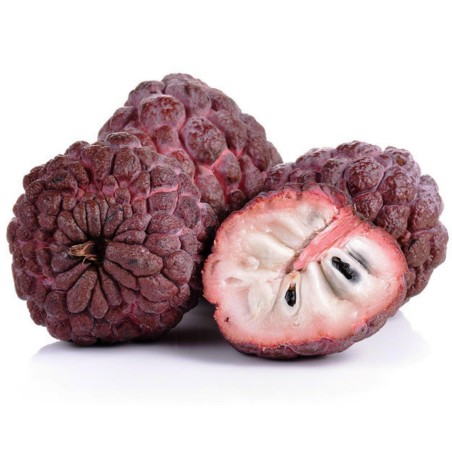
The red custard apple is a very close relative to the sugar apple and atemoya. They have a thick creamy custard-like pulp that can be pink, red. The fruit have a pleasant flavor and aroma, and they are best eaten out of hand or in ice cream. Both in tree and in fruit, the custard apple, Annona reticulata L., is
Niet op voorraad
Zaden in verpakking:
Share on
Red Custard Apple Seeds RARE (Annona reticulata)
Price for Package of 2 seeds.
The red custard apple is a very close relative to the sugar apple and atemoya. They have a thick creamy custard-like pulp that can be pink, red. The fruit have a pleasant flavor and aroma, and they are best eaten out of hand or in ice cream.
Both in tree and in fruit, the custard apple, Annona reticulata L., is generally rated as the mediocre or "ugly duckling" species among the prominent members of this genus. Its descriptive English name has been widely misapplied to other species and to the hybrid ATEMOYA, and it is sometimes erroneously termed "sugar apple", "sweetsop" and, by Spanish-speaking people, "anon" or "rinon", in India, "ramphal", all properly applied only to Annona squamosa. It has, itself, acquired relatively few appropriate regional names. Most commonly employed as an alternate name in English-speaking areas is bullock's-heart or bull's-heart; in French, coeur de boeuf; Portuguese, coracao de boi; in Spanish, often merely corazon—all alluding to its form and external blush. The skin color is reflected in the Bolivian name, chirimoya roia, the Salvadoran anona rosada, and the Guatemalan anona roja or anona colorada. In the latter country it is also known as anona de seso. Araticum ape or araticum do mato are additional names in Brazil. Some people refer to it as Jamaica apple, or as netted custard apple, which is translated as anona de redecilla in Honduras and Nicaragua. Cachiman, cachiman coeur de boeuf and corossol sauvage may be heard in the French-influenced West Indies. In the Netherlands Antilles it is kasjoema. This name and boeah nona are used in Surinam. In Cuba, it is mamon or chirimoya. Some Central Americans give it the name anona, or anonillo; Colombians, anon pelon. To the Carib Indians the fruit was known as alacalyoua; to the Aztecs, quaultzapotl, and to the Maya, tsulimay, tsulilpox, tsulipox, pox, oop, or op. It is generally called in the Philippines sarikaya; in India ramphal, nona or luvuni, in Malaya, nona kapri, or lonang; in Thailand, noi nong";; in Cambodia, mo bat or mean bat; in Laos, khan tua lot; in South Vietnam, binh bat; North Vietnam, qua na.
Description
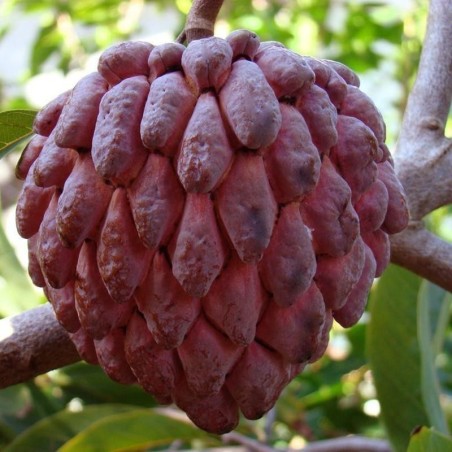
The custard apple tree is not especially attractive. It is erect, with a rounded or spreading crown and trunk 10 to 14 in (25-35 cm) thick. Height ranges from 15 to 35 ft (4.5-10 m). The ill-smelling leaves are deciduous, alternate, oblong or narrow-lanceolate, 4 to 8 in (10-20 cm) long, 3/4 to 2 in (2 5 cm) wide, with conspicuous veins. Flowers, in drooping clusters, are fragrant, slender, with 3 outer fleshy, narrow petals 3/4 to 1 1/4 in (2 3 cm) long; light-green externally and pale-yellow with a dark-red or purple spot on the inside at the base. The flowers never fully open. The compound fruit, 3 l/4 to 6 1/2 in (8-16 cm) in diameter, may be symmetrically heart-shaped, lopsided, or irregular; or nearly round, or oblate, with a deep or shallow depression at the base. The skin, thin but tough, may be yellow or brownish when ripe, with a pink, reddish or brownish-red blush, and faintly, moderately, or distinctly reticulated. There is a thick, cream-white layer of custardlike, somewhat granular, flesh beneath the skin surrounding the concolorous moderately juicy segments, in many of which there is a single, hard, dark-brown or black, glossy seed, oblong, smooth, less than 1/2 in (1.25 cm) long. Actual seed counts have been 55, 60 and 76. A pointed, fibrous, central core, attached to the thick stem, extends more than halfway through the fruit. The flavor is sweet and agreeable though without the distinct character of the cherimoya, sugar apple, or atemoya.
Origin and Distribution
The custard apple is believed to be a native of the West Indies but it was carried in early times through Central America to southern Mexico. It has long been cultivated and naturalized as far south as Peru and Brazil. It is commonly grown in the Bahamas and occasionally in Bermuda and southern Florida. Apparently it was introduced into tropical Africa early in the 17th century and it is grown in South Africa as a dooryard fruit tree. In India the tree is cultivated, especially around Calcutta, and runs wild in many areas. It has become fairly common on the east coast of Malaya, and more or less throughout southeast Asia and the Philippines though nowhere particularly esteemed. Eighty years ago it was reported as thoroughly naturalized in Guam. In Hawaii it is not well known.
Cultivars
No named cultivars are reported but there is considerable variation in the quality of fruit from different trees. The yellow-skinned types seem superior to the brownish, and, when well filled out, have thicker and juicier flesh. Seeds of a purple-skinned, purple-fleshed form, from Mexico, were planted in Florida and the tree has produced fruit of unremarkable quality.
Climate
The custard apple tree needs a tropical climate but with cooler winters than those of the west coast of Malaya. It flourishes in the coastal lowlands of Ecuador; is rare above 5,000 ft (1,500 m). In Guatemala, it is nearly always found below 4,000 ft (1,220 m). In India, it does well from the plains up to an elevation of 4,000 ft (1,220 m); in Ceylon, it cannot be grown above 3,000 ft (915 m). Around Luzon in the Philippines, it is common below 2,600 ft (800 m). It is too tender for California and trees introduced into Palestine succumbed to the cold. In southem Florida the leaves are shed at the first onset of cold weather and the tree is dormant all winter. Fully grown, it has survived temperatures of 27º to 28ºF (-2.78º to 2.22ºC) without serious harm. This species is less drought-tolerant than the sugar apple and prefers a more humid atmosphere.
Soil
The custard apple does best in low-lying, deep, rich soil with ample moisture and good drainage. It grows to full size on oolitic limestone in southern Florida and runs wild in light sand and various other types of soil in the New and Old World tropics but is doubtless less productive in the less desirable sites.
Propagation
Seed is the usual means of propagation. Nevertheless, the tree can be multiplied by inarching, or by budding or grafting onto its own seedlings or onto soursop, sugar apple or pond apple rootstocks. Experiments in Mexico, utilizing cherimoya, llama, soursop, custard apple, Annona sp. Af. lutescens and Rollinia jimenezii Schlecht. as rootstocks showed best results when custard apple scions were side-grafted onto self-rootstock, soursop, or A. sp. Af. lutescens. Custard apple seedlings are frequently used as rootstocks for the soursop, sugar apple and atemoya.
Culture
The tree is fast-growing and responds well to mulching, organic fertilizers and to frequent irrigation if there is dry weather during the growing period. The form of the tree may be improved by judicious pruning.
Harvesting And Yield
The custard apple has the advantage of cropping in late winter and spring when the preferred members of the genus are not in season. It is picked when it has lost all green color and ripens without splitting so that it is readily sold in local markets. If picked green, it will not color well and will be of inferior quality. The tree is naturally a fairly heavy bearer. With adequate care, a mature tree will produce 75 to 100 lbs (34-45 kg) of fruits per year. The short twigs are shed after they have borne flowers and fruits.
Pests and Diseases
The custard apple is heavily attacked by the chalcid fly. Many if not all of the fruits on a tree may be mummified before maturity. In India, the ripening fruits must be covered with bags or nets to avoid damage from fruit bats. A dry charcoal rot was observed on the fruits in Assam in 1947. In 1957 and 1958 it made its appearance at Saharanpur. The causal fungus was identified as Diplodia annonae. The infection begins at the stem end of the fruit and gradually spreads until it covers the entire fruit.
Food Uses
In India, the fruit is eaten only by the lower classes, out-of-hand. In Central America, Mexico and the West Indies, the fruit is appreciated by all. When fully ripe it is soft to the touch and the stem and attached core can be easily pulled out. The flesh may be scooped from the skin and eaten as is or served with light cream and a sprinkling of sugar. Often it is pressed through a sieve and added to milk shakes, custards or ice cream. I have made a delicious sauce for cake and puddings by blending the seeded flesh with mashed banana and a little cream.
Food Value Per 100 g of Edible portion*
Calories 80-101
Moisture 68.3-80.1 g
Protein 1.17-2.47 g
Fat 0.5-0.6 g
Carbohydrates 20-25.2 g
Crude Fiber 0.9-6.6 g
Ash 0.5-1.11 g
Calcium 17.6-27 mg
Phosphorus 14.7-32.1 mg
Iron 0.42-1.14 mg
Carotene 0.007-0.018 mg
Thiamine 0.075-0.119 mg
Riboflavin 0.086-0.175 mg
Niacin 0.528-1.190 m
Ascorbic Acid 15.0-44.4 mg
Nicotinic Acid 0.5 mg
*Minimum and maximum levels of constituents from analyses made in Central America, Philippines and elsewhere.
Toxicity
The seeds are so hard that they may be swallowed whole with no ill effects but the kernels are very toxic. The seeds, leaves and young fruits are insecticidal. The leaf juice kills lice. The bark contains 0.12% anonaine. Injection of an extract from the bark caused paralysis in a rear limb of an experimental toad. Sap from cut branches is acrid and irritant and can severely injure the eyes. The root bark has yielded 3 alkaloids: anonaine, liriodenine and reticuline (muricinine).
Other Uses
The leaves have been employed in tanning and they yield a blue or black dye. A fiber derived from the young twigs is superior to the bark fiber from Annona squamosa. Custard apple wood is yellow, rather soft, fibrous but durable, moderately close-grained, with a specific gravity of 0.650. It has been used to make yokes for oxen.
Medicinal Uses
The leaf decoction is given as a vermifuge. Crushed leaves or a paste of the flesh may be poulticed on boils, abscesses and ulcers. The unripe fruit is rich in tannin; is dried, pulverized and employed against diarrhea and dysentery. The bark is very astringent and the decoction is taken as a tonic and also as a remedy for diarrhea and dysentery. In severe cases, the leaves, bark and green fruits are all boiled together for 5 minutes in a liter of water to make an exceedingly potent decoction. Fragments of the root bark are packed around the gums to relieve toothache. The root decoction is taken as a febrifuge.
|
Sowing Instructions |
|
|
Propagation: |
Seeds / Cuttings |
|
Pretreat: |
pour hot water over the seeds + soak about 24-48 h |
|
Stratification: |
0 |
|
Sowing Time: |
all year round |
|
Sowing Depth: |
1 cm |
|
Sowing Mix: |
Coir or sowing mix + sand or perlite |
|
Germination temperature: |
25 ° C + |
|
Location: |
bright + keep constantly moist not wet |
|
Germination Time: |
about 2-6 weeks |
|
Watering: |
Water regularly during the growing season |
|
|
|
Categorie Home
Beoordeling verstuurd
Uw beoordeling is toegevoegd en wordt beschikbaar zodra deze is goedgekeurd.
Uw beoordeling kan niet worden verzonden
🌍 Livrare în toată lumea din UE
Expediem în toată lumea din Uniunea Europeană prin poștă aeriană recomandată, cu semnătură obligatorie la livrare.
📦 Urmărirea comenzii dumneavoastră
Pentru a găsi numărul de urmărire, conectați-vă la contul dumneavoastră și accesați: Istoric comenzi > Detalii. Numărul de urmărire se află direct în detaliile comenzii.
Veți primi notificări prin e-mail pentru fiecare etapă a comenzii dumneavoastră.
Dacă nu vedeți aceste mesaje, vă rugăm să verificați folderul Spam/Junk sau să contactați furnizorul dumneavoastră de e-mail. Alternativ, căutați online cum să deblocați e-mailurile de la expeditor.
SERVICIUL NOSTRU DE E-MAIL FUNCȚIONEAZĂ — Dacă nu primiți e-mailuri, este probabil o problemă cu furnizorul dumneavoastră de e-mail sau cu setările dumneavoastră.
📧 Cum să vă asigurați că e-mailurile de la magazinul nostru online ajung întotdeauna în Inbox
Pentru a preveni marcarea e-mailurilor noastre ca spam, adăugați adresa noastră de e-mail în contactele dumneavoastră:
Deschideți Gmail (sau orice alt furnizor) și găsiți un e-mail de la noi (xxxxxxxxxxxx@xxx.com).
Treceți mouse-ul peste numele sau adresa de e-mail a expeditorului.
Faceți clic pe pictograma "Adaugă în contacte" (pictograma cu persoana mică).
Nu vă putem ajuta dacă setările dumneavoastră nu sunt așa. Contactați furnizorul de e-mail pentru asistență.
Alternativ, creați un filtru în Gmail:
Deschideți Gmail și accesați Setări > Vezi toate setările.
Mergeți la fila Filtre și adrese blocate.
Faceți clic pe Creați un filtru nou și introduceți adresa noastră de e-mail.
Bifați Nu se trimite niciodată în Spam și faceți clic pe Creați filtru.
📍 Urmăriți-vă pachetul
Numărul de urmărire se află în detaliile comenzii dumneavoastră. Vă puteți urmări comanda prin următoarele platforme:
⚠️ Notificări importante
Plata la livrare (ramburs) NU este disponibilă.
Când comandați, furnizați întotdeauna un număr de telefon mobil valid cu prefixul țării (de ex. +40 712 345 678).
NU comandați la căsuțe poștale (P.O. Boxes) sau dacă nu puteți fi acasă pentru a semna pentru pachet. Pachetele nu pot fi lăsate la vecini.
Dacă un pachet trimis la o căsuță poștală este pierdut sau nelivrat, nu se va acorda nicio rambursare.
⚖️ Responsabilitatea clientului pentru conformitatea legală
Clientul este responsabil să se asigure că produsul este legal pentru import în țara sa, inclusiv respectarea tuturor reglementărilor de import, obținerea permiselor necesare și plata taxelor vamale aplicabile, a impozitelor și a altor taxe. Vă rugăm să verificați legile locale înainte de a comanda.
🔄 Pachete pierdute, returnate și reexpediate
Clienți din Brazilia și Mexic: Nu putem rambursa pachetele pierdute sau distruse de vamă.
Dacă pachetul dumneavoastră este returnat, vom rambursa doar costul produsului — costurile de transport sunt nerambursabile.
Taxa poștală de returnare (2 €) și orice costuri de reexpediere trebuie acoperite de client.
🚚 Livrarea transportului
Expedierile recomandate necesită semnătură.
Dacă urmărirea arată că pachetul este încă la oficiul poștal de origine, acesta este în tranzit — contactați oficiul poștal local pentru actualizări.
Din păcate, nici noi, nici oficiul poștal prin care a fost trimisă comanda dumneavoastră nu vă putem ajuta cu întrebarea unde se află exact comanda dumneavoastră. Când vedeți că pachetul este în țara dumneavoastră, TREBUIE să contactați oficiul poștal cu numărul de urmărire.
⏱️ Opțiuni de livrare și timp estimat
| Opțiune de livrare | Timp de procesare | Note |
| Priority Delivery | Se expediază în 1–7 zile lucrătoare | Prioritizează procesarea comenzii; posibile întârzieri în timpul sărbătorilor (3–10 zile) |
| Secured Delivery | Se expediază în 1–7 zile lucrătoare | Disponibil pentru comenzi de până la 150 €; rambursare în caz de pierdere |
| Standard Delivery | Se expediază în 7–10 zile lucrătoare | Mai economic; posibile întârzieri în timpul sărbătorilor (7–14 zile) |
Timp estimat de livrare:
În interiorul UE: 3–20 zile
În restul lumii: 5–30 zile
Notă: Timpul de livrare depinde de locația dumneavoastră și de sistemul poștal local. COVID-19 sau perioadele de sărbători pot cauza întârzieri suplimentare.
💰 Costuri de livrare
Taxele de transport și manipulare sunt calculate automat la finalizarea comenzii pe baza greutății coletului și a destinației.
⏰ Programul de procesare a comenzilor
Nu procesăm și nu expediem comenzi sâmbăta sau duminica.
💳 Opțiuni de plată
Dorim să vă informăm despre o modificare importantă privind taxele de plată. Din păcate, din cauza comisioanelor de tranzacție excepțional de mari impuse de PayPal, suntem forțați să aplicăm o suprataxă pentru plățile efectuate prin serviciul lor.
Cu toate acestea, avem o soluție pentru dumneavoastră! Puteți evita aceste taxe astronomice alegând una dintre metodele noastre alternative de plată cu COMISION ZERO:
✅ Plată cu cardul de credit/debit – comision 0%
✅ Transfer bancar – comision 0%
Transfer bancar (SEPA / IBAN / SWIFT-BIC): Includeți referința comenzii dumneavoastră în descrierea plății. Comenzile fără plată în termen de 4 zile vor fi anulate automat.
PayPal: Plățile sunt acceptate numai în euro. Vă rugăm să selectați euro în timpul procesului de plată.
Plata cu cardul: Acceptăm Visa, MasterCard, American Express, CB, Diners Club, Discover, China UnionPay, JCB și Discover.
⚠️ Comisioane de tranzacție
Clienții sunt responsabili pentru orice comisioane bancare sau taxe de tranzacție PayPal.
📝 Note finale
Înainte de a plasa comanda, verificați întotdeauna site-ul nostru pentru anunțuri speciale, programe de sărbători sau condiții specifice de livrare.
Commentaar (0)
Uw beoordelingswaardering kan niet worden verzonden
Rapporteer reactie
Melding verzonden
Uw opmerking kan niet worden verzonden