Hippophae is a genus of sea buckthorns, deciduous shrubs in the family Elaeagnaceae. The name sea buckthorn may be hyphenated to avoid confusion with the buckthorns(Rhamnus,
Hippophae is a genus of sea buckthorns, deciduous shrubs in the family Elaeagnaceae. The name sea buckthorn may be hyphenated to avoid confusion with the buckthorns(Rhamnus, family Rhamnaceae). It is also referred to as sandthorn, sallowthorn, or seaberry. It produces orange-yellow berries, which have been used over centuries as food, traditional medicine, and skin treatment in Mongolia, Russia, and northern Europe, which are its origin regions.
It is an exceptionally hardy plant able to withstand winter temperatures as low as −43 °C (−45 °F).[4] Because Hippophae develops an aggressive and extensive root system, it is planted to inhibit soil erosion and is used in land reclamation for its nitrogen fixing properties, wildlife habitat, and soil enrichment.[5] Hippophae berries and leaves are manufactured into various human and animal food and skincare products
Taxonomy and name
Hippophae is a small genus of Elaeagnaceae having a terminal taxon with seven species recognized, as of 2002. Hippophae rhamnoides is a highly variable species with eight subspecies.
In ancient times, leaves and young branches from sea buckthorn were supposedly fed as a remedy to horses to support weight gain and appearance of the coat, leading to the name of the genus, Hippophae derived from hippo (horse), and phaos (shining).
Distribution
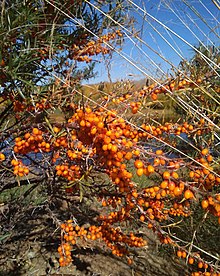
Ripe berries of sea-buckthorn. Selenginsky district, Buryatia, Russia
Hippophae rhamnoides, the common sea buckthorn, is the most widespread of the species in the genus, with the ranges of its eight subspecies extending from the Atlantic coasts of Europe across to northwestern Mongolia and northwestern China. In western Europe, it is largely confined to sea coasts where salt spray off the sea prevents other larger plants from outcompeting it. In central Asia, it is more widespread in dry semi-desert sites where other plants cannot survive the dry conditions.
In central Europe and Asia, it also occurs as a sub-alpine shrub above the tree line in mountains, and other sunny areas such as river banks where it has been used to stabilize erosion. They are tolerant of salt in the air and soil, but demand full sunlight for good growth and do not tolerate shady conditions near larger trees. They typically grow in dry, sandy areas.
More than 90% or about 1,500,000 ha (5,800 sq mi) of the world's natural sea buckthorn habitat is found in China, Mongolia, Russia, northern Europe, and Canada, where the plant is used for soil, water and wildlife conservation, anti-desertification purposes, and consumer products.
Sea buckthorn USDA hardiness zones are about 3 through 7.
Description
The shrubs reach 0.5–6 metres (1.6–19.7 ft) tall, rarely up to 10 metres (33 ft) in central Asia. The leaf arrangement can be alternate or opposite.
Hippophae goniocarpa grows in mountainous regions in Nepal and China on mountain slopes, river banks, flood lands and valley terraces. The growth altitude is typically between 2650 and 3700 m. The species is divided into two distinct subspecies, H. goniocarpa subsp. litangensis and H. goniocarpa subsp. goniocarpa. H. goniocarpa subsp. litangensis differs from the typical subspecies by the young branchlets and the lower surface of leaves. The Latin specific epithet goniocarpa refers to goniocarpus -a -um with angular fruits.[
Hippophae gyantsensis
Hippophae litangensis
Hippophae neurocarpa
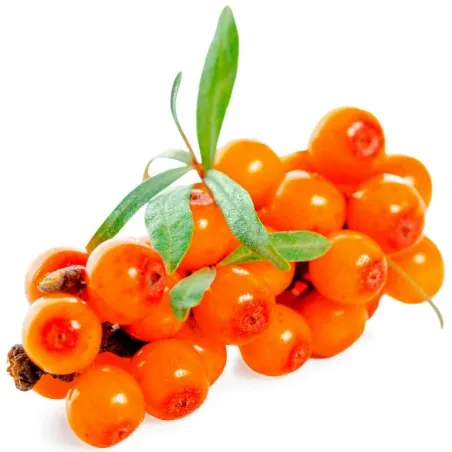
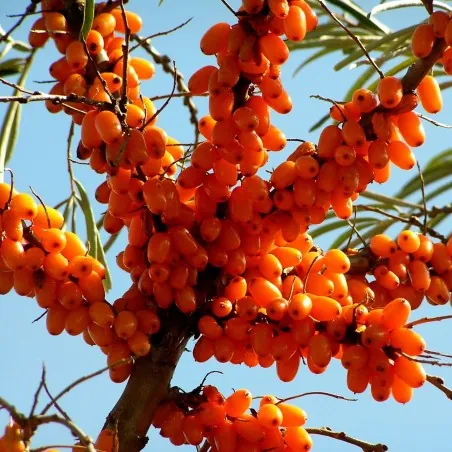
Hippophae rhamnoides: Common sea buckthorn has dense and stiff branches, and are very thorny. The leaves are a distinct pale silvery-green, lanceolate, 3–8 cm (1.2–3.1 in) long, and less than 7 mm (0.28 in) broad. It is dioecious, with separate male and female plants. The male produces brownish flowers which produce wind-distributed pollen. The female plants produce orange berries 6–9 mm (0.24–0.35 in) in diameter, soft, juicy, and rich in oils. The roots distribute rapidly and extensively, providing a nonleguminous nitrogen fixation role in surrounding soils.
Hippophae salicifolia (willow-leaved sea buckthorn) is restricted to the Himalayas, to the south of the common sea buckthorn, growing at high altitudes in dry valleys; it differs from H. rhamnoides in having broader (to 10 mm (0.39 in)) and greener (less silvery) leaves, and yellow berries. A wild variant occurs in the same area, but at even higher altitudes in the alpine zone.[citation needed] It is a low shrub not growing taller than 1 m (3.3 ft) with small leaves 1–3 cm (0.39–1.18 in) long.[citation needed]
Hippophae tibetana
Common sea buckthorn
Varieties
During the Cold War, Russian and East German horticulturists developed new varieties with greater nutritional value, larger berries, different ripening months and branches that are easier to harvest. Over the past 20 years, experimental crops have been grown in the United States, one in Nevada and one in Arizona, and in several provinces of Canada.
Genetics
A study of nuclear ribosomal internal transcribed spacer sequence data showed that the genus can be divided into three clades:
H. tibetana
H. rhamnoides with the exception of H. rhamnoides ssp. gyantsensis (=H. gyantsensis)
remaining species
A study using chloroplast sequences and morphology,[7] however, recovered only two clades:
H. tibetana, H. gyantsensis, H. salicifolia, H. neurocarpa
H. rhamnoides
Natural history
The fruit is an important winter food resource for some birds, notably fieldfares.[citation needed]
Leaves are eaten by the larva of the coastal race of the ash pug moth and by larvae of other Lepidoptera, including brown-tail, dun-bar, emperor moth, mottled umber, and Coleophora elaeagnisella.
Uses
Common sea buckthorn
Products
Sea buckthorn berries are edible and nutritious, though astringent, sour, and oily unless 'bletted' (frosted to reduce the astringency) and/or mixed as a drink with sweeter substances such as apple or grape juice. Additionally, malolactic fermentation of sea buckthorn juice reduces sourness, enhancing its sensory properties. The mechanism behind this change is transformation of malic acid into lactic acid in microbial metabolism.
When the berries are pressed, the resulting sea buckthorn juice separates into three layers: on top is a thick, orange cream; in the middle, a layer containing sea buckthorn's characteristic high content of saturated and polyunsaturated fats; and the bottom layer is sediment and juice. Containing fat sources applicable for cosmetic purposes, the upper two layers can be processed for skin creams and liniments, whereas the bottom layer can be used for edible products such as syrup.
Besides juice, sea buckthorn fruit can be used to make pies, jams, lotions, teas, fruit wines, and liquors.[4] The juice or pulp has other potential applications in foods, beverages, or cosmetics products.[4] Fruit drinks were among the earliest sea buckthorn products developed in China. Sea buckthorn-based juice is common in Germany and Scandinavian countries. It provides a beverage rich in vitamin C and carotenoids.
For its troops confronting low winter temperatures (see Siachen), India's Defence Research Development Organization established a factory in Leh to manufacture a multivitamin herbal beverage based on sea buckthorn juice.
The seed and pulp oils have nutritional properties that vary under different processing methods.[16] Sea buckthorn oils are used as a source for ingredients in several commercially available cosmetic products and nutritional supplements.
Landscape uses
Sea buckthorn may be used as a landscaping shrub with an aggressive basal shoot system used for barrier hedges and windbreaks, and to stabilize riverbanks and steep slopes.[4] They have value in northern climates for their landscape qualities, as the colorful berry clusters are retained through winter.[4][5][17] Branches may be used by florists for designing ornaments.
In northwestern China, sea buckthorn shrubs have been planted on the bottoms of dry riverbeds to increase water retention of the soil, thus decreasing sediment loss.[4] Because of increased moisture conservation of the soil and nitrogen-fixing capabilities of sea buckthorn, vegetation levels have increased in areas where sea buckthorn have been planted.[18][19] Sea buckthorn was once distributed free of charge to Canadian prairie farmers by PFRA to be used in shelterbelts.[20]
Folk medicine and research
Sea buckthorn has been used over centuries in traditional medicine.[4] Although seabuckthorn fruit extracts are under preliminary research for their pharmacological effects, there is no high-quality clinical evidence for the ability of Hippophae products to lower the risk of human diseases,[21] and are not approved as prescription drugs by any national regulatory agency, as of 2019. Berry oil from seeds or fruit pulp, either taken orally as a dietary supplement or applied topically, is believed to be a skin softener or medicine, but there is inadequate clinical evidence of its effectiveness.[21] There have been no systematic studies of toxicity and safety for any Hippophae product.[21] The fruit of sea buckthorn contains very high amounts of oxalic acid, as well as small amounts of vitamin B12, which is rare in plants.[22]
Organizations
In 2005, the "EAN-Seabuck" network between European Union states, China, Russia and New Independent States was funded by the European Commission to promote sustainable crop and consumer product development. In Mongolia, there is an active National Association of Seabuckthorn Cultivators and Producers.
The International Seabuckthorn Association, formerly the International Center for Research and Training on Seabuckthorn (ICRTS), was formed jointly in 1988 by the China Research and Training Center on Seabuckthorn, the Seabuckthorn Office of the Yellow River Water Commission, and the Shaanxi Seabuckthorn Development Office. From 1995 to 2000, ICRTS published the research journal, Hippophae, which appears to be no longer active.
Sowing Instructions
Propagation:
Seeds
Pretreat:
soak in water for 24 hours
Stratification:
3 months in moist sowing mix at 2-5 ° C refrigerator
Czy jesteś pewien, że chcesz zgłosić ten komentarz?
Zgłoszenie wysłane
Twój komentarz został wysłany i będzie widoczny po zatwierdzeniu przez moderatora.
Twoje zgłoszenie nie może zostać wysłane
Napisz swoją opinię
Recenzja została wysłana
Twój komentarz został dodany i będzie widoczny jak tylko zatwierdzi go moderator.
Twoja recenzja nie może być wysłana
🌍 Wysyłka na cały świat z UE
Wysyłamy na cały świat z Unii Europejskiej za pośrednictwem zarejestrowanej poczty lotniczej z wymaganym podpisem przy odbiorze.
📦 Śledzenie zamówienia
Aby znaleźć swój numer śledzenia, zaloguj się na swoje konto i przejdź do: Historia zamówień > Szczegóły. Twój numer śledzenia znajduje się bezpośrednio w szczegółach zamówienia.
Będziesz otrzymywać powiadomienia e-mail na każdym etapie zamówienia.
Jeśli nie widzisz tych wiadomości, sprawdź folder Spam/Wiadomości śmieci lub skontaktuj się ze swoim dostawcą e-mail. Alternatywnie poszukaj w Internecie informacji, jak odblokować wiadomości e-mail od nadawcy.
NASZ SERWIS E-MAIL DZIAŁA — Jeśli nie otrzymujesz wiadomości e-mail, prawdopodobnie jest to problem z Twoim dostawcą poczty lub ustawieniami.
📧 Jak zapewnić, aby e-maile z naszego sklepu internetowego zawsze trafiały do Twojej skrzynki odbiorczej
Aby zapobiec oznaczaniu naszych wiadomości jako spam, dodaj nasz adres e-mail do swoich kontaktów:
Otwórz Gmail (lub innego dostawcę) i znajdź e-mail od nas (xxxxxxxxxxxx@xxx.com).
Najedź kursorem na nazwę lub adres e-mail nadawcy.
Kliknij ikonę „Dodaj do kontaktów” (ikonka małej osoby).
Nie możemy Ci pomóc, jeśli Twoje ustawienia nie są skonfigurowane w ten sposób. Skontaktuj się ze swoim dostawcą e-mail, aby uzyskać pomoc.
Alternatywnie utwórz filtr w Gmailu:
Otwórz Gmail i przejdź do Ustawienia > Zobacz wszystkie ustawienia.
Przejdź do karty Filtry i zablokowane adresy.
Kliknij Utwórz nowy filtr i wpisz nasz adres e-mail.
Zaznacz Nigdy nie wysyłaj do spamu i kliknij Utwórz filtr.
📍 Śledź swoją paczkę
Twój numer śledzenia znajduje się w szczegółach zamówienia. Możesz śledzić swoje zamówienie za pośrednictwem następujących platform:
Podczas składania zamówienia zawsze podawaj ważny numer telefonu komórkowego z numerem kierunkowym kraju (np. +48 601 234 567).
NIE zamawiaj do skrytek pocztowych (P.O. Boxes) ani jeśli nie możesz być w domu, aby podpisać odbiór paczki. Paczek nie można zostawiać u sąsiadów.
Jeśli paczka wysłana do skrytki pocztowej zaginie lub nie zostanie doręczona, zwrot pieniędzy nie zostanie przyznany.
⚖️ Odpowiedzialność klienta za zgodność z prawem
Klient jest odpowiedzialny za upewnienie się, że produkt może być legalnie importowany do jego kraju, w tym za przestrzeganie wszystkich przepisów importowych, uzyskanie niezbędnych zezwoleń oraz opłacenie obowiązujących ceł, podatków i innych opłat. Przed złożeniem zamówienia sprawdź lokalne przepisy.
🔄 Paczki zagubione, zwrócone i ponowna wysyłka
Klienci z Brazylii i Meksyku: Nie możemy zwrócić pieniędzy za paczki zagubione lub zniszczone przez urząd celny.
Jeśli Twoja paczka zostanie zwrócona, zwrócimy tylko koszt produktu — koszty wysyłki nie podlegają zwrotowi.
Opłatę za zwrot (2 €) oraz wszelkie koszty ponownej wysyłki musi pokryć klient.
🚚 Dostawa przesyłki
Przesyłki polecone wymagają podpisu.
Jeśli śledzenie pokazuje, że paczka nadal znajduje się w placówce początkowej, oznacza to, że jest w drodze — skontaktuj się ze swoim lokalnym urzędem pocztowym, aby uzyskać aktualne informacje.
Niestety, ani my, ani poczta, za pośrednictwem której wysłano zamówienie, nie możemy pomóc w ustaleniu, gdzie dokładnie znajduje się paczka. Gdy zobaczysz, że paczka jest w Twoim kraju, MUSISZ skontaktować się ze swoją pocztą, podając numer śledzenia.
⏱️ Opcje dostawy i szacowany czas
Opcja dostawy
Czas przetwarzania
Uwagi
Priority Delivery
Wysyłka w ciągu 1–7 dni roboczych
Priorytetowe przetwarzanie; możliwe opóźnienia w okresie świątecznym (3–10 dni)
Secured Delivery
Wysyłka w ciągu 1–7 dni roboczych
Dostępne dla zamówień do 150 €; zwrot pieniędzy w przypadku zagubienia
Standard Delivery
Wysyłka w ciągu 7–10 dni roboczych
Bardziej ekonomiczna; możliwe opóźnienia w okresie świątecznym (7–14 dni)
Szacowany czas dostawy:
Wewnątrz UE: 3–20 dni
Reszta świata: 5–30 dni
Uwaga: Czas dostawy zależy od Twojej lokalizacji i lokalnego systemu pocztowego. COVID-19 lub sezony świąteczne mogą powodować dodatkowe opóźnienia.
💰 Koszty wysyłki
Koszty wysyłki i obsługi są obliczane automatycznie podczas składania zamówienia na podstawie wagi paczki i miejsca przeznaczenia.
⏰ Godziny przetwarzania zamówień
Nie przetwarzamy ani nie wysyłamy zamówień w soboty i niedziele.
💳 Opcje płatności
Chcielibyśmy poinformować o ważnej zmianie dotyczącej opłat za płatności. Niestety, ze względu na wyjątkowo wysokie opłaty transakcyjne nakładane przez PayPal, jesteśmy zmuszeni doliczać dopłatę do płatności dokonywanych za pośrednictwem ich serwisu.
Mamy jednak dla Ciebie rozwiązanie! Możesz uniknąć tych astronomicznych opłat, wybierając jedną z naszych alternatywnych metod płatności z PROWIZJĄ 0%:
✅ Płatność kartą kredytową/debetową – 0% prowizji
✅ Przelew bankowy – 0% prowizji
Przelew bankowy (SEPA / IBAN / SWIFT-BIC): W opisie płatności podaj numer referencyjny zamówienia. Zamówienia nieopłacone w ciągu 4 dni zostaną automatycznie anulowane.
PayPal: Płatności są akceptowane wyłącznie w euro. Prosimy o wybranie euro podczas finalizacji zakupu.
Płatność kartą: Akceptujemy karty Visa, MasterCard, American Express, CB, Diners Club, Discover, China UnionPay, JCB i Discover.
⚠️ Opłaty transakcyjne
Klienci są odpowiedzialni za wszelkie bankowe lub transakcyjne opłaty PayPal.
📝 Uwagi końcowe
Przed złożeniem zamówienia zawsze sprawdzaj naszą stronę internetową pod kątem specjalnych ogłoszeń, harmonogramów świątecznych lub określonych warunków wysyłki.