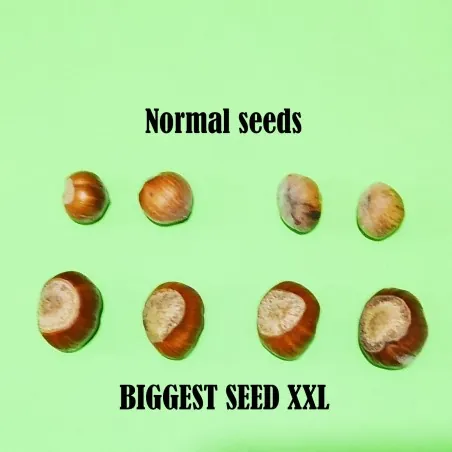
A hazelnut is the nut of the hazel and is also known as cobnut or filbert nut according to species. A cob is roughly spherical to oval, about 15–25 mm long and 10–15 mm in diameter, with an outer fibrous husk
A hazelnut is the nut of the hazel and is also known as cobnut or filbert nut according to species. A cob is roughly spherical to oval, about 15–25 mm long and 10–15 mm in diameter, with an outer fibrous husk surrounding a smooth shell. A filbert is more elongated, being about twice as long as it is round. The nut falls out of the husk when ripe, about seven to eight months after pollination. The kernel of the seed is edible and used raw or roasted, or ground into a paste. Hazelnuts are also used for livestock feed, as are chestnuts and acorns. The seed has a thin, dark brown skin, which is sometimes removed before cooking.
Hazelnuts are produced in commercial quantities in Turkey, Italy, Greece, Georgia, in south of the Spanish region of Catalonia, in the UK county of Kent and in the American states of Oregon and Washington. Turkey is the largest producer of hazelnuts in the world with approximately 75% of worldwide production.
Hazelnuts are used in confectionery to make praline, and also used in combination with chocolate for chocolate truffles and products such as Nutella and Frangelico liqueur. Hazelnut oil, pressed from hazelnuts, is strongly flavoured and used as a cooking oil.
Hazelnuts are rich in protein and unsaturated fat. Moreover, they contain significant amounts of thiamine and vitamin B6, as well as smaller amounts of other B vitamins.
Historical cultivation
In 1995, evidence of large-scale Mesolithic nut processing, some 9,000 years old, was found in a midden pit on the island of Colonsay in Scotland. The evidence consists of a large, shallow pit full of the remains of hundreds of thousands of burned hazelnut shells. Hazelnuts have been found on other Mesolithic sites, but rarely in such quantities or concentrated in one pit. The nuts were radiocarbon dated to 7720+/-110BP, which calibrates to circa 7000 BC. Similar sites in Britain are known only at Farnham in Surrey and Cass ny Hawin on the Isle of Man.[2][3] See also Sruwaddacon Bay, Kilcommon, Erris, County Mayo, Ireland.
This discovery gives an insight into communal activity and planning in the period. The nuts were harvested in a single year, and pollen analysis suggests the hazel trees were all cut down at the same time.[3] The scale of the activity, unparalleled elsewhere in Scotland, and the lack of large game on the island, suggest the possibility that Colonsay contained a community with a largely vegetarian diet for the time they spent on the island. The pit was originally on a beach close to the shore, and was associated with two smaller, stone-lined pits whose function remains obscure, a hearth, and a second cluster of pits.[2]
Because hazelnuts do not generally need to be toasted, indeed Kentish Cobnuts are still traditionally sold fresh, it has been speculated this was done to make them more digestible for children. Toasting the nuts was thought to increase how long they would keep, and they have historically been a useful food for mariners because they keep well.
Hazel has been grown historically in coppices for use in wattle and daub buildings, and in hedges. The Romans cultivated hazelnuts including in Britain, although there is no evidence that they spread specific cultivars. Cultivated varieties have been grown since at least the 16th century, with a great increase in varieties during the 1800s. In particular, the first really widespread cultivar, the Kentish Cobnut, was introduced in 1830.
The traditional method to increase nut production is called 'brutting', which involves prompting more of the trees' energy to go into flower bud production, by snapping but not breaking off the tips of the new year's shoots six or seven leaf groups from the join with the trunk or branch, at the end of the growing season. The traditional term for an area of cultivated hazelnuts is a plat.
Modern cultivation
The harvesting of hazelnuts is done either by hand or by manual or mechanical raking of fallen nuts. Common hazel is widely cultivated for its nuts, including in commercial orchards in Europe, Turkey, Iran and the Caucasus. The name "hazelnut" applies to the nuts of any of the species of the genus Corylus. This hazelnut, the kernel of the seed, is edible and used raw or roasted, or ground into a paste. The seed has a thin, dark brown skin, which has a bitter flavour and is sometimes removed before cooking.
The top producer of hazelnuts, by a large margin, is Turkey, specifically Ordu and Giresun Province. Turkish hazelnut production of 625,000 tonnes accounts for approximately 75% of worldwide production.[5]
In North America: in the United States, hazelnut production is concentrated in Oregon; they are also grown extensively just to the north, in the Fraser Valley of British Columbia, Canada. In 1996, the in-shell production in Oregon was about 19,900 tons (18,000 tonnes), compared to 100 tons (91 tonnes) in Washington. The hazelnut is growing in popularity in the U.S., where the Hazelnut Marketing Board was established in 1949 by Federal Hazelnut Marketing Order section 982.
Hazelnuts are also found in the Pangi Valley of Chamba district in India, where they are known as thangi.
Cultivars
The many cultivars of the hazel include: 'Barcelona', 'Butler', 'Casina', 'Clark' 'Cosford', 'Daviana', 'Delle Langhe', 'England', 'Ennis', 'Fillbert', 'Halls Giant', 'Jemtegaard', 'Kent Cob', 'Lewis', 'Tokolyi', 'Tonda Gentile', 'Tonda di Giffoni', 'Tonda Romana', 'Wanliss Pride', and 'Willamette'.[6] Some of these are grown for specific qualities of the nut; these qualities include large nut size and early- and late-fruiting cultivars, whereas others are grown as pollinators. The majority of commercial hazelnuts are propagated from root sprouts.[6] Some cultivars are of hybrid origin between common hazel and filbert.[7] One cultivar grown in Washington state, the 'DuChilly', has an elongated appearance, a thinner and less bitter skin, and a distinctly sweeter flavor than other varieties.
Turkish hazelnut
Turkish hazelnuts are not to be confused with the wild hazelnut of Turkey, Corylus colurna.
Harvesting
Hazelnuts are harvested annually in midautumn. As autumn comes to a close, the trees drop their nuts and leaves. Most commercial growers wait for the nuts to drop on their own, rather than use equipment to shake them from the tree.
Four primary pieces of equipment are used in commercial harvesting: the sweeper, the harvester, the nut cart and the forklift. The sweeper moves the nuts into the center of the rows, the harvester lifts and separates the nuts from any debris (i.e. twigs and leaves), the nut cart holds the nuts picked up by the harvester, and the forklift brings a tote to offload the nuts from the nut cart and then stacks the totes to be shipped to the processor (nut dryer). The sweeper is a low-to-the-ground machine that makes two passes in each tree row. It has a 2 m belt attached to the front that rotates to sweep leaves, nuts, and small twigs from left to right, depositing the material in the row's center as it drives forward. On the rear of the sweeper is a powerful blower to blow material left into the adjacent row with air speeds up to 90 m/s. Careful grooming during the year and patient blowing at harvest can eliminate the need for hand raking around the trunk of the tree, where nuts can accumulate. The sweeper prepares a single center row of nuts narrow enough for the harvesting tractor to drive over without driving on the center row. It is best to only sweep a few rows ahead of the harvesters at any given time, to prevent the tractor that drives the harvester from crushing the nuts that may still be falling from the trees. Hazelnut orchards may be harvested up to three times during the harvest season, depending on the quantity of nuts in the trees and the rate of nut drop as a result of weather.
The harvester is a slow-moving machine pulled by a tractor, which lifts the material off the ground and separates the nuts from the leaves, empty husks, and twigs. As the harvester drives over the rows, a rotating cylinder with hundreds of tines rakes the material onto a belt. The belt takes the material over a blower and under a powerful vacuum that sucks the lightweight dirt and leaves from the nuts, and discharges it into the orchard. The remaining nuts are conveyed into a nut cart pulled behind the harvester. Once a tote is filled with nuts, the forklift will haul away the full totes and bring empties back to the harvester to maximize the harvester's time.
Two different timing strategies are used for collecting the fallen nuts. The first is to harvest early when approximately half of the nuts have fallen. With less material on the ground, the harvester can work faster with less chance of a breakdown. The second option is to wait for all the nuts to fall before harvesting. Though the first option is considered the better of the two,[10] two or three passes do take more time to complete than one. Weather must also be a consideration. Rain inhibits harvest and should a farmer wait for all the nuts to fall after a rainy season, it becomes much more difficult to harvest. Pickup also varies with how many acres are being farmed and the number of sweepers, harvesters, nut carts and forklifts available.
A dry orchard can be dusty, so equipment operators should wear breathing protection. Conversely, if it is too wet, mud cakes in the machinery and moisture weighs down the material, making it impossible for the equipment to function without picking up large quantities of mud.
Culinary uses
Hazelnuts are used in confectionery to make some pralines, in chocolate for some chocolate truffles, and in hazelnut paste products. In Austria (especially Vienna), hazelnut paste is an ingredient in the making of tortes (such as Viennese hazelnut torte) which are famous there. In Kiev cake, hazelnut flour is used to flavor its meringue body, and crushed hazelnuts are sprinkled over its sides. Dacquoise, a French dessert cake, often contains a layer of hazelnut meringue. Hazelnut is a primary ingredient of the vodka-based liqueur frangelico. Hazelnuts are used abundantly in Turkish cuisine especially on the Pontic coast of Anatolia. In Georgian cuisine, traditional snack churchkhela and sauce satsivi are often cooked with hazelnuts (along with walnuts).[11]
Hazelnut-flavoured coffee seems (to many users) to be slightly sweetened and less acidic, though the nut is low in natural saccharides.[citation needed] The reason for such perception is not yet understood.
Over 2,000 tonnes are imported annually into Australia, mostly to supply the demand from the Cadbury-Schweppes company. Hazelnut oil pressed from hazelnuts is strongly flavoured and used as a cooking oil.
Common hazel plants are eaten by these species of Lepidoptera.
Health benefits
Hazelnuts have a significant place among the types of dried nuts in terms of nutrition and health because of the composition of fats (primarily oleic acid), protein, carbohydrates, vitamins (vitamin E), minerals, dietary fibers, phytosterol (beta-sitosterol), and antioxidant phenolics[13] such as flavan-3-ols.
Aprecierea ta pentru recenzie nu a putut fi trimisa
Reclama un comentariu
Sigur doresti sa raportezi acest comentariu?
Raport trimis
Comentariul tau a fost inregistrat si va fi examinat de un moderator.
Reclamatia tau nu a putut fi trimisa
Recenzia a fost trimisa
Comentariul dumeavoastra a fost inregistrat si va fi vizibil de indata ce va fi aprobat de un moderator.
Recenzia ta nu a putut fi trimisa
🌍 Wysyłka na cały świat z UE
Wysyłamy na cały świat z Unii Europejskiej za pośrednictwem zarejestrowanej poczty lotniczej z wymaganym podpisem przy odbiorze.
📦 Śledzenie zamówienia
Aby znaleźć swój numer śledzenia, zaloguj się na swoje konto i przejdź do: Historia zamówień > Szczegóły. Twój numer śledzenia znajduje się bezpośrednio w szczegółach zamówienia.
Będziesz otrzymywać powiadomienia e-mail na każdym etapie zamówienia.
Jeśli nie widzisz tych wiadomości, sprawdź folder Spam/Wiadomości śmieci lub skontaktuj się ze swoim dostawcą e-mail. Alternatywnie poszukaj w Internecie informacji, jak odblokować wiadomości e-mail od nadawcy.
NASZ SERWIS E-MAIL DZIAŁA — Jeśli nie otrzymujesz wiadomości e-mail, prawdopodobnie jest to problem z Twoim dostawcą poczty lub ustawieniami.
📧 Jak zapewnić, aby e-maile z naszego sklepu internetowego zawsze trafiały do Twojej skrzynki odbiorczej
Aby zapobiec oznaczaniu naszych wiadomości jako spam, dodaj nasz adres e-mail do swoich kontaktów:
Otwórz Gmail (lub innego dostawcę) i znajdź e-mail od nas (xxxxxxxxxxxx@xxx.com).
Najedź kursorem na nazwę lub adres e-mail nadawcy.
Kliknij ikonę „Dodaj do kontaktów” (ikonka małej osoby).
Nie możemy Ci pomóc, jeśli Twoje ustawienia nie są skonfigurowane w ten sposób. Skontaktuj się ze swoim dostawcą e-mail, aby uzyskać pomoc.
Alternatywnie utwórz filtr w Gmailu:
Otwórz Gmail i przejdź do Ustawienia > Zobacz wszystkie ustawienia.
Przejdź do karty Filtry i zablokowane adresy.
Kliknij Utwórz nowy filtr i wpisz nasz adres e-mail.
Zaznacz Nigdy nie wysyłaj do spamu i kliknij Utwórz filtr.
📍 Śledź swoją paczkę
Twój numer śledzenia znajduje się w szczegółach zamówienia. Możesz śledzić swoje zamówienie za pośrednictwem następujących platform:
Podczas składania zamówienia zawsze podawaj ważny numer telefonu komórkowego z numerem kierunkowym kraju (np. +48 601 234 567).
NIE zamawiaj do skrytek pocztowych (P.O. Boxes) ani jeśli nie możesz być w domu, aby podpisać odbiór paczki. Paczek nie można zostawiać u sąsiadów.
Jeśli paczka wysłana do skrytki pocztowej zaginie lub nie zostanie doręczona, zwrot pieniędzy nie zostanie przyznany.
⚖️ Odpowiedzialność klienta za zgodność z prawem
Klient jest odpowiedzialny za upewnienie się, że produkt może być legalnie importowany do jego kraju, w tym za przestrzeganie wszystkich przepisów importowych, uzyskanie niezbędnych zezwoleń oraz opłacenie obowiązujących ceł, podatków i innych opłat. Przed złożeniem zamówienia sprawdź lokalne przepisy.
🔄 Paczki zagubione, zwrócone i ponowna wysyłka
Klienci z Brazylii i Meksyku: Nie możemy zwrócić pieniędzy za paczki zagubione lub zniszczone przez urząd celny.
Jeśli Twoja paczka zostanie zwrócona, zwrócimy tylko koszt produktu — koszty wysyłki nie podlegają zwrotowi.
Opłatę za zwrot (2 €) oraz wszelkie koszty ponownej wysyłki musi pokryć klient.
🚚 Dostawa przesyłki
Przesyłki polecone wymagają podpisu.
Jeśli śledzenie pokazuje, że paczka nadal znajduje się w placówce początkowej, oznacza to, że jest w drodze — skontaktuj się ze swoim lokalnym urzędem pocztowym, aby uzyskać aktualne informacje.
Niestety, ani my, ani poczta, za pośrednictwem której wysłano zamówienie, nie możemy pomóc w ustaleniu, gdzie dokładnie znajduje się paczka. Gdy zobaczysz, że paczka jest w Twoim kraju, MUSISZ skontaktować się ze swoją pocztą, podając numer śledzenia.
⏱️ Opcje dostawy i szacowany czas
Opcja dostawy
Czas przetwarzania
Uwagi
Priority Delivery
Wysyłka w ciągu 1–7 dni roboczych
Priorytetowe przetwarzanie; możliwe opóźnienia w okresie świątecznym (3–10 dni)
Secured Delivery
Wysyłka w ciągu 1–7 dni roboczych
Dostępne dla zamówień do 150 €; zwrot pieniędzy w przypadku zagubienia
Standard Delivery
Wysyłka w ciągu 7–10 dni roboczych
Bardziej ekonomiczna; możliwe opóźnienia w okresie świątecznym (7–14 dni)
Szacowany czas dostawy:
Wewnątrz UE: 3–20 dni
Reszta świata: 5–30 dni
Uwaga: Czas dostawy zależy od Twojej lokalizacji i lokalnego systemu pocztowego. COVID-19 lub sezony świąteczne mogą powodować dodatkowe opóźnienia.
💰 Koszty wysyłki
Koszty wysyłki i obsługi są obliczane automatycznie podczas składania zamówienia na podstawie wagi paczki i miejsca przeznaczenia.
⏰ Godziny przetwarzania zamówień
Nie przetwarzamy ani nie wysyłamy zamówień w soboty i niedziele.
💳 Opcje płatności
Chcielibyśmy poinformować o ważnej zmianie dotyczącej opłat za płatności. Niestety, ze względu na wyjątkowo wysokie opłaty transakcyjne nakładane przez PayPal, jesteśmy zmuszeni doliczać dopłatę do płatności dokonywanych za pośrednictwem ich serwisu.
Mamy jednak dla Ciebie rozwiązanie! Możesz uniknąć tych astronomicznych opłat, wybierając jedną z naszych alternatywnych metod płatności z PROWIZJĄ 0%:
✅ Płatność kartą kredytową/debetową – 0% prowizji
✅ Przelew bankowy – 0% prowizji
Przelew bankowy (SEPA / IBAN / SWIFT-BIC): W opisie płatności podaj numer referencyjny zamówienia. Zamówienia nieopłacone w ciągu 4 dni zostaną automatycznie anulowane.
PayPal: Płatności są akceptowane wyłącznie w euro. Prosimy o wybranie euro podczas finalizacji zakupu.
Płatność kartą: Akceptujemy karty Visa, MasterCard, American Express, CB, Diners Club, Discover, China UnionPay, JCB i Discover.
⚠️ Opłaty transakcyjne
Klienci są odpowiedzialni za wszelkie bankowe lub transakcyjne opłaty PayPal.
📝 Uwagi końcowe
Przed złożeniem zamówienia zawsze sprawdzaj naszą stronę internetową pod kątem specjalnych ogłoszeń, harmonogramów świątecznych lub określonych warunków wysyłki.


Comentarii (0)
Aprecierea ta pentru recenzie nu a putut fi trimisa
Reclama un comentariu
Raport trimis
Reclamatia tau nu a putut fi trimisa