Black pepper (Piper nigrum) is a flowering vine in the family Piperaceae, cultivated for its fruit, which is usually dried and used as a spice and seasoning. When dried, the fruit is known as a peppercorn. When
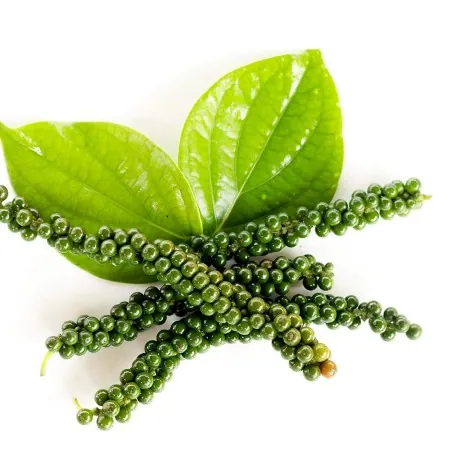
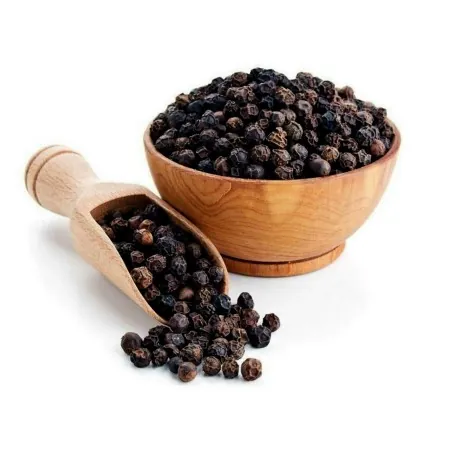
Black pepper (Piper nigrum) is a flowering vine in the family Piperaceae, cultivated for its fruit, which is usually dried and used as a spice and seasoning. When dried, the fruit is known as a peppercorn. When fresh and fully mature, it is approximately 5 millimeters (0.20 in) in diameter, dark red, and, like all drupes, contains a single seed. Peppercorns, and the ground pepper derived from them, maybe described simply as pepper, or more precisely as black pepper (cooked and dried unripe fruit), green pepper (dried unripe fruit) and white pepper (ripe fruit seeds).
Black pepper is native to south India and is extensively cultivated there and elsewhere in tropical regions. Currently, Vietnam is the world's largest producer and exporter of pepper, producing 34% of the world's Piper nigrum crop as of 2013.
Dried ground pepper has been used since antiquity for both its flavor and as traditional medicine. Black pepper is the world's most traded spice. It is one of the most common spices added to cuisines around the world. The spiciness of black pepper is due to the chemical piperine, not to be confused with the capsaicin characteristic of fresh hot peppers. Black pepper is ubiquitous in the modern world as a seasoning and is often paired with salt.
Etymology
The word "pepper" has its roots in the Dravidian word for long pepper, pippali.[2][3][4] Ancient Greek and Latin turned pippali into the Greek πέπερι peperi and then into the Latin piper, which was used by the Romans to refer both to black pepper and long pepper, as the Romans erroneously believed that both of these spices were derived from the same plant.[5] Today's "pepper" derives from the Old English pipor. The Latin word is also the source of Romanian piper, Italian pepe, Dutch peper, German Pfeffer, French poivre, and other similar forms.
In the 16th century, pepper started referring to the unrelated New World chili pepper as well. "Pepper" was used in a figurative sense to mean "spirit" or "energy" at least as far back as the 1840s; in the early 20th century, this was shortened to pep.
Black pepper
Black pepper is produced from the still-green, unripe drupes of the pepper plant. The drupes are cooked briefly in hot water, both to clean them and to prepare them for drying. The heat ruptures cell walls in the pepper, speeding the work of browning enzymes during drying. The drupes are dried in the sun or by machine for several days, during which the pepper around the seed shrinks and darkens into a thin, wrinkled black layer. Once dried, the spice is called black peppercorn. On some estates, the berries are separated from the stem by hand and then sun-dried without the boiling process.
Once the peppercorns are dried, pepper spirit and oil can be extracted from the berries by crushing them. Pepper spirit is used in many medicinal and beauty products. Pepper oil is also used as an ayurvedic massage oil and used in certain beauty and herbal treatments.
Plant
The pepper plant is a perennial woody vine growing up to 4 meters (13 ft) in height on supporting trees, poles, or trellises. It is a spreading vine, rooting readily where trailing stems touch the ground. The leaves are alternate, entire, 5 to 10 centimetres (2.0 to 3.9 in) long and 3 to 6 centimetres (1.2 to 2.4 in) across. The flowers are small, produced on pendulous spikes 4 to 8 centimetres (1.6 to 3.1 in) long at the leaf nodes, the spikes lengthening up to 7 to 15 centimetres (2.8 to 5.9 in) as the fruit matures.[15] The fruit of the black pepper is called a drupe and when dried is known as a peppercorn.
Pepper can be grown in soil that is neither too dry nor susceptible to flooding, moist, well-drained and rich in organic matter (the vines do not do too well over an altitude of 900 m (3,000 ft) above sea level). The plants are propagated by cuttings about 40 to 50 centimetres (16 to 20 in) long, tied up to neighbouring trees or climbing frames at distances of about 2 metres (6 ft 7 in) apart; trees with rough bark are favoured over those with smooth bark, as the pepper plants climb rough bark more readily. Competing plants are cleared away, leaving only sufficient trees to provide shade and permit free ventilation. The roots are covered in leaf mulch and manure, and the shoots are trimmed twice a year. On dry soils the young plants require watering every other day during the dry season for the first three years. The plants bear fruit from the fourth or fifth year, and typically continue to bear fruit for seven years. The cuttings are usually cultivars, selected both for yield and quality of fruit.
A single stem will bear 20 to 30 fruiting spikes. The harvest begins as soon as one or two fruits at the base of the spikes begin to turn red, and before the fruit is fully mature, and still hard; if allowed to ripen completely, the fruit lose pungency, and ultimately fall off and are lost. The spikes are collected and spread out to dry in the sun, then the peppercorns are stripped off the spikes.[15]
Black pepper is either native to Southeast Asia[16] or South Asia.[17] Within the genus Piper, it is most closely related to other Asian species such as Piper caninum.
History
Pepper is native to South Asia and Southeast Asia and has been known to Indian cooking since at least 2000 BCE.[20] J. Innes Miller notes that while pepper was grown in southern Thailand and in Malaysia, its most important source was India, particularly the Malabar Coast, in what is now the state of Kerala[21] Peppercorns were a much-prized trade good, often referred to as "black gold" and used as a form of commodity money. The legacy of this trade remains in some Western legal systems which recognize the term "peppercorn rent" as a form of a token payment made for something that is in fact being given.
The ancient history of black pepper is often interlinked with (and confused with) that of long pepper, the dried fruit of closely related Piper longum. The Romans knew of both and often referred to either as just "piper". In fact, it was not until the discovery of the New World and of chili peppers that the popularity of long pepper entirely declined. Chili peppers, some of which when dried are similar in shape and taste to long pepper, were easier to grow in a variety of locations more convenient to Europe.
Before the 16th century, pepper was being grown in Java, Sunda, Sumatra, Madagascar, Malaysia, and everywhere in Southeast Asia. These areas traded mainly with China, or used the pepper locally.[22] Ports in the Malabar area also served as a stop-off point for much of the trade in other spices from farther east in the Indian Ocean. Following the British hegemony in India, virtually all of the black pepper found in Europe, the Middle East, and North Africa was traded from Malabar region.
Ancient times
Black peppercorns were found stuffed in the nostrils of Ramesses II, placed there as part of the mummification rituals shortly after his death in 1213 BCE.[23] Little else is known about the use of pepper in ancient Egypt and how it reached the Nile from South Asia.
Pepper (both long and black) was known in Greece at least as early as the 4th century BCE, though it was probably an uncommon and expensive item that only the very rich could afford. Trade routes of the time were by land, or in ships which hugged the coastlines of the Arabian Sea. Long pepper, growing in the north-western part of India, was more accessible than the black pepper from further south; this trade advantage, plus long pepper's greater spiciness, probably made black pepper less popular at the time.
By the time of the early Roman Empire, especially after Rome's conquest of Egypt in 30 BCE, open-ocean crossing of the Arabian Sea direct to southern India's Malabar Coast was near routine. Details of this trading across the Indian Ocean have been passed down in the Periplus of the Erythraean Sea. According to the Roman geographer Strabo, the early Empire sent a fleet of around 120 ships on an annual one-year trip to China, Southeast Asia, India and back. The fleet timed its travel across the Arabian Sea to take advantage of the predictable monsoon winds. Returning from India, the ships travelled up the Red Sea, from where the cargo was carried overland or via the Nile-Red Sea canal to the Nile River, barged to Alexandria, and shipped from there to Italy and Rome. The rough geographical outlines of this same trade route would dominate the pepper trade into Europe for a millennium and a half to come.
With ships sailing directly to the Malabar coast, black pepper was now travelling a shorter trade route than long pepper, and the prices reflected it. Pliny the Elder's Natural History tells us the prices in Rome around 77 CE: "Long pepper ... is fifteen denarii per pound, while that of white pepper is seven, and of black, four." Pliny also complains "there is no year in which India does not drain the Roman Empire of fifty million sesterces," and further moralizes on pepper:
It is quite surprising that the use of pepper has come so much into fashion, seeing that in other substances which we use, it is sometimes their sweetness, and sometimes their appearance that has attracted our notice; whereas, pepper has nothing in it that can plead as a recommendation to either fruit or berry, its only desirable quality being a certain pungency; and yet it is for this that we import it all the way from India! Who was the first to make trial of it as an article of food? and who, I wonder, was the man that was not content to prepare himself by hunger only for the satisfying of a greedy appetite?
Black pepper was a well-known and widespread, if expensive, seasoning in the Roman Empire. Apicius' De re coquinaria, a 3rd-century cookbook probably based at least partly on one from the 1st century CE, includes pepper in a majority of its recipes. Edward Gibbon wrote, in The History of the Decline and Fall of the Roman Empire, that pepper was "a favorite ingredient of the most expensive Roman cookery".
Phytochemicals, folk medicine, and research
Like many eastern spices, pepper was historically both a seasoning and a folk medicine. Long pepper, being stronger, was often the preferred medication, but both were used. Black pepper (or perhaps long pepper) was believed to cure several illnesses, such as constipation, insomnia, oral abscesses, sunburn and toothaches, among others.[35] Various sources from the 5th century onward recommended pepper to treat eye problems, often by applying salves or poultices made with pepper directly to the eye. There is no current medical evidence that any of these treatments has any benefit.
Pepper is known to cause sneezing. Some sources say that piperine, a substance present in black pepper, irritates the nostrils, causing the sneezing.[37] Few, if any, controlled studies have been carried out to answer the question.
Piperine is under study for its potential to increase absorption of selenium, vitamin B, beta-carotene and curcumin, as well as other compounds.[38] As a folk medicine, pepper appears in the Buddhist Samaññaphala Sutta, chapter five, as one of the few medicines allowed to be carried by a monk.[39] Pepper contains phytochemicals,[40] including amides, piperidines, pyrrolidines and trace amounts of safrole which may be carcinogenic in laboratory rodents.
Piperine is under study for a variety of possible physiological effects,[42] although this work is preliminary and mechanisms of activity for piperine in the human body remain unknown.
Nutrition
One tablespoon (6 grams) of ground black pepper contains moderate amounts of vitamin K (13% of the daily value or DV), iron (10% DV) and manganese (18% DV), with trace amounts of other essential nutrients, protein and dietary fibre.
Flavor
Pepper gets its spicy heat mostly from piperine derived both from the outer fruit and the seed. Black pepper contains between 4.6% and 9.7% piperine by mass, and white pepper slightly more than that.[44] Refined piperine, by weight, is about one percent as hot as the capsaicin found in chili peppers.[45] The outer fruit layer, left on black pepper, also contains important odour-contributing terpenes including pinene, sabinene, limonene, caryophyllene, and linalool, which give citrusy, woody, and floral notes. These scents are mostly missing in white pepper, which is stripped of the fruit layer. White pepper can gain some different odours (including musty notes) from its longer fermentation stage.[46] The aroma of pepper is attributed to rotundone (3,4,5,6,7,8-Hexahydro-3α,8α-dimethyl-5α-(1-methylethenyl)azulene-1(2H)-one), a sesquiterpene originally discovered in the tubers of cyperus rotundus, which can be detected in concentrations of 0.4 nanograms/L in water and in wine: rotundone is also present in marjoram, oregano, rosemary, basil, thyme, and geranium, as well as in some Shiraz wines.
Pepper loses flavour and aroma through evaporation, so airtight storage helps preserve its spiciness longer. Pepper can also lose flavour when exposed to light, which can transform piperine into nearly tasteless isochavicine. Once ground, pepper's aromatics can evaporate quickly; most culinary sources recommend grinding whole peppercorns immediately before use for this reason. Handheld pepper mills or grinders, which mechanically grind or crush whole peppercorns, are used for this, sometimes instead of pepper shakers that dispense pre-ground pepper. Spice mills such as pepper mills were found in European kitchens as early as the 14th century, but the mortar and pestle used earlier for crushing pepper have remained a popular method for centuries as well.
Na tento produkt momentálně není přidána žádná recenze.
Vaše hodnocení nelze odeslat
Nahlásit komentář
Opravdu chcete nahlásit tento komentář?
Zpráva odeslána
Váš podnět byl odeslán a bude ho posuzovat moderátor.
Váš podnět nelze odeslat
Zkontrolovat před odesláním
Váš komentář byl přidán a bude zobrazen po schválení moderátorem.
Vaši recenzi nelze odeslat
🌍 Wereldwijde verzending vanuit de EU
Wij verzenden wereldwijd vanuit de Europese Unie via aangetekende luchtpost met handtekening voor ontvangst bij levering.
📦 Uw bestelling volgen
Om uw trackingnummer te vinden, logt u in op uw account en gaat u naar: Bestelgeschiedenis > Details. Uw trackingnummer bevindt zich direct in de bestelgegevens.
U ontvangt e-mailmeldingen voor elke fase van uw bestelling.
Als u deze berichten niet ziet, controleer dan uw map Spam/Ongewenste e-mail of neem contact op met uw e-mailprovider. Zoek anders online naar hoe u e-mails van afzenders kunt deblokkeren.
ONZE E-MAILSERVICE WERKT — Als u geen e-mails ontvangt, ligt dit waarschijnlijk aan uw e-mailprovider of instellingen.
📧 Hoe u ervoor zorgt dat e-mails van onze webshop altijd in uw inbox terechtkomen
Om te voorkomen dat onze e-mails als spam worden gemarkeerd, voegt u ons e-mailadres toe aan uw contacten:
Open Gmail (of een andere provider) en zoek een e-mail van ons (xxxxxxxxxxxx@xxx.com).
Beweeg de muis over de naam of het e-mailadres van de afzender.
Klik op het icoon "Toevoegen aan contacten" (het poppetje).
We kunnen u niet helpen als uw instellingen niet zo staan. Neem contact op met uw e-mailprovider voor hulp.
Als alternatief kunt u een filter maken in Gmail:
Open Gmail en ga naar Instellingen > Alle instellingen bekijken.
Ga naar het tabblad Filters en geblokkeerde adressen.
Klik op Nieuw filter maken en voer ons e-mailadres in.
Vink Nooit naar Spam verzenden aan en klik op Filter maken.
📍 Uw pakket volgen
Uw trackingnummer staat in uw bestelgegevens. U kunt uw bestelling volgen via de volgende platforms:
Geef bij het bestellen altijd een geldig mobiel nummer op met landnummer (bijv. +31 6 1234 5678).
Bestel NIET naar postbussen (P.O. Boxes) of als u niet thuis kunt zijn om voor het pakket te tekenen. Pakketten kunnen niet bij de buren worden afgegeven.
Als een pakket dat naar een postbus is verzonden verloren gaat of niet wordt bezorgd, vindt er geen terugbetaling plaats.
⚖️ Verantwoordelijkheid van de klant voor wettelijke naleving
De klant is verantwoordelijk om ervoor te zorgen dat het product legaal in zijn land mag worden geïmporteerd, inclusief naleving van alle importvoorschriften, het verkrijgen van de nodige vergunningen en de betaling van toepasselijke douanerechten, belastingen en andere kosten. Controleer uw lokale wetgeving voordat u bestelt.
🔄 Verloren, geretourneerde en opnieuw verzonden pakketten
Klanten uit Brazilië en Mexico: We kunnen geen pakketten terugbetalen die door de douane zijn verloren of vernietigd.
Als uw pakket wordt geretourneerd, betalen we alleen de productkosten terug — verzendkosten worden niet gerestitueerd.
Retourkosten (€2) en eventuele kosten voor opnieuw verzenden zijn voor rekening van de klant.
🚚 Levering van de zending
Aangetekende zendingen vereisen een handtekening.
Als de tracking aangeeft dat het pakket nog op het postkantoor van herkomst is, is het onderweg — neem contact op met uw lokale postkantoor voor updates.
Helaas kunnen wij, noch het postkantoor waardoor uw bestelling is verzonden, u helpen met de vraag waar uw bestelling zich precies bevindt. Wanneer u ziet dat het pakket in uw land is, MOET u contact opnemen met uw postkantoor met het trackingnummer.
⏱️ Leveringsopties & geschatte tijden
Leveringsoptie
Verwerkingstijd
Opmerkingen
Priority Delivery
Verzonden binnen 1–7 werkdagen
Prioriteit bij orderverwerking; vertragingen mogelijk tijdens feestdagen (3–10 dagen)
Secured Delivery
Verzonden binnen 1–7 werkdagen
Beschikbaar voor bestellingen tot €150; terugbetaling bij verlies
Standard Delivery
Verzonden binnen 7–10 werkdagen
Voordeliger; vertragingen mogelijk tijdens feestdagen (7–14 dagen)
Geschatte levertijden:
Binnen de EU: 3–20 dagen
Wereldwijd: 5–30 dagen
Opmerking: Levertijden zijn afhankelijk van uw locatie en het lokale postsysteem. COVID-19 of feestdagen kunnen extra vertraging veroorzaken.
💰 Verzendkosten
Verzend- en administratiekosten worden automatisch berekend bij het afrekenen op basis van het gewicht van het pakket en de bestemming.
⏰ Verwerkingstijden
Wij verwerken of verzenden geen bestellingen op zaterdag of zondag.
💳 Betalingsmogelijkheden
Wij willen u informeren over een belangrijke wijziging met betrekking tot de betalingskosten. Helaas zijn wij, vanwege de uitzonderlijk hoge transactiekosten die PayPal in rekening brengt, genoodzaakt een toeslag toe te passen voor betalingen die via hun service worden gedaan.
We hebben echter een oplossing voor u! U kunt deze astronomische kosten vermijden door te kiezen voor een van onze alternatieve betaalmethoden met NUL COMMISSIE:
✅ Creditcard/Betaalpas betaling – 0% Kosten
✅ Bankoverschrijving – 0% Kosten
Bankoverschrijving (SEPA / IBAN / SWIFT-BIC): Vermeld uw bestelreferentie in de betalingsomschrijving. Bestellingen zonder betaling binnen 4 dagen worden automatisch geannuleerd.
PayPal: Betalingen worden alleen in Euro geaccepteerd. Selecteer Euro tijdens het afrekenen.
Kaartbetaling: Wij accepteren Visa, MasterCard, American Express, CB, Diners Club, Discover, China UnionPay, JCB en Discover.
⚠️ Transactiekosten
Klanten zijn verantwoordelijk voor eventuele bank- of PayPal-transactiekosten.
📝 Slotopmerkingen
Controleer voor het plaatsen van uw bestelling altijd onze website voor speciale mededelingen, vakantieschema's of specifieke verzendvoorwaarden.


Komentáře (0)
Vaše hodnocení nelze odeslat
Nahlásit komentář
Zpráva odeslána
Váš podnět nelze odeslat