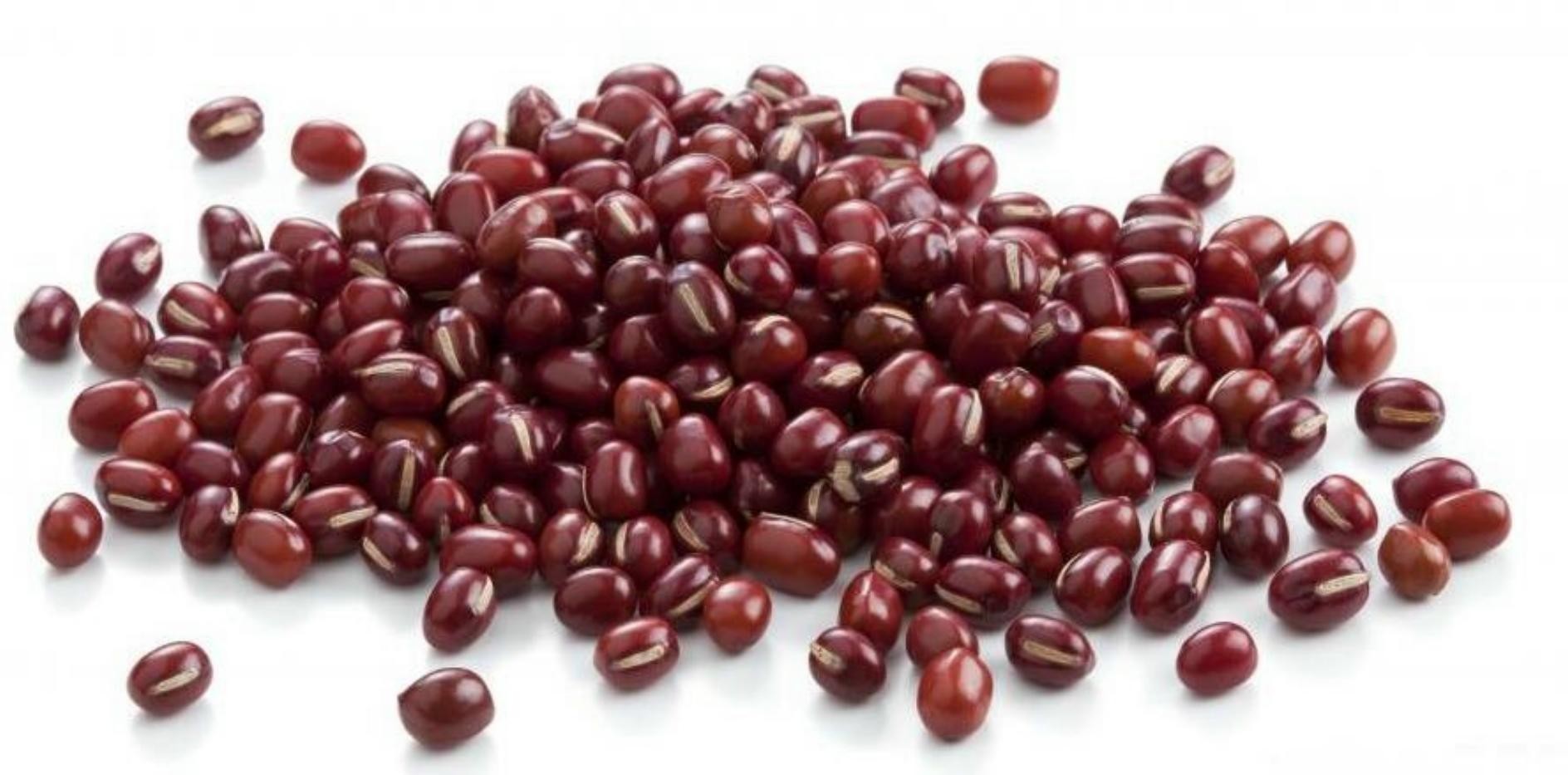
The adzuki bean (Vigna angularis; from the Japanese アズキ(小豆) (azuki?), sometimes transliterated as azuki or aduki, or English Red Mung Bean) is an annual vine widely grown throughout East Asia and the Himalayas for its small (approximately 5 mm) bean. The cultivars most familiar in Northeast Asia have a uniform red colour, however, white
The adzuki bean (Vigna angularis; from the Japanese アズキ(小豆) (azuki?), sometimes transliterated as azuki or aduki, or English Red Mung Bean) is an annual vine widely grown throughout East Asia and the Himalayas for its small (approximately 5 mm) bean. The cultivars most familiar in Northeast Asia have a uniform red colour, however, white, black, gray, and variously mottled varieties also are known. Scientists presume Vigna angularis var. nipponensis is the progenitor.
Speciation and domestication
The wild ancestor of cultivated adzuki bean is probably Vigna angularis var. nipponensis,[1] which is distributed across Japan, Korea, China, Nepal and Bhutan.[2] Speciation between Vigna angularis var. nipponensis and Vigna angularis var. angularis occurred around 50,000 years ago.[3] Archaeologists estimate it was domesticated around 3000 BCE.[4] However, adzuki beans (as well as soy beans) dating from 3000 BCE to 2000 BCE are indicated to still be largely within the wild size range. Enlarged seeds occurred during the later Bronze Age or Iron Age, periods with plough use.[5] Domestication of adzuki beans resulted in a trade-off between yield and seed size. Cultivated adzuki beans have fewer but longer pods, fewer but larger seeds and a shorter stature, but also a smaller overall seed yield than wild forms. The exact place of domestication is not known, multiple domestication origins in northeast Asia (for example Japan, China, and Korea) have been suggested.
Breeding
In Japan, the adzuki bean was one of the first crops subjected to scientific plant breeding.
Important breeding traits are yield, pureness of the bean colour and the maturing time.[6] Separate cultivars with smaller seeds and higher biomass are bred for fodder production and as green manure.[6] Locally adapted cultivars are available in China, Japan, Korea and Taiwan.[7] More than 300 cultivars/landraces/breeding lines are registered in Japan.
Moreover, China (Institute of Crop Germplasm Resources (CAAS), Beijing, more than 3700 accessions) and Japan (Tokachi Agricultural Experiment Station, Hokkaido-ken, about 2500 accessions) accommodate large germplasm collections of adzuki bean.
Weed forms
Furthermore, also weed forms of adzuki bean are frequently occurring in Japan. The wide spread of weed forms is due to adaptation to human-disturbed habitats, escapes of old cultivars, natural establishment from derivatives of hybrids between cultivars and wild forms.[1] In contrast to wild forms, the weed forms of adzuki bean are used as a substitute for the cultivated form and consumed as sweet beans, especially if cultivated adzuki beans are attacked by pests. However, in cultivated gardens the weed form is recognized as contamination and lowers seed quality of adzuki cultivars.
Names
The name adzuki is a transliteration of the native Japanese name. Japanese also has a Chinese loanword, shōzu (小豆?), which means "small bean", its counterpart "large bean" (大豆 daizu?) being the soybean. It is common to write 小豆 in kanji but pronounce it as azuki About this sound listen (help·info), an example of jukujikun.
In China, the corresponding name (Chinese: 小豆; pinyin: xiǎodòu) still is used in botanical or agricultural parlance, however, in everyday Chinese, the more common terms are hongdou (紅豆; hóngdòu) and chidou (赤豆; chìdòu), both meaning "red bean", because almost all Chinese cultivars are uniformly red. In English-language discussions of Chinese topics, the term "red bean" often is used (especially in reference to red bean paste), but in other contexts this usage may cause confusion with other beans that also are red. In normal contexts, "red cowpeas" have been used to refer to this bean.
The Korean name is pat (hangul: 팥), and in Vietnamese it is called đậu đỏ (literally: red bean). In some parts of India, they are referred to as "Red Chori".[8] In Punjabi it is called "ravaa'n" and is a common ingredient of chaat. In Marathi, it is known as Lal Chavali (लाल चवळी)- literally meaning 'red cowpea'. In Iraq its name is (لوبيا حمره) and that mean "red cowpeas".
Cultivation
Area and yield
The adzuki bean is mainly cultivated in China (670,000 ha), Japan (60,000 ha), South Korea (25,000 ha) and Taiwan (15,000 ha) (data published 2006).[7] Additionally, commercial growth takes place in the US, South America and India,[9] as well as New Zealand, Kongo and Angola.
In Japan, the adzuki bean is the second most important legume after soy bean, an annual yield of around 100,000t (data published 1998) is reached.[6] With a consumption of about 140,000 t/year (data published 2006), Japan is as well the most important importer of adzuki bean.[7] The imports are received from China, Korea, Columbia, Taiwan, US, Thailand and Canada.
The bean yields per area spread over a broad range due to differing cultivation intensity. Amounts of 4 to 8 dt/ha are reported. But in Japan and China also bean yields between 20 and 30 dt/ha are reached.
Ecological requirements
Optimal temperature range for adzuki bean growth is between 15 °C and 30 °C. The crop is not frost-hardy and needs soil temperatures above 6-10 °C (30°-34 °C optimal) for germination. Hot temperatures stimulate vegetative growth and are therefore less favorable for pea production.[6][7][9] The adzuki bean is usually not irrigated. Annual rainfall ranges from 500–1750 mm in areas where the bean is grown. The plant can withstand drought but severe reduction in yield is expected.[6][7] The cultivation of the adzuki bean is possible on preferably well drained soils with pH 5-7.5.[7][9] Fertilizer application differs widely depending on expected yield but is generally similar to soybean. Due to nodulation with rhizobia nitrogen fixation of up to 100 kg/ha is possible.
Production
The sowing of the peas is in 2–3 cm depth in rows 30–90 cm apart and 10–45 cm within the row. Rarely seeds are sown by broadcast. The amount of seeds ranges between 8–70 kg/ha. Growth of the crop is slow, therefore weed control is crucial mainly between germination and flowering. Cultivation systems differ largely among different countries. In China adzuki bean is often grown in intercrops with maize, sorghum and millet while in Japan the bean is grown in crop rotations. Harvest of the peas should not be done as long as moisture content of the seed is higher than 16%.
Pests and diseases
Fungal and bacterial diseases of the adzuki bean are powdery mildew, brown stem rot and bacterial blight. Furthermore, pests as adzuki pod worm, Japanese butterbur borer and cutworm attack the crop. Bean weevil is an important storage pest.
Botany
The description of the adzuki bean can vary between authors because there are wild [10] and cultivated forms [6] of the plant. The adzuki bean is an annual,[7][10] rarely biennial [6] bushy erect or twining herb [7][10] usually between 30 and 90 centimeters high.[10][11] There exist climbing or prostrate forms of the plant.[7] The stem is normally green [11] and sparsely pilose.
Roots
The adzuki bean has a taproot type of root system that can reach a depth of 40–50 cm from the point of seed germination.
Leaves
The leaves of the adzuki bean are trifoliate, pinnate and arranged alternately along the stem on a long petiole. Leaflets are ovate and about 5–10 cm long and 5–8 cm wide.
Flowers
Adzuki flowers are papilionaceous and bright yellow. The inflorescence is an axillary false raceme consisting of six to ten (two to twenty) flowers.
Fruits
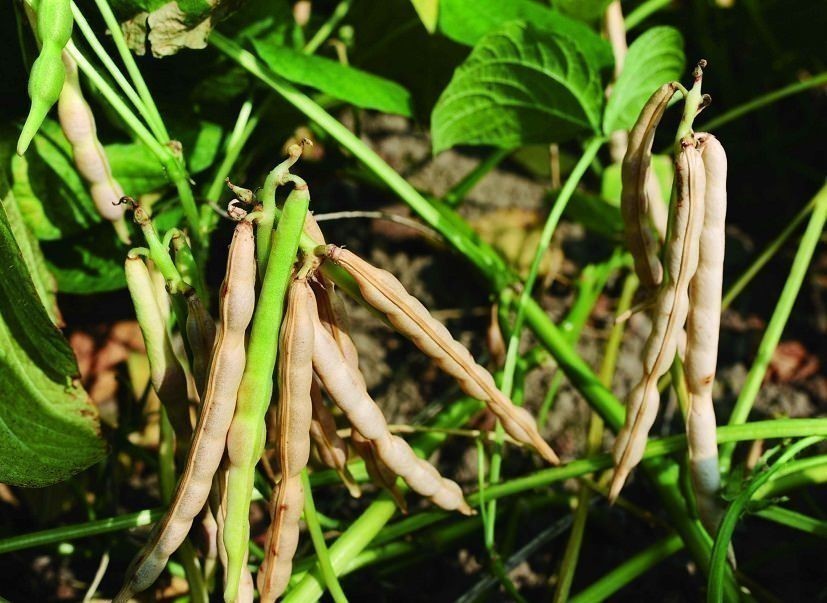
Adzuki pods are smooth, cylindrical and thin-walled. The colour of the pods is green turning white to grey as they mature. The size is between 5–13 cm x 0.5 cm with 2 to 14 seeds per pod. Pod shatter during seed ripening and harvesting might be a difficulty under certain conditions.
Seeds
The seeds are smooth and subcylindric with a length of 5.0-9.1 mm, width of 4.0-6.3 mm, thickness of 4.1-6.0 mm. The thousand kernel weight is between 50 and 200 g. There are many different seed colours from maroon to blue-black mottled with straw.
Uses
In East Asian cuisine, the adzuki bean is commonly sweetened before eating. In particular, it often is boiled with sugar, resulting in red bean paste (anko), a very common ingredient in all of these cuisines. It also is common to add flavoring to the bean paste, such as chestnut.
Red bean paste is used in many Chinese dishes, such as tangyuan, zongzi, mooncakes, baozi, and red bean ice. It also serves as a filling in Japanese sweets such as anpan, dorayaki, imagawayaki, manjū, monaka, anmitsu, taiyaki, and daifuku. A more liquid version, using adzuki beans boiled with sugar and a pinch of salt, produces a sweet dish called red bean soup. Adzuki beans commonly are eaten sprouted, or boiled in a hot, tea-like drink. Some Asian cultures enjoy red bean paste as a filling or topping for various kinds of waffles, pastries, baked buns, or biscuits.
Traditionally in Japan, rice with adzuki beans (赤飯; sekihan) is cooked for auspicious occasions. Adzuki beans are used in amanattō and ice cream with the whole bean (such as in the 'Cream & Red Bean' product produced by IMEI) or as paste.
On October 20, 2009, Pepsi Japan released an adzuki-flavored Pepsi product.
Adzuki beans, along with butter and sugar, form the basis of the Somali supper dish cambuulo. In Gujarat, India, they are known as chori.[8] In Malaysia and Singapore, red beans are a major component of the dessert Ais kacang.
Uw beoordelingswaardering kan niet worden verzonden
Rapporteer reactie
Bent u zeker dat u deze opmerking wil rapporteren?
Melding verzonden
Uw opmerking is ingediend en zal door een beheerder worden behandeld.
Uw opmerking kan niet worden verzonden
Schrijf uw recensie
Beoordeling verstuurd
Uw beoordeling is toegevoegd en wordt beschikbaar zodra deze is goedgekeurd.
Uw beoordeling kan niet worden verzonden
🌍 Wereldwijde verzending vanuit de EU
Wij verzenden wereldwijd vanuit de Europese Unie via aangetekende luchtpost met handtekening voor ontvangst bij levering.
📦 Uw bestelling volgen
Om uw trackingnummer te vinden, logt u in op uw account en gaat u naar: Bestelgeschiedenis > Details. Uw trackingnummer bevindt zich direct in de bestelgegevens.
U ontvangt e-mailmeldingen voor elke fase van uw bestelling.
Als u deze berichten niet ziet, controleer dan uw map Spam/Ongewenste e-mail of neem contact op met uw e-mailprovider. Zoek anders online naar hoe u e-mails van afzenders kunt deblokkeren.
ONZE E-MAILSERVICE WERKT — Als u geen e-mails ontvangt, ligt dit waarschijnlijk aan uw e-mailprovider of instellingen.
📧 Hoe u ervoor zorgt dat e-mails van onze webshop altijd in uw inbox terechtkomen
Om te voorkomen dat onze e-mails als spam worden gemarkeerd, voegt u ons e-mailadres toe aan uw contacten:
Open Gmail (of een andere provider) en zoek een e-mail van ons (xxxxxxxxxxxx@xxx.com).
Beweeg de muis over de naam of het e-mailadres van de afzender.
Klik op het icoon "Toevoegen aan contacten" (het poppetje).
We kunnen u niet helpen als uw instellingen niet zo staan. Neem contact op met uw e-mailprovider voor hulp.
Als alternatief kunt u een filter maken in Gmail:
Open Gmail en ga naar Instellingen > Alle instellingen bekijken.
Ga naar het tabblad Filters en geblokkeerde adressen.
Klik op Nieuw filter maken en voer ons e-mailadres in.
Vink Nooit naar Spam verzenden aan en klik op Filter maken.
📍 Uw pakket volgen
Uw trackingnummer staat in uw bestelgegevens. U kunt uw bestelling volgen via de volgende platforms:
Geef bij het bestellen altijd een geldig mobiel nummer op met landnummer (bijv. +31 6 1234 5678).
Bestel NIET naar postbussen (P.O. Boxes) of als u niet thuis kunt zijn om voor het pakket te tekenen. Pakketten kunnen niet bij de buren worden afgegeven.
Als een pakket dat naar een postbus is verzonden verloren gaat of niet wordt bezorgd, vindt er geen terugbetaling plaats.
⚖️ Verantwoordelijkheid van de klant voor wettelijke naleving
De klant is verantwoordelijk om ervoor te zorgen dat het product legaal in zijn land mag worden geïmporteerd, inclusief naleving van alle importvoorschriften, het verkrijgen van de nodige vergunningen en de betaling van toepasselijke douanerechten, belastingen en andere kosten. Controleer uw lokale wetgeving voordat u bestelt.
🔄 Verloren, geretourneerde en opnieuw verzonden pakketten
Klanten uit Brazilië en Mexico: We kunnen geen pakketten terugbetalen die door de douane zijn verloren of vernietigd.
Als uw pakket wordt geretourneerd, betalen we alleen de productkosten terug — verzendkosten worden niet gerestitueerd.
Retourkosten (€2) en eventuele kosten voor opnieuw verzenden zijn voor rekening van de klant.
🚚 Levering van de zending
Aangetekende zendingen vereisen een handtekening.
Als de tracking aangeeft dat het pakket nog op het postkantoor van herkomst is, is het onderweg — neem contact op met uw lokale postkantoor voor updates.
Helaas kunnen wij, noch het postkantoor waardoor uw bestelling is verzonden, u helpen met de vraag waar uw bestelling zich precies bevindt. Wanneer u ziet dat het pakket in uw land is, MOET u contact opnemen met uw postkantoor met het trackingnummer.
⏱️ Leveringsopties & geschatte tijden
Leveringsoptie
Verwerkingstijd
Opmerkingen
Priority Delivery
Verzonden binnen 1–7 werkdagen
Prioriteit bij orderverwerking; vertragingen mogelijk tijdens feestdagen (3–10 dagen)
Secured Delivery
Verzonden binnen 1–7 werkdagen
Beschikbaar voor bestellingen tot €150; terugbetaling bij verlies
Standard Delivery
Verzonden binnen 7–10 werkdagen
Voordeliger; vertragingen mogelijk tijdens feestdagen (7–14 dagen)
Geschatte levertijden:
Binnen de EU: 3–20 dagen
Wereldwijd: 5–30 dagen
Opmerking: Levertijden zijn afhankelijk van uw locatie en het lokale postsysteem. COVID-19 of feestdagen kunnen extra vertraging veroorzaken.
💰 Verzendkosten
Verzend- en administratiekosten worden automatisch berekend bij het afrekenen op basis van het gewicht van het pakket en de bestemming.
⏰ Verwerkingstijden
Wij verwerken of verzenden geen bestellingen op zaterdag of zondag.
💳 Betalingsmogelijkheden
Wij willen u informeren over een belangrijke wijziging met betrekking tot de betalingskosten. Helaas zijn wij, vanwege de uitzonderlijk hoge transactiekosten die PayPal in rekening brengt, genoodzaakt een toeslag toe te passen voor betalingen die via hun service worden gedaan.
We hebben echter een oplossing voor u! U kunt deze astronomische kosten vermijden door te kiezen voor een van onze alternatieve betaalmethoden met NUL COMMISSIE:
✅ Creditcard/Betaalpas betaling – 0% Kosten
✅ Bankoverschrijving – 0% Kosten
Bankoverschrijving (SEPA / IBAN / SWIFT-BIC): Vermeld uw bestelreferentie in de betalingsomschrijving. Bestellingen zonder betaling binnen 4 dagen worden automatisch geannuleerd.
PayPal: Betalingen worden alleen in Euro geaccepteerd. Selecteer Euro tijdens het afrekenen.
Kaartbetaling: Wij accepteren Visa, MasterCard, American Express, CB, Diners Club, Discover, China UnionPay, JCB en Discover.
⚠️ Transactiekosten
Klanten zijn verantwoordelijk voor eventuele bank- of PayPal-transactiekosten.
📝 Slotopmerkingen
Controleer voor het plaatsen van uw bestelling altijd onze website voor speciale mededelingen, vakantieschema's of specifieke verzendvoorwaarden.