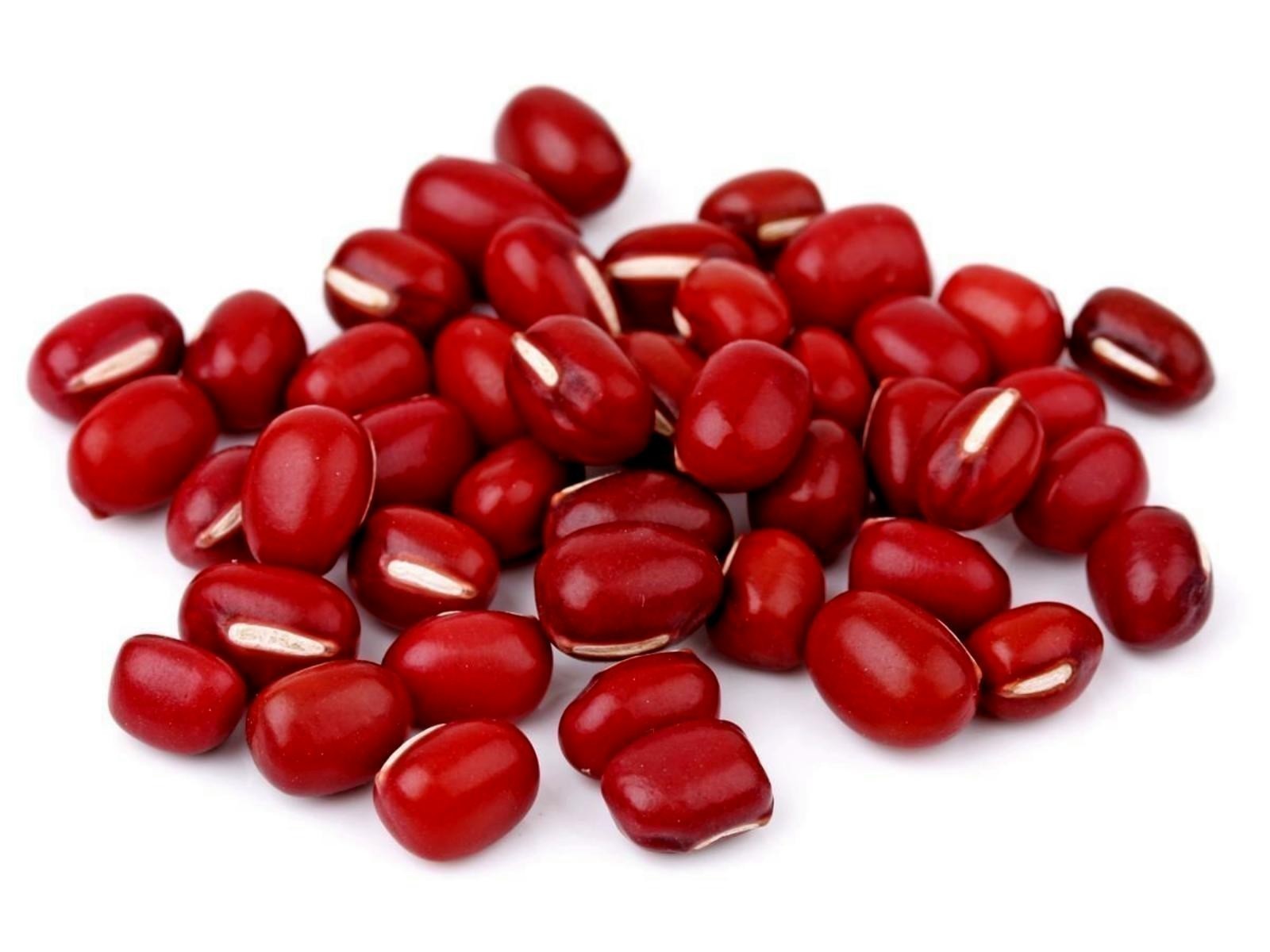
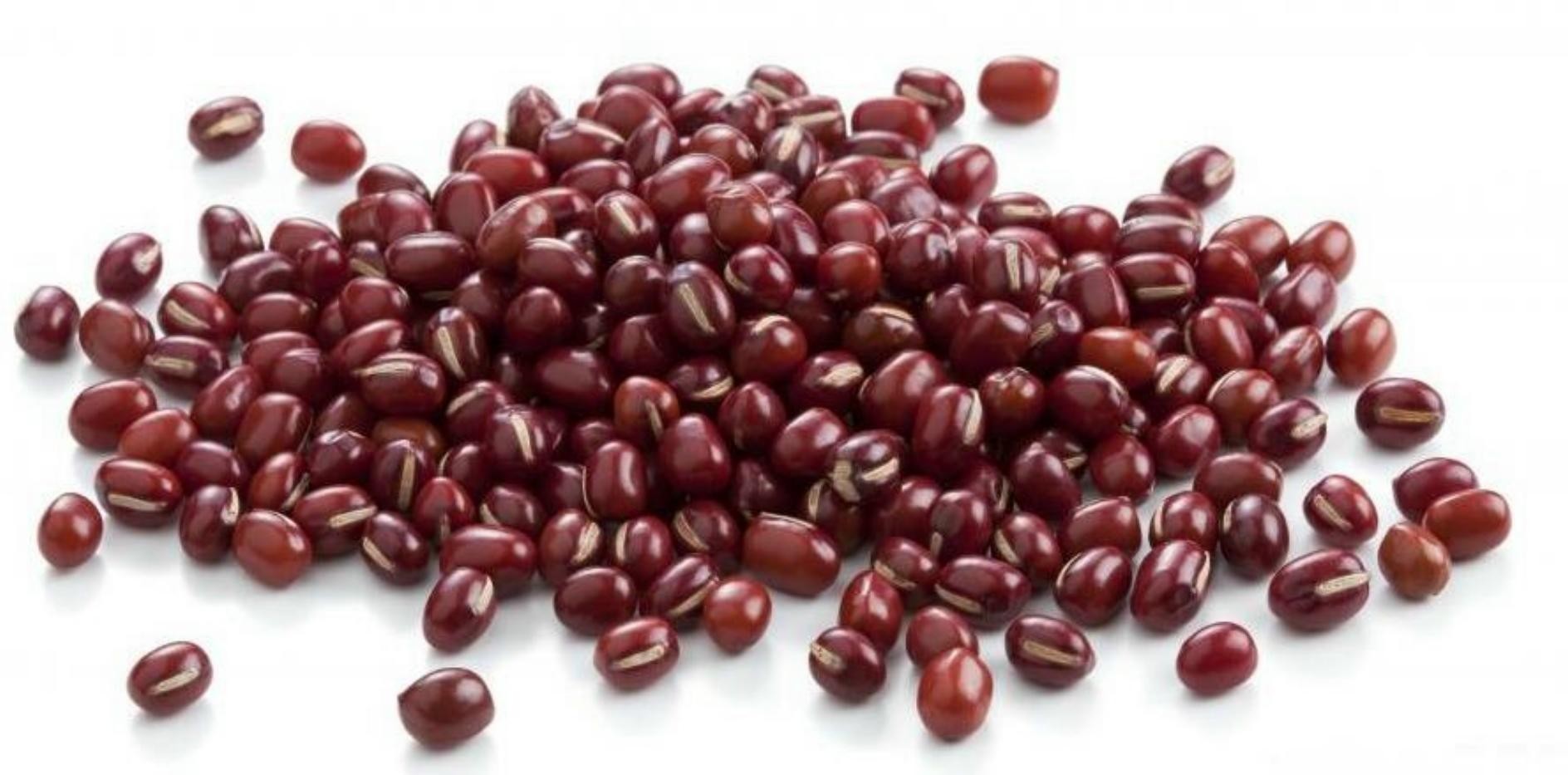
The adzuki bean (Vigna angularis; from the Japanese アズキ(小豆) (azuki?), sometimes transliterated as azuki or aduki, or English Red Mung Bean) is an annual vine widely grown throughout East Asia and the Himalayas for its small (approximately 5 mm) bean. The cultivars most familiar in Northeast Asia have a uniform red colour, however, white
The adzuki bean (Vigna angularis; from the Japanese アズキ(小豆) (azuki?), sometimes transliterated as azuki or aduki, or English Red Mung Bean) is an annual vine widely grown throughout East Asia and the Himalayas for its small (approximately 5 mm) bean. The cultivars most familiar in Northeast Asia have a uniform red colour, however, white, black, gray, and variously mottled varieties also are known. Scientists presume Vigna angularis var. nipponensis is the progenitor.
Speciation and domestication
The wild ancestor of cultivated adzuki bean is probably Vigna angularis var. nipponensis,[1] which is distributed across Japan, Korea, China, Nepal and Bhutan.[2] Speciation between Vigna angularis var. nipponensis and Vigna angularis var. angularis occurred around 50,000 years ago.[3] Archaeologists estimate it was domesticated around 3000 BCE.[4] However, adzuki beans (as well as soy beans) dating from 3000 BCE to 2000 BCE are indicated to still be largely within the wild size range. Enlarged seeds occurred during the later Bronze Age or Iron Age, periods with plough use.[5] Domestication of adzuki beans resulted in a trade-off between yield and seed size. Cultivated adzuki beans have fewer but longer pods, fewer but larger seeds and a shorter stature, but also a smaller overall seed yield than wild forms. The exact place of domestication is not known, multiple domestication origins in northeast Asia (for example Japan, China, and Korea) have been suggested.
Breeding
In Japan, the adzuki bean was one of the first crops subjected to scientific plant breeding.
Important breeding traits are yield, pureness of the bean colour and the maturing time.[6] Separate cultivars with smaller seeds and higher biomass are bred for fodder production and as green manure.[6] Locally adapted cultivars are available in China, Japan, Korea and Taiwan.[7] More than 300 cultivars/landraces/breeding lines are registered in Japan.
Moreover, China (Institute of Crop Germplasm Resources (CAAS), Beijing, more than 3700 accessions) and Japan (Tokachi Agricultural Experiment Station, Hokkaido-ken, about 2500 accessions) accommodate large germplasm collections of adzuki bean.
Weed forms
Furthermore, also weed forms of adzuki bean are frequently occurring in Japan. The wide spread of weed forms is due to adaptation to human-disturbed habitats, escapes of old cultivars, natural establishment from derivatives of hybrids between cultivars and wild forms.[1] In contrast to wild forms, the weed forms of adzuki bean are used as a substitute for the cultivated form and consumed as sweet beans, especially if cultivated adzuki beans are attacked by pests. However, in cultivated gardens the weed form is recognized as contamination and lowers seed quality of adzuki cultivars.
Names
The name adzuki is a transliteration of the native Japanese name. Japanese also has a Chinese loanword, shōzu (小豆?), which means "small bean", its counterpart "large bean" (大豆 daizu?) being the soybean. It is common to write 小豆 in kanji but pronounce it as azuki About this sound listen (help·info), an example of jukujikun.
In China, the corresponding name (Chinese: 小豆; pinyin: xiǎodòu) still is used in botanical or agricultural parlance, however, in everyday Chinese, the more common terms are hongdou (紅豆; hóngdòu) and chidou (赤豆; chìdòu), both meaning "red bean", because almost all Chinese cultivars are uniformly red. In English-language discussions of Chinese topics, the term "red bean" often is used (especially in reference to red bean paste), but in other contexts this usage may cause confusion with other beans that also are red. In normal contexts, "red cowpeas" have been used to refer to this bean.
The Korean name is pat (hangul: 팥), and in Vietnamese it is called đậu đỏ (literally: red bean). In some parts of India, they are referred to as "Red Chori".[8] In Punjabi it is called "ravaa'n" and is a common ingredient of chaat. In Marathi, it is known as Lal Chavali (लाल चवळी)- literally meaning 'red cowpea'. In Iraq its name is (لوبيا حمره) and that mean "red cowpeas".
Cultivation
Area and yield
The adzuki bean is mainly cultivated in China (670,000 ha), Japan (60,000 ha), South Korea (25,000 ha) and Taiwan (15,000 ha) (data published 2006).[7] Additionally, commercial growth takes place in the US, South America and India,[9] as well as New Zealand, Kongo and Angola.
In Japan, the adzuki bean is the second most important legume after soy bean, an annual yield of around 100,000t (data published 1998) is reached.[6] With a consumption of about 140,000 t/year (data published 2006), Japan is as well the most important importer of adzuki bean.[7] The imports are received from China, Korea, Columbia, Taiwan, US, Thailand and Canada.
The bean yields per area spread over a broad range due to differing cultivation intensity. Amounts of 4 to 8 dt/ha are reported. But in Japan and China also bean yields between 20 and 30 dt/ha are reached.
Ecological requirements
Optimal temperature range for adzuki bean growth is between 15 °C and 30 °C. The crop is not frost-hardy and needs soil temperatures above 6-10 °C (30°-34 °C optimal) for germination. Hot temperatures stimulate vegetative growth and are therefore less favorable for pea production.[6][7][9] The adzuki bean is usually not irrigated. Annual rainfall ranges from 500–1750 mm in areas where the bean is grown. The plant can withstand drought but severe reduction in yield is expected.[6][7] The cultivation of the adzuki bean is possible on preferably well drained soils with pH 5-7.5.[7][9] Fertilizer application differs widely depending on expected yield but is generally similar to soybean. Due to nodulation with rhizobia nitrogen fixation of up to 100 kg/ha is possible.
Production
The sowing of the peas is in 2–3 cm depth in rows 30–90 cm apart and 10–45 cm within the row. Rarely seeds are sown by broadcast. The amount of seeds ranges between 8–70 kg/ha. Growth of the crop is slow, therefore weed control is crucial mainly between germination and flowering. Cultivation systems differ largely among different countries. In China adzuki bean is often grown in intercrops with maize, sorghum and millet while in Japan the bean is grown in crop rotations. Harvest of the peas should not be done as long as moisture content of the seed is higher than 16%.
Pests and diseases
Fungal and bacterial diseases of the adzuki bean are powdery mildew, brown stem rot and bacterial blight. Furthermore, pests as adzuki pod worm, Japanese butterbur borer and cutworm attack the crop. Bean weevil is an important storage pest.
Botany
The description of the adzuki bean can vary between authors because there are wild [10] and cultivated forms [6] of the plant. The adzuki bean is an annual,[7][10] rarely biennial [6] bushy erect or twining herb [7][10] usually between 30 and 90 centimeters high.[10][11] There exist climbing or prostrate forms of the plant.[7] The stem is normally green [11] and sparsely pilose.
Roots
The adzuki bean has a taproot type of root system that can reach a depth of 40–50 cm from the point of seed germination.
Leaves
The leaves of the adzuki bean are trifoliate, pinnate and arranged alternately along the stem on a long petiole. Leaflets are ovate and about 5–10 cm long and 5–8 cm wide.
Flowers
Adzuki flowers are papilionaceous and bright yellow. The inflorescence is an axillary false raceme consisting of six to ten (two to twenty) flowers.
Fruits
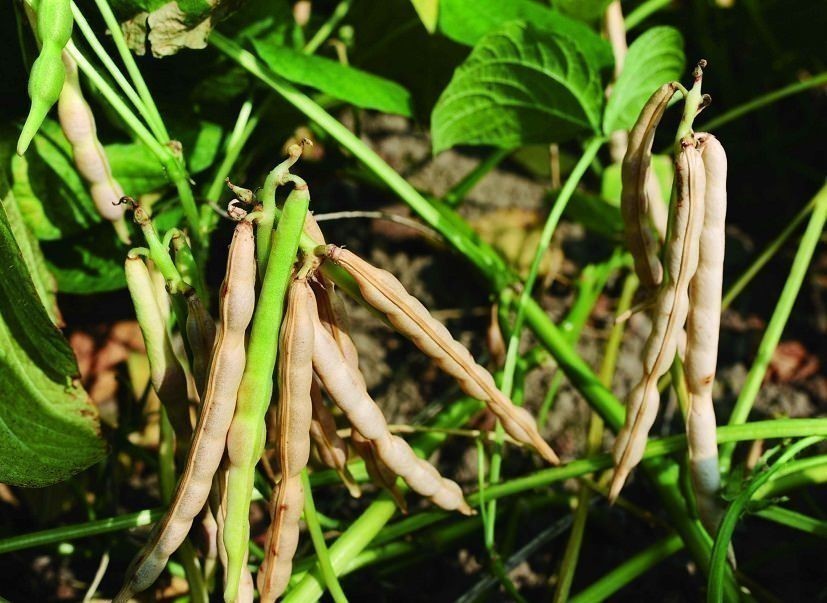
Adzuki pods are smooth, cylindrical and thin-walled. The colour of the pods is green turning white to grey as they mature. The size is between 5–13 cm x 0.5 cm with 2 to 14 seeds per pod. Pod shatter during seed ripening and harvesting might be a difficulty under certain conditions.
Seeds
The seeds are smooth and subcylindric with a length of 5.0-9.1 mm, width of 4.0-6.3 mm, thickness of 4.1-6.0 mm. The thousand kernel weight is between 50 and 200 g. There are many different seed colours from maroon to blue-black mottled with straw.
Uses
In East Asian cuisine, the adzuki bean is commonly sweetened before eating. In particular, it often is boiled with sugar, resulting in red bean paste (anko), a very common ingredient in all of these cuisines. It also is common to add flavoring to the bean paste, such as chestnut.
Red bean paste is used in many Chinese dishes, such as tangyuan, zongzi, mooncakes, baozi, and red bean ice. It also serves as a filling in Japanese sweets such as anpan, dorayaki, imagawayaki, manjū, monaka, anmitsu, taiyaki, and daifuku. A more liquid version, using adzuki beans boiled with sugar and a pinch of salt, produces a sweet dish called red bean soup. Adzuki beans commonly are eaten sprouted, or boiled in a hot, tea-like drink. Some Asian cultures enjoy red bean paste as a filling or topping for various kinds of waffles, pastries, baked buns, or biscuits.
Traditionally in Japan, rice with adzuki beans (赤飯; sekihan) is cooked for auspicious occasions. Adzuki beans are used in amanattō and ice cream with the whole bean (such as in the 'Cream & Red Bean' product produced by IMEI) or as paste.
On October 20, 2009, Pepsi Japan released an adzuki-flavored Pepsi product.
Adzuki beans, along with butter and sugar, form the basis of the Somali supper dish cambuulo. In Gujarat, India, they are known as chori.[8] In Malaysia and Singapore, red beans are a major component of the dessert Ais kacang.
Czy jesteś pewien, że chcesz zgłosić ten komentarz?
Zgłoszenie wysłane
Twój komentarz został wysłany i będzie widoczny po zatwierdzeniu przez moderatora.
Twoje zgłoszenie nie może zostać wysłane
Napisz swoją opinię
Recenzja została wysłana
Twój komentarz został dodany i będzie widoczny jak tylko zatwierdzi go moderator.
Twoja recenzja nie może być wysłana
🌍 Wysyłka na cały świat z UE
Wysyłamy na cały świat z Unii Europejskiej za pośrednictwem zarejestrowanej poczty lotniczej z wymaganym podpisem przy odbiorze.
📦 Śledzenie zamówienia
Aby znaleźć swój numer śledzenia, zaloguj się na swoje konto i przejdź do: Historia zamówień > Szczegóły. Twój numer śledzenia znajduje się bezpośrednio w szczegółach zamówienia.
Będziesz otrzymywać powiadomienia e-mail na każdym etapie zamówienia.
Jeśli nie widzisz tych wiadomości, sprawdź folder Spam/Wiadomości śmieci lub skontaktuj się ze swoim dostawcą e-mail. Alternatywnie poszukaj w Internecie informacji, jak odblokować wiadomości e-mail od nadawcy.
NASZ SERWIS E-MAIL DZIAŁA — Jeśli nie otrzymujesz wiadomości e-mail, prawdopodobnie jest to problem z Twoim dostawcą poczty lub ustawieniami.
📧 Jak zapewnić, aby e-maile z naszego sklepu internetowego zawsze trafiały do Twojej skrzynki odbiorczej
Aby zapobiec oznaczaniu naszych wiadomości jako spam, dodaj nasz adres e-mail do swoich kontaktów:
Otwórz Gmail (lub innego dostawcę) i znajdź e-mail od nas (xxxxxxxxxxxx@xxx.com).
Najedź kursorem na nazwę lub adres e-mail nadawcy.
Kliknij ikonę „Dodaj do kontaktów” (ikonka małej osoby).
Nie możemy Ci pomóc, jeśli Twoje ustawienia nie są skonfigurowane w ten sposób. Skontaktuj się ze swoim dostawcą e-mail, aby uzyskać pomoc.
Alternatywnie utwórz filtr w Gmailu:
Otwórz Gmail i przejdź do Ustawienia > Zobacz wszystkie ustawienia.
Przejdź do karty Filtry i zablokowane adresy.
Kliknij Utwórz nowy filtr i wpisz nasz adres e-mail.
Zaznacz Nigdy nie wysyłaj do spamu i kliknij Utwórz filtr.
📍 Śledź swoją paczkę
Twój numer śledzenia znajduje się w szczegółach zamówienia. Możesz śledzić swoje zamówienie za pośrednictwem następujących platform:
Podczas składania zamówienia zawsze podawaj ważny numer telefonu komórkowego z numerem kierunkowym kraju (np. +48 601 234 567).
NIE zamawiaj do skrytek pocztowych (P.O. Boxes) ani jeśli nie możesz być w domu, aby podpisać odbiór paczki. Paczek nie można zostawiać u sąsiadów.
Jeśli paczka wysłana do skrytki pocztowej zaginie lub nie zostanie doręczona, zwrot pieniędzy nie zostanie przyznany.
⚖️ Odpowiedzialność klienta za zgodność z prawem
Klient jest odpowiedzialny za upewnienie się, że produkt może być legalnie importowany do jego kraju, w tym za przestrzeganie wszystkich przepisów importowych, uzyskanie niezbędnych zezwoleń oraz opłacenie obowiązujących ceł, podatków i innych opłat. Przed złożeniem zamówienia sprawdź lokalne przepisy.
🔄 Paczki zagubione, zwrócone i ponowna wysyłka
Klienci z Brazylii i Meksyku: Nie możemy zwrócić pieniędzy za paczki zagubione lub zniszczone przez urząd celny.
Jeśli Twoja paczka zostanie zwrócona, zwrócimy tylko koszt produktu — koszty wysyłki nie podlegają zwrotowi.
Opłatę za zwrot (2 €) oraz wszelkie koszty ponownej wysyłki musi pokryć klient.
🚚 Dostawa przesyłki
Przesyłki polecone wymagają podpisu.
Jeśli śledzenie pokazuje, że paczka nadal znajduje się w placówce początkowej, oznacza to, że jest w drodze — skontaktuj się ze swoim lokalnym urzędem pocztowym, aby uzyskać aktualne informacje.
Niestety, ani my, ani poczta, za pośrednictwem której wysłano zamówienie, nie możemy pomóc w ustaleniu, gdzie dokładnie znajduje się paczka. Gdy zobaczysz, że paczka jest w Twoim kraju, MUSISZ skontaktować się ze swoją pocztą, podając numer śledzenia.
⏱️ Opcje dostawy i szacowany czas
Opcja dostawy
Czas przetwarzania
Uwagi
Priority Delivery
Wysyłka w ciągu 1–7 dni roboczych
Priorytetowe przetwarzanie; możliwe opóźnienia w okresie świątecznym (3–10 dni)
Secured Delivery
Wysyłka w ciągu 1–7 dni roboczych
Dostępne dla zamówień do 150 €; zwrot pieniędzy w przypadku zagubienia
Standard Delivery
Wysyłka w ciągu 7–10 dni roboczych
Bardziej ekonomiczna; możliwe opóźnienia w okresie świątecznym (7–14 dni)
Szacowany czas dostawy:
Wewnątrz UE: 3–20 dni
Reszta świata: 5–30 dni
Uwaga: Czas dostawy zależy od Twojej lokalizacji i lokalnego systemu pocztowego. COVID-19 lub sezony świąteczne mogą powodować dodatkowe opóźnienia.
💰 Koszty wysyłki
Koszty wysyłki i obsługi są obliczane automatycznie podczas składania zamówienia na podstawie wagi paczki i miejsca przeznaczenia.
⏰ Godziny przetwarzania zamówień
Nie przetwarzamy ani nie wysyłamy zamówień w soboty i niedziele.
💳 Opcje płatności
Chcielibyśmy poinformować o ważnej zmianie dotyczącej opłat za płatności. Niestety, ze względu na wyjątkowo wysokie opłaty transakcyjne nakładane przez PayPal, jesteśmy zmuszeni doliczać dopłatę do płatności dokonywanych za pośrednictwem ich serwisu.
Mamy jednak dla Ciebie rozwiązanie! Możesz uniknąć tych astronomicznych opłat, wybierając jedną z naszych alternatywnych metod płatności z PROWIZJĄ 0%:
✅ Płatność kartą kredytową/debetową – 0% prowizji
✅ Przelew bankowy – 0% prowizji
Przelew bankowy (SEPA / IBAN / SWIFT-BIC): W opisie płatności podaj numer referencyjny zamówienia. Zamówienia nieopłacone w ciągu 4 dni zostaną automatycznie anulowane.
PayPal: Płatności są akceptowane wyłącznie w euro. Prosimy o wybranie euro podczas finalizacji zakupu.
Płatność kartą: Akceptujemy karty Visa, MasterCard, American Express, CB, Diners Club, Discover, China UnionPay, JCB i Discover.
⚠️ Opłaty transakcyjne
Klienci są odpowiedzialni za wszelkie bankowe lub transakcyjne opłaty PayPal.
📝 Uwagi końcowe
Przed złożeniem zamówienia zawsze sprawdzaj naszą stronę internetową pod kątem specjalnych ogłoszeń, harmonogramów świątecznych lub określonych warunków wysyłki.