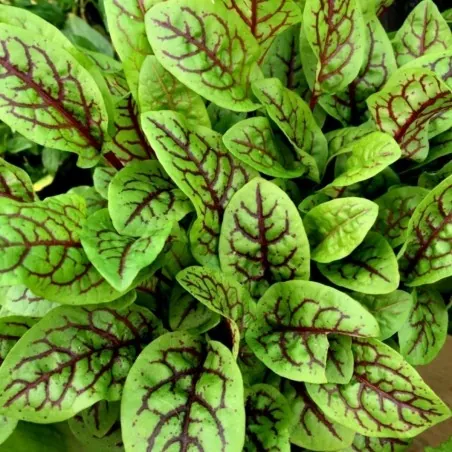
Common Sorrel Seeds (Rumex acetosa)

SKU VE-115-(20-S) Categorie Home
Prijs: โ‚ฌย 2,00

Common Sorrel Seeds (Rumex acetosa)

Price for a Package of 20 seeds.

Of the two kinds of Sorrel cultivated for use as vegetables or salads, Rumex acetosa, the Garden Sorrel, is an indigenous English plant, common, too in the greater part of Europe, in almost all soils and situations. It grows abundantly in meadows, a slender plant about

Niet op voorraad
Zaden in verpakking:
Share on

Common Sorrel Seeds (Rumex acetosa)

Price for a Package of 20 seeds.

Of the two kinds of Sorrel cultivated for use as vegetables or salads, Rumex acetosa, the Garden Sorrel, is an indigenous English plant, common, too in the greater part of Europe, in almost all soils and situations. It grows abundantly in meadows, a slender plant about 2 feet high, with juicy stems and leaves, and whorled spikes of reddish-green flowers, which give colour, during the months of June and July, to the grassy spots in which it grows.

It is generally found in pastures where the soil contains iron.

The leaves are oblong, the lower ones 3 to 6 inches in length, slightly arrow-shaped at the base, with very long petioles. The upper ones are sessile. They frequently become a beautiful crimson.

As the flowers increase in size, they become a purplish colour. The stamens and pistils are on different plants. The seeds, when ripe, are brown and shining. The perennial roots run deeply into the ground.

Sorrel is well known for the grateful acidity of its herbage, which is most marked when the plant is in full season, though in early spring it is almost tasteless.

The plant is also called 'Cuckoo's-meate' from an old belief that the bird cleared its voice by its agency. In Scotland it is 'gowkemeat.'

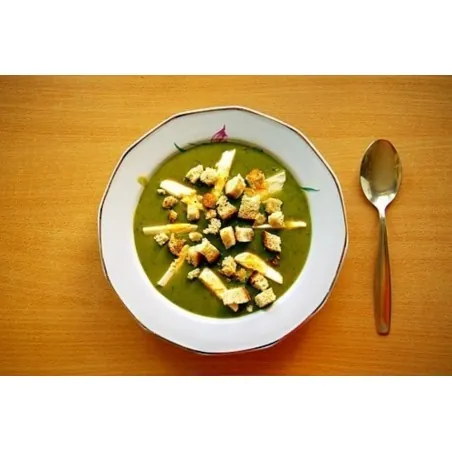
Domestic animals are fond of this and other species of Sorrel. The leaves contain a considerable quantity of binoxalate of potash, which gives them their acid flavour and medicinal and dietetic properties. They have been employed from the most distant time as a salad. In France, Sorrel is put into ragouts, fricassรฉes and soups, forming the chief constituent of the favourite Soupe aux herbes.

In the time of Henry VIII, this plant was held in great repute in England, for table use, but after the introduction of French Sorrel, with large succulent leaves, it gradually lost its position as a salad and a potherb, and for many years it has ceased to be cultivated.

John Evelyn thought that Sorrel imparted 'so grateful a quickness to the salad that it should never be left out.' He wrote in 1720:

ย ย ย  'Sorrel sharpens the appetite, assuages heat, cools the liver and strengthens the heart; is an antiscorbutic, resisting putrefaction and in the making of sallets imparts a grateful quickness to the rest as supplying the want of oranges and lemons. Together with salt, it gives both the name and the relish to sallets from the sapidity, which renders not plants and herbs only, but men themselves pleasant and agreeable.

Culpepper tells us:

ย ย ย  'Sorrel is prevalent in all hot diseases, to cool any inflammation and heat of blood in agues pestilential or choleric, or sickness or fainting, arising from heat, and to refresh the overspent spirits with the violence of furious or fiery fits of agues: to quench thirst, and procure an appetite in fainting or decaying stomachs: For it resists the putrefaction of the blood, kills worms, and is a cordial to the heart, which the seed doth more effectually, being more drying and binding.... Both roots and seeds, as well as the herb, are held powerful to resist the poison of the scorpion. . . . The leaves, wrapt in a colewort leaf and roasted in the embers, and applied to a large imposthume, botch boil, or plague-sore, doth both ripen and break it. The distilled water of the herb is of much good use for all the purposes aforesaid.'

In this country, the leaves are now rarely eaten, unless by children and rustics, to allay thirst, though in Ireland they are still largely consumed by the peasantry with fish and milk. Our country people used to beat the herb to a mash and take it mixed with vinegar and sugar, as a green sauce with cold meat, hence one of its popular names: Greensauce.

Because of their acidity, the leaves, treated as spinach, make a capital dressing with stewed lamb, veal or sweetbread. A few of the leaves may also with advantage be added to turnips and spinach. When boiled by itself, without water, it serves as an excellent accompaniment to roast goose or pork, instead of apple sauce.

'To Stew Sorrel for Fricandean and Roast Meat.

'Wash the Sorrel, and put it into a silver vessel, or stone jar, with no more water than hangs to the leaves. Simmer it as slow as you can, and when done enough, put a bit of butter and beat it well.'

Unless cooked carefully, Sorrel is likely to disagree with gouty persons, from the acid oxalate of potash it contains, but this may be got rid of if it is plunged for two or three minutes in boiling water, before cooking, this first water being then thrown away.

In Scandinavia, Sorrel has sometimes been used in time of scarcity to put into bread. The leaves contain a little starch and mucilage, and the root is rather farinaceous.

The juice of the leaves will curdle milk as well as rennet, and the Laplanders use it as a substitute for the latter.

The dried root affords a beautiful red colour when boiled and used for making barley water look like red wine, when in France they wish to avoid giving anything of a vinous nature to the sick.

The salt of Sorrel, binoxalate of potash, is much used for bleaching straw and removing ink stains from linen, and is often sold in the shops under the name of 'essential salt of lemons.'

Cultivation

Sorrel of two kinds is cultivated, R. acetosa, or Garden Sorrel, and R. scrutatus, or French Sorrel. Garden Sorrel likes a damp situation, French Sorrel a dry soil and an open situation.

The finest plants are propagated from seed, sown in March, though it may be sown in any of the spring months. Sow moderately thin, in drills 6 inches apart, and thin out when the plants are 1 or 2 inches high. When the stalks run up in July, they should be cut back. The roots will then put out new leaves, which will be tender and better for kitchen use than the older leaves, so that by cutting down the shoots of some plants at different times, there will always be a supply of young leaves.

Both varieties are generally increased by dividing the roots, which may be done either in spring or autumn, the roots being planted about a foot apart each way, and watered.

Parts Used Medicinally

The leaves both dried and fresh.

Constituents

The sour taste of Sorrel is due to the acid oxalate of potash it contains; tartaric and tannic acids are also present.

Medicinal Action and Uses

The medicinal action of Sorrel is refrigerant and diuretic, and it is employed as a cooling drink in all febrile disorders.

It is corrective of scrofulous deposits: for cutaneous tumours, a preparation compounded of burnt alum, citric acid, and juice of Sorrel, applied as a paint, has been employed with success.

Sorrel is especially beneficial in scurvy.

Both the root and the seed were formerly esteemed for their astringent properties, and were employed to stem haemorrhage.

A syrup made with the juice of Fumitory and Sorrel had the reputation of curing the itch, and the juice, with a little vinegar, was considered a cure for ringworm, and recommended as a gargle for sore throat.

A decoction of the flowers, made with wine, was said to cure jaundice and ulcerated bowels, the root in decoction or powder being also employed for jaundice, and gravel and stone in the kidneys.

Gerard enumerated eight different kinds of Sorrel - the Garden, bunched or knobbed, Sheep, Romane, Curled, Barren and Great Broad-leaved Sorrel, and said of them:

ย ย ย  'The Sorrells are moderately cold and dry. Sorrell doth undoubtedly cool and mightily dry, but because it is sour, it likewise cutteth tough humours. The juice thereof in summer time is a profitable sauce in many meats and pleasant to the taste. It cooleth a hot stomach. The leaves are with good success added to decoctions, and are used in agues. The leaves are taken in good quantity, stamped and stained into some ale and cooleth the body. The leaves are eaten in a tart spinach. The seed of Sorrell drunk in wine stoppeth the bloody flow.'

Categorie Home Referentie VE-115-(20-S)
Common Sorrel Seeds (Rumex acetosa)
Commentaar (0)
Geen klantenbeoordelingen op het moment.

๐ŸŒ Wereldwijde verzending vanuit de EU

Wij verzenden wereldwijd vanuit de Europese Unie via aangetekende luchtpost met handtekening voor ontvangst bij levering.

๐Ÿ“ฆ Uw bestelling volgen

Om uw trackingnummer te vinden, logt u in op uw account en gaat u naar: Bestelgeschiedenis > Details. Uw trackingnummer bevindt zich direct in de bestelgegevens.

U ontvangt e-mailmeldingen voor elke fase van uw bestelling.

Als u deze berichten niet ziet, controleer dan uw map Spam/Ongewenste e-mail of neem contact op met uw e-mailprovider. Zoek anders online naar hoe u e-mails van afzenders kunt deblokkeren.

ONZE E-MAILSERVICE WERKT โ€” Als u geen e-mails ontvangt, ligt dit waarschijnlijk aan uw e-mailprovider of instellingen.

๐Ÿ“ง Hoe u ervoor zorgt dat e-mails van onze webshop altijd in uw inbox terechtkomen

Om te voorkomen dat onze e-mails als spam worden gemarkeerd, voegt u ons e-mailadres toe aan uw contacten:

  1. Open Gmail (of een andere provider) en zoek een e-mail van ons (xxxxxxxxxxxx@xxx.com).

  2. Beweeg de muis over de naam of het e-mailadres van de afzender.

  3. Klik op het icoon "Toevoegen aan contacten" (het poppetje).

We kunnen u niet helpen als uw instellingen niet zo staan. Neem contact op met uw e-mailprovider voor hulp.

Als alternatief kunt u een filter maken in Gmail:

  1. Open Gmail en ga naar Instellingen > Alle instellingen bekijken.

  2. Ga naar het tabblad Filters en geblokkeerde adressen.

  3. Klik op Nieuw filter maken en voer ons e-mailadres in.

  4. Vink Nooit naar Spam verzenden aan en klik op Filter maken.

๐Ÿ“ Uw pakket volgen

Uw trackingnummer staat in uw bestelgegevens. U kunt uw bestelling volgen via de volgende platforms:

โš ๏ธ Belangrijke mededelingen

  • Betaling onder rembours is NIET mogelijk.

  • Geef bij het bestellen altijd een geldig mobiel nummer op met landnummer (bijv. +31 6 1234 5678).

  • Bestel NIET naar postbussen (P.O. Boxes) of als u niet thuis kunt zijn om voor het pakket te tekenen. Pakketten kunnen niet bij de buren worden afgegeven.

  • Als een pakket dat naar een postbus is verzonden verloren gaat of niet wordt bezorgd, vindt er geen terugbetaling plaats.

โš–๏ธ Verantwoordelijkheid van de klant voor wettelijke naleving

De klant is verantwoordelijk om ervoor te zorgen dat het product legaal in zijn land mag worden geรฏmporteerd, inclusief naleving van alle importvoorschriften, het verkrijgen van de nodige vergunningen en de betaling van toepasselijke douanerechten, belastingen en andere kosten. Controleer uw lokale wetgeving voordat u bestelt.

๐Ÿ”„ Verloren, geretourneerde en opnieuw verzonden pakketten

  • Klanten uit Braziliรซ en Mexico: We kunnen geen pakketten terugbetalen die door de douane zijn verloren of vernietigd.

  • Als uw pakket wordt geretourneerd, betalen we alleen de productkosten terug โ€” verzendkosten worden niet gerestitueerd.

  • Retourkosten (โ‚ฌ2) en eventuele kosten voor opnieuw verzenden zijn voor rekening van de klant.

๐Ÿšš Levering van de zending

  • Aangetekende zendingen vereisen een handtekening.

  • Als de tracking aangeeft dat het pakket nog op het postkantoor van herkomst is, is het onderweg โ€” neem contact op met uw lokale postkantoor voor updates.

  • Helaas kunnen wij, noch het postkantoor waardoor uw bestelling is verzonden, u helpen met de vraag waar uw bestelling zich precies bevindt. Wanneer u ziet dat het pakket in uw land is, MOET u contact opnemen met uw postkantoor met het trackingnummer.

โฑ๏ธ Leveringsopties & geschatte tijden

LeveringsoptieVerwerkingstijdOpmerkingen
Priority DeliveryVerzonden binnen 1โ€“7 werkdagenPrioriteit bij orderverwerking; vertragingen mogelijk tijdens feestdagen (3โ€“10 dagen)
Secured DeliveryVerzonden binnen 1โ€“7 werkdagenBeschikbaar voor bestellingen tot โ‚ฌ150; terugbetaling bij verlies
Standard DeliveryVerzonden binnen 7โ€“10 werkdagenVoordeliger; vertragingen mogelijk tijdens feestdagen (7โ€“14 dagen)

Geschatte levertijden:

  • Binnen de EU: 3โ€“20 dagen

  • Wereldwijd: 5โ€“30 dagen

  • Opmerking: Levertijden zijn afhankelijk van uw locatie en het lokale postsysteem. COVID-19 of feestdagen kunnen extra vertraging veroorzaken.

๐Ÿ’ฐ Verzendkosten

Verzend- en administratiekosten worden automatisch berekend bij het afrekenen op basis van het gewicht van het pakket en de bestemming.

โฐ Verwerkingstijden

Wij verwerken of verzenden geen bestellingen op zaterdag of zondag.

๐Ÿ’ณ Betalingsmogelijkheden

Wij willen u informeren over een belangrijke wijziging met betrekking tot de betalingskosten. Helaas zijn wij, vanwege de uitzonderlijk hoge transactiekosten die PayPal in rekening brengt, genoodzaakt een toeslag toe te passen voor betalingen die via hun service worden gedaan.

We hebben echter een oplossing voor u! U kunt deze astronomische kosten vermijden door te kiezen voor een van onze alternatieve betaalmethoden met NUL COMMISSIE:

โœ… Creditcard/Betaalpas betaling โ€“ 0% Kosten

โœ… Bankoverschrijving โ€“ 0% Kosten

  • Bankoverschrijving (SEPA / IBAN / SWIFT-BIC): Vermeld uw bestelreferentie in de betalingsomschrijving. Bestellingen zonder betaling binnen 4 dagen worden automatisch geannuleerd.

  • PayPal: Betalingen worden alleen in Euro geaccepteerd. Selecteer Euro tijdens het afrekenen.

  • Kaartbetaling: Wij accepteren Visa, MasterCard, American Express, CB, Diners Club, Discover, China UnionPay, JCB en Discover.

โš ๏ธ Transactiekosten

Klanten zijn verantwoordelijk voor eventuele bank- of PayPal-transactiekosten.

๐Ÿ“ Slotopmerkingen

Controleer voor het plaatsen van uw bestelling altijd onze website voor speciale mededelingen, vakantieschema's of specifieke verzendvoorwaarden.

Related Products