Η μετάφραση ακολουθεί Neolamarckia cadamba, with English common names burflower-tree, laran, and Leichhardt pine, and called kadam locally, is an evergreen, tropical tree native to South and Southeast
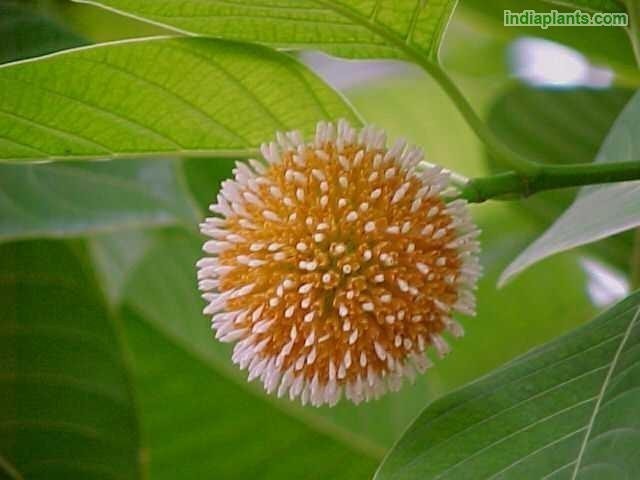
Neolamarckia cadamba, with English common names burflower-tree, laran, and Leichhardt pine,[2] and called kadam[2] locally, is an evergreen, tropical tree native to South and Southeast Asia. The genus name honours French naturalist Jean-Baptiste Lamarck. It has scented orange flowers in dense globe-shaped clusters. The flowers are used in perfumes. The tree is grown as an ornamental plant and for timber and paper-making. Kadam features in Indian religions and mythologies.
A fully mature kadam tree can reach up to 45 m (148 ft) in height. It is a large tree with a broad crown and straight cylindrical bole. It is quick growing, with broad spreading branches and grows rapidly in the first 6–8 years. The trunk has a diameter of 100–160 cm, but typically less than that. Leaves are 13–32 cm (5.1–12.6 in) long. Flowering usually begins when the tree is 4–5 years old.
Kadam flowers are sweetly fragrant, red to orange in colour, occurring in dense, globular heads of approximately 5.5 cm (2.2 in) diameter.
The fruit of N. cadamba occur in small, fleshy capsules packed closely together to form a fleshy yellow-orange infructescence containing approximately 8000 seeds. On maturing, the fruit splits apart, releasing the seeds, which are then dispersed by wind or rain.
Stamens 5, inserted on the corolla tube, filaments short, anthers basifixed. Ovary inferior, bi-locular, sometimes 4-locular in the upper part, style exserted and a spindle-shaped stigma.
Fruitlets numerous with their upper parts containing 4 hollow or solid structures. Seed trigonal or irregularly shaped.
The sapwood is white with a light yellow tinge becoming creamy yellow on exposure and is not clearly differentiated from the heartwood.
Taxonomy
The botanical name of this species has been the subject of a long taxonomic debate, beginning in the 1930s. The problem arose because scientific names are based on type specimens. In 1785 Jean-Baptiste Lamarck described a specimen under the name Cephalanthus chinensis, stating that it came from Madagascar. In 1830, Achille Richard created the name Anthocephalus indicus, stating that the species came from Asia and that his description was based on the same specimen as Lamarck's Cephalanthus chinensis.[7] (Under the rules of the International Code of Nomenclature for algae, fungi, and plants, Richard should have used the name A. chinensis rather than A. indicus, as he should not have changed the specific epithet.)
The issue is whether Richard was indeed using the same specimen as Lamarck; the geographical origin is said to be different, and the descriptions do not match; for example in Lamarck's Cephalanthus chinensis the inflorescences are axillary whereas in Richard's Anthocephalus they are terminal. If specimens were the same, then Anthocephalus is a synonym of the Madagascan Cephalanthus and cannot be a generic name for the Asian kadam tree. If they were different (in spite of Richard's claim that they were the same) then Anthocephalus could be a generic name for the kadam tree. Based on the latter view, the name Anthocephalus chinensis has been widely used for the kadam tree.[7]
The current view taken by most taxonomic sources is that Richard's Anthocephalus indicus or Anthocephalus chinensis is a synonym of Cephalanthus chinensis (now transferred to the genus Breonia as Breonia chinensis (Lam.) Capuron), and that the widespread use of Anthocephalus chinensis for the kadam tree is an error. (This erroneous sense of the scientific name is shown by writing A. chinensis auct., where "auct." is an abbreviation of the Latin for "of authors", i.e. rather than of the correct authority.)
Given that Richard's name for the kadam tree is incorrect, the earliest name is William Roxburgh's 1824 Nauclea cadamba. In 1984, Jean Marie Bosser created the new generic name Neolamarckia, honouring Lamarck, for the Asian genus which matched Richard's description of his Anthocephalus, transferring Nauclea cadamba as Neolamarckia cadamba (Roxb.) Bosser.[7] However, not all botanical sources have accepted this taxonomic analysis and the name Anthocephalus is still in use for the Asian genus.
Uses
The fruit and inflorescences are reportedly edible by humans. The fresh leaves are fed to cattle. N. lamarckia is grown as an ornamental, and for low-grade timber and paper. The timber is used for plywood, light construction, pulp and paper, boxes and crates, dug-out canoes, and furniture components. Kadamba yields a pulp of satisfactory brightness and performance as a hand sheet. The wood can be easily impregnated with synthetic resins to increase its density and compressive strength. The wood has a density of 290–560 kg/cu m at 15% moisture content, a fine to medium texture; straight grain; low luster and has no characteristic odor or taste. It is easy to work, with hand and machine tools, cuts cleanly, gives a very good surface and is easy to nail. The timber air dries rapidly with little or no degrade. Kadamba wood is very easy to preserve using either open tank or pressure-vacuum systems.
Kadamba is one of the most frequently planted trees in the tropics. The tree is grown along avenues, roadsides and villages for shade. Kadamba are suitable for reforestation programs. It sheds large amounts of leaf and non-leaf litter which on decomposition improves some physical and chemical properties of soil under its canopy. This reflects an increase in the level of soil organic carbon, cation-exchange capacity, available plant nutrients and exchangeable bases.
A yellow dye is obtained from the root bark. Kadamba flowers are an important raw material in the production of ‘attar’, which is Indian perfume with sandalwood (Santalum spp.) base in which one of the essences is absorbed through hydro-distillation. An extract of the leaves serves as a mouth gargle.
The leaf extract has recently been used to produce silver nanoparticles for surface-enhanced Raman spectroscopy.
Symbolism
The kadamba flower was the emblem of Athmallik State, one of the princely states of India during the period of the British Raj.[10]
The kadamba lends its name to the Kadamba Dynasty that ruled from Banavasi in what is now the state of Karnataka from 345 CE to 525 CE, as per Talagunda inscription of c.450 CE.[11] The kadamba tree was considered a holy tree by the Kadamba dynasty.
According to tradition the 27 nakshatras, constituting 12 Houses (Rasis) and nine planets, are specifically represented precisely by 27 trees —one for each star. The kadamba tree is said to represent Shatabhisha, roughly corresponding to Aquarii
Religious significance
Kadamba is mentioned in the Bhagavata Purana. In North India, it is associated with Krishna while in the south it is known as "Parvati’s tree". Radha and Krishna are supposed to have conducted their love play in the hospitable and sweet-scented shade of the kadamba tree.[14] In the Sangam period of Tamil Nadu, Murugan of Tirupparankundram Hill of Madurai was referred to as a centre of nature worship. He was in the form of a spear under a kadamba tree.[15]
An episode from the life of Krishna narrates of when he stole the garments of gopis when they were bathing in a pond near Vrindavan. Varuna, the sea-god, had forbidden nude bathing in rivers, ponds and other public places, but gopis often resorted to it. One day, to teach them a lesson, Krishna reached the bank of the pond where they were taking a bath and took away their garments and spread them on the branches of nearby kadamba tree. He himself climbed the tree and hid there behind a branch. After the gopis had bathed, they looked for their garments but found them missing. Suddenly their attention was drawn to the nearby kadamba tree by the stirring of its branches. When they looked up, they saw Krishna hiding there and their garments scattered all over the branches of the tree. Krishna insisted that they come out naked to receive their garments. This episode is portrayed in song, story, painting and artifacts, in the backdrop of the kadamba tree.[16]
Karam-Kadamba is a popular harvest festival, celebrated on the eleventh lunar day of the month Bhadra. A twig of the tree is brought and worshipped in the courtyard of the house. Later in the day, young ears of grain are distributed among friends and relatives. This festive custom has been adopted by the Tulu people. Onam (Kerala) and Huttari (Kodagu) are regional variants of this festival.[17] Kadambotsava ("The festival of Kadamba") is also the festival that is celebrated every year by the Government of Karnataka in honor of the Kadamba kingdom, the first ruling Kingdom of Karnataka, at Banavasi, as it was here that the Kadamba kings organised the spring festival every year.[18]
The kadamba tree is also associated with a tree deity called Kadambariyamman.[19][20] The kadamba, which is considered the sthalavruksham ("tree of the place") of the city that is otherwise known as Kadambavanam (kadamba forest) and is present in Meenakshi Amman Temple.[19] A withered relic of the kadamba is also preserved there.[21]
In Theravada Buddhism, the kadamba tree was where Sumedha Buddha achieved enlightenment.
Η βαθμολόγηση της κριτικής δεν μπορεί να αποσταλεί
Αναφορά σχολίου
Είστε σίγουρος ότι θέλετε να αναφέρετε αυτό το σχόλιο;
Αναφορά αποστάλθηκε
Η αναφορά σας υποβλήθηκε και θα εξεταστεί από συντονιστή.
Η αναφορά σου δεν μπορεί να σταλεί
Γράψτε μια κριτική
Κριτική αποστάλθηκε
Το σχόλιό σας υποβλήθηκε και θα είναι διαθέσιμο μόλις το εγκρίνει ένας συντονιστής.
Η κριτική σου δεν μπορεί να σταλεί
🌍 Αποστολή σε όλο τον κόσμο από την ΕΕ
Αποστέλλουμε σε όλο τον κόσμο από την Ευρωπαϊκή Ένωση μέσω συστημένης αεροπορικής αλληλογραφίας με υποχρεωτική υπογραφή κατά την παράδοση.
📦 Παρακολούθηση της παραγγελίας σας
Για να βρείτε τον αριθμό παρακολούθησης, συνδεθείτε στον λογαριασμό σας και μεταβείτε στο: Ιστορικό παραγγελιών > Λεπτομέρειες. Ο αριθμός παρακολούθησης βρίσκεται απευθείας στις λεπτομέρειες της παραγγελίας σας.
Θα λαμβάνετε ειδοποιήσεις μέσω email για κάθε στάδιο της παραγγελίας σας.
Εάν δεν βλέπετε αυτά τα μηνύματα, ελέγξτε τον φάκελο Ανεπιθύμητα (Spam) ή επικοινωνήστε με τον πάροχο email σας. Εναλλακτικά, αναζητήστε στο διαδίκτυο πώς να ξεμπλοκάρετε τα email του αποστολέα.
Η ΥΠΗΡΕΣΙΑ EMAIL ΜΑΣ ΛΕΙΤΟΥΡΓΕΙ — Εάν δεν λαμβάνετε email, είναι πιθανό να φταίει ο πάροχος email σας ή οι ρυθμίσεις σας.
📧 Πώς να διασφαλίσετε ότι τα email από το ηλεκτρονικό μας κατάστημα φτάνουν πάντα στα εισερχόμενά σας
Για να αποτρέψετε τον χαρακτηρισμό των email μας ως ανεπιθύμητα, προσθέστε τη διεύθυνση email μας στις επαφές σας:
Ανοίξτε το Gmail (ή οποιονδήποτε άλλο πάροχο) και βρείτε ένα email από εμάς (xxxxxxxxxxxx@xxx.com).
Περάστε το ποντίκι πάνω από το όνομα ή τη διεύθυνση email του αποστολέα.
Κάντε κλικ στο εικονίδιο "Προσθήκη στις επαφές" (το εικονίδιο με το ανθρωπάκι).
Δεν μπορούμε να σας βοηθήσουμε εάν οι ρυθμίσεις σας δεν είναι έτσι. Επικοινωνήστε με τον πάροχο email σας για βοήθεια.
Εναλλακτικά, δημιουργήστε ένα φίλτρο στο Gmail:
Ανοίξτε το Gmail και μεταβείτε στις Ρυθμίσεις > Δείτε όλες τις ρυθμίσεις.
Μεταβείτε στην καρτέλα Φίλτρα και αποκλεισμένες διευθύνσεις.
Κάντε κλικ στο Δημιουργία νέου φίλτρου και εισαγάγετε τη διεύθυνση email μας.
Επιλέξτε Να μην αποστέλλεται ποτέ στα Ανεπιθύμητα και κάντε κλικ στο Δημιουργία φίλτρου.
📍 Παρακολουθήστε το δέμα σας
Ο αριθμός παρακολούθησης βρίσκεται στις λεπτομέρειες της παραγγελίας σας. Μπορείτε να παρακολουθήσετε την παραγγελία σας μέσω των παρακάτω πλατφορμών:
Posta.hr (για αριθμούς παρακολούθησης όπως RGxxxxxxHR)
⚠️ Σημαντικές σημειώσεις
Η αντικαταβολή ΔΕΝ είναι διαθέσιμη.
Κατά την παραγγελία, παρέχετε πάντα έναν έγκυρο αριθμό κινητού τηλεφώνου με τον κωδικό χώρας (π.χ. +30 691 234 5678).
ΜΗΝ παραγγέλνετε σε Ταχυδρομικές Θυρίδες (P.O. Boxes) ή εάν δεν μπορείτε να είστε σπίτι για να υπογράψετε για το δέμα. Τα δέματα δεν μπορούν να αφεθούν σε γείτονες.
Εάν ένα δέμα που στάλθηκε σε Ταχυδρομική Θυρίδα χαθεί ή δεν παραδοθεί, δεν θα γίνει επιστροφή χρημάτων.
⚖️ Ευθύνη πελάτη για νομική συμμόρφωση
Ο πελάτης είναι υπεύθυνος να διασφαλίσει ότι το προϊόν είναι νόμιμο για εισαγωγή στη χώρα του, συμπεριλαμβανομένης της συμμόρφωσης με όλους τους κανονισμούς εισαγωγής, της απόκτησης απαραίτητων αδειών και της πληρωμής ισχυόντων δασμών, φόρων και άλλων τελών. Ελέγξτε τους τοπικούς νόμους πριν παραγγείλετε.
Πελάτες από Βραζιλία & Μεξικό: Δεν μπορούμε να επιστρέψουμε χρήματα για δέματα που χάθηκαν ή καταστράφηκαν από το τελωνείο.
Εάν το δέμα σας επιστραφεί, θα επιστρέψουμε μόνο το κόστος του προϊόντος — τα έξοδα αποστολής δεν επιστρέφονται.
Τα έξοδα επιστροφής (2 €) και τυχόν έξοδα επαναποστολής επιβαρύνουν τον πελάτη.
🚚 Παράδοση αποστολής
Οι συστημένες αποστολές απαιτούν υπογραφή.
Εάν η παρακολούθηση δείχνει ότι το δέμα βρίσκεται ακόμα στο ταχυδρομείο προέλευσης, είναι υπό διαμετακόμιση — επικοινωνήστε με το τοπικό σας ταχυδρομείο για ενημερώσεις.
Δυστυχώς, ούτε εμείς ούτε το ταχυδρομείο μέσω του οποίου στάλθηκε η παραγγελία σας μπορούμε να σας βοηθήσουμε σχετικά με το πού ακριβώς βρίσκεται η παραγγελία σας. Όταν δείτε ότι το δέμα βρίσκεται στη χώρα σας, ΠΡΕΠΕΙ να επικοινωνήσετε με το ταχυδρομείο σας με τον αριθμό παρακολούθησης.
⏱️ Επιλογές παράδοσης και εκτιμώμενοι χρόνοι
Επιλογή Παράδοσης
Χρόνος Επεξεργασίας
Σημειώσεις
Priority Delivery
Αποστολή σε 1–7 εργάσιμες ημέρες
Προτεραιότητα στην επεξεργασία. καθυστερήσεις πιθανές στις γιορτές (3–10 ημέρες)
Secured Delivery
Αποστολή σε 1–7 εργάσιμες ημέρες
Διαθέσιμο για παραγγελίες έως 150 €. επιστροφή χρημάτων σε περίπτωση απώλειας
Standard Delivery
Αποστολή σε 7–10 εργάσιμες ημέρες
Πιο οικονομικό. καθυστερήσεις πιθανές στις γιορτές (7–14 ημέρες)
Εκτιμώμενοι χρόνοι παράδοσης:
Εντός ΕΕ: 3–20 ημέρες
Σε όλο τον κόσμο: 5–30 ημέρες
Σημείωση: Οι χρόνοι παράδοσης εξαρτώνται από την τοποθεσία σας και το τοπικό ταχυδρομικό σύστημα. Ο COVID-19 ή οι περίοδοι εορτών ενδέχεται να προκαλέσουν πρόσθετες καθυστερήσεις.
💰 Έξοδα αποστολής
Τα έξοδα αποστολής και διαχείρισης υπολογίζονται αυτόματα κατά την πληρωμή με βάση το βάρος του δέματος και τον προορισμό.
⏰ Ώρες επεξεργασίας παραγγελιών
Δεν επεξεργαζόμαστε ούτε αποστέλλουμε παραγγελίες τα Σάββατα ή τις Κυριακές.
💳 Επιλογές πληρωμής
Θα θέλαμε να σας ενημερώσουμε για μια σημαντική αλλαγή σχετικά με τις προμήθειες πληρωμής. Δυστυχώς, λόγω των εξαιρετικά υψηλών προμηθειών συναλλαγών που επιβάλλει το PayPal, είμαστε αναγκασμένοι να εφαρμόσουμε μια επιπλέον χρέωση για πληρωμές που πραγματοποιούνται μέσω της υπηρεσίας τους.
Ωστόσο, έχουμε μια λύση για εσάς! Μπορείτε να αποφύγετε αυτές τις αστρονομικές χρεώσεις επιλέγοντας μία από τις εναλλακτικές μεθόδους πληρωμής μας με ΜΗΔΕΝΙΚΗ ΠΡΟΜΗΘΕΙΑ:
✅ Πληρωμή με Πιστωτική/Χρεωστική Κάρτα – 0% Προμήθεια
✅ Τραπεζική Μεταφορά – 0% Προμήθεια
Τραπεζική Μεταφορά (SEPA / IBAN / SWIFT-BIC): Συμπεριλάβετε την αναφορά της παραγγελίας σας στην περιγραφή της πληρωμής. Παραγγελίες χωρίς πληρωμή εντός 4 ημερών θα ακυρώνονται αυτόματα.
PayPal: Οι πληρωμές γίνονται δεκτές μόνο σε ευρώ. Παρακαλούμε επιλέξτε ευρώ κατά την πληρωμή.
Πληρωμή με κάρτα: Δεχόμαστε Visa, MasterCard, American Express, CB, Diners Club, Discover, China UnionPay, JCB και Discover.
⚠️ Προμήθειες συναλλαγών
Οι πελάτες είναι υπεύθυνοι για τυχόν τραπεζικές προμήθειες ή προμήθειες του PayPal.
📝 Τελικές σημειώσεις
Πριν τοποθετήσετε την παραγγελία σας, ελέγχετε πάντα την ιστοσελίδα μας για ειδικές ειδοποιήσεις, προγράμματα αργιών ή συγκεκριμένους όρους αποστολής.