Neolamarckia cadamba, with English common names burflower-tree, laran, and Leichhardt pine,[2] and called kadam locally, is an evergreen, tropical tree native to South and Southeast
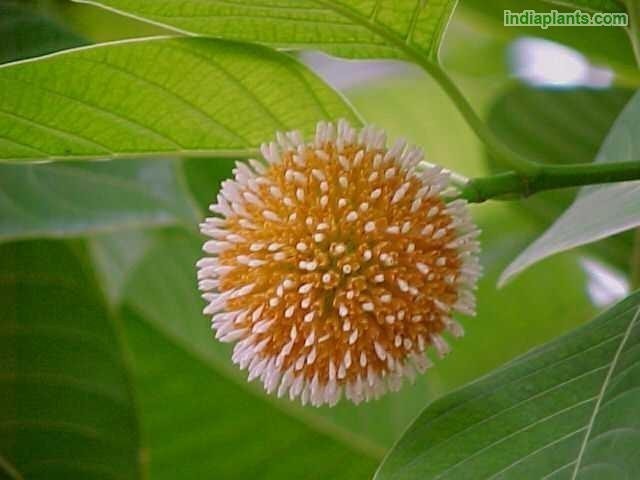
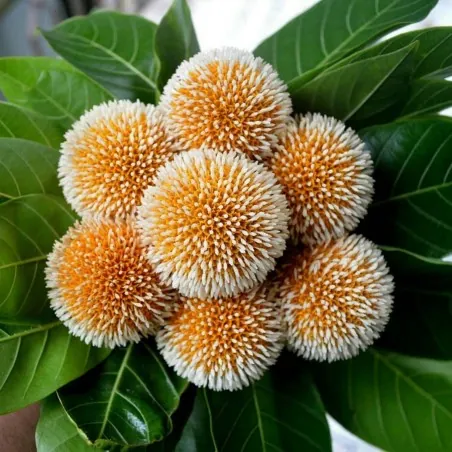
Neolamarckia cadamba, with English common names burflower-tree, laran, and Leichhardt pine, and called kadam locally, is an evergreen, tropical tree native to South and Southeast Asia. The genus name honours French naturalist Jean-Baptiste Lamarck. It has scented orange flowers in dense globe-shaped clusters. The flowers are used in perfumes. The tree is grown as an ornamental plant and for timber and paper-making. Kadam features in Indian religions and mythologies.
A fully mature kadam tree can reach up to 45 m (148 ft) in height. It is a large tree with a broad crown and straight cylindrical bole. It is quick growing, with broad spreading branches and grows rapidly in the first 6–8 years. The trunk has a diameter of 100–160 cm, but typically less than that. Leaves are 13–32 cm (5.1–12.6 in) long. Flowering usually begins when the tree is 4–5 years old.
Kadam flowers are sweetly fragrant, red to orange in color, occurring in dense, globular heads of approximately 5.5 cm (2.2 in) diameter.
The fruit of N. cadamba occur in small, fleshy capsules packed closely together to form a fleshy yellow-orange infructescence containing approximately 8000 seeds. On maturing, the fruit splits apart, releasing the seeds, which are then dispersed by wind or rain.
Stamens 5, inserted on the corolla tube, filaments short, anthers basifixed. Ovary inferior, bi-locular, sometimes 4-locular in the upper part, style exserted, and a spindle-shaped stigma.
Fruitlets numerous with their upper parts containing 4 hollow or solid structures. Seed trigonal or irregularly shaped.
The sapwood is white with a light yellow tinge becoming creamy yellow on exposure and is not clearly differentiated from the heartwood.
Taxonomy
The botanical name of this species has been the subject of a long taxonomic debate, beginning in the 1930s. The problem arose because scientific names are based on type specimens. In 1785 Jean-Baptiste Lamarck described a specimen under the name Cephalanthus chinensis, stating that it came from Madagascar. In 1830, Achille Richard created the name Anthocephalus indicus, stating that the species came from Asia and that his description was based on the same specimen as Lamarck's Cephalanthus chinensis.[7] (Under the rules of the International Code of Nomenclature for algae, fungi, and plants, Richard should have used the name A. chinensis rather than A. indicus, as he should not have changed the specific epithet.)
The issue is whether Richard was indeed using the same specimen as Lamarck; the geographical origin is said to be different, and the descriptions do not match; for example in Lamarck's Cephalanthus chinensis the inflorescences are axillary whereas in Richard's Anthocephalus they are terminal. If specimens were the same, then Anthocephalus is a synonym of the Madagascan Cephalanthus and cannot be a generic name for the Asian kadam tree. If they were different (in spite of Richard's claim that they were the same) then Anthocephalus could be a generic name for the kadam tree. Based on the latter view, the name Anthocephalus chinensis has been widely used for the kadam tree.
The current view taken by most taxonomic sources is that Richard's Anthocephalus indicus or Anthocephalus chinensis is a synonym of Cephalanthus chinensis (now transferred to the genus Breonia as Breonia chinensis (Lam.) Capuron), and that the widespread use of Anthocephalus chinensis for the kadam tree is an error. (This erroneous sense of the scientific name is shown by writing A. chinensis auct., where "auct." is an abbreviation of the Latin for "of authors", i.e. rather than of the correct authority.)
Given that Richard's name for the kadam tree is incorrect, the earliest name is William Roxburgh's 1824 Nauclea cadamba. In 1984, Jean Marie Bosser created the new generic name Neolamarckia, honouring Lamarck, for the Asian genus which matched Richard's description of his Anthocephalus, transferring Nauclea cadamba as Neolamarckia cadamba (Roxb.) Bosser.[7] However, not all botanical sources have accepted this taxonomic analysis and the name Anthocephalus is still in use for the Asian genus.
Uses
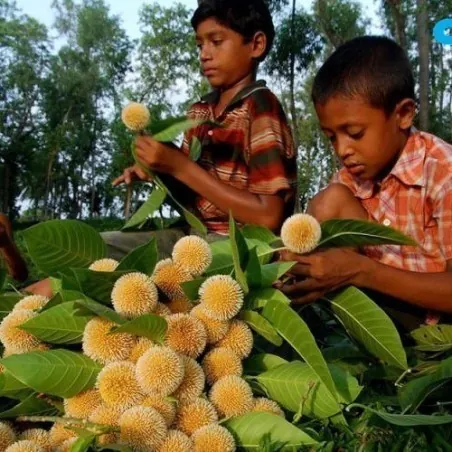
The fruit and inflorescences are reportedly edible by humans. The fresh leaves are fed to cattle. N. lamarckia is grown as an ornamental, and for low-grade timber and paper. The timber is used for plywood, light construction, pulp and paper, boxes and crates, dug-out canoes, and furniture components. Kadamba yields a pulp of satisfactory brightness and performance as a hand sheet. The wood can be easily impregnated with synthetic resins to increase its density and compressive strength. The wood has a density of 290–560 kg/cu m at 15% moisture content, a fine to medium texture; straight grain; low luster and has no characteristic odor or taste. It is easy to work, with hand and machine tools, cuts cleanly, gives a very good surface and is easy to nail. The timber air dries rapidly with little or no degrade. Kadamba wood is very easy to preserve using either open tank or pressure-vacuum systems.
Kadamba is one of the most frequently planted trees in the tropics. The tree is grown along avenues, roadsides and villages for shade. Kadamba are suitable for reforestation programs. It sheds large amounts of leaf and non-leaf litter which on decomposition improves some physical and chemical properties of soil under its canopy. This reflects an increase in the level of soil organic carbon, cation-exchange capacity, available plant nutrients and exchangeable bases.
A yellow dye is obtained from the root bark. Kadamba flowers are an important raw material in the production of ‘attar’, which is Indian perfume with sandalwood (Santalum spp.) base in which one of the essences is absorbed through hydro-distillation. An extract of the leaves serves as a mouth gargle.
The leaf extract has recently been used to produce silver nanoparticles for surface-enhanced Raman spectroscopy.
Symbolism
The kadamba flower was the emblem of Athmallik State, one of the princely states of India during the period of the British Raj.
The kadamba lends its name to the Kadamba Dynasty that ruled from Banavasi in what is now the state of Karnataka from 345 CE to 525 CE, as per Talagunda inscription of c.450 CE.[11] The kadamba tree was considered a holy tree by the Kadamba dynasty.
According to tradition the 27 nakshatras, constituting 12 Houses (Rasis) and nine planets, are specifically represented precisely by 27 trees —one for each star. The kadamba tree is said to represent Shatabhisha, roughly corresponding to Aquarii
Religious significance
Kadamba is mentioned in the Bhagavata Purana. In North India, it is associated with Krishna while in the south it is known as "Parvati’s tree". Radha and Krishna are supposed to have conducted their love play in the hospitable and sweet-scented shade of the kadamba tree.[14] In the Sangam period of Tamil Nadu, Murugan of Tirupparankundram Hill of Madurai was referred to as a centre of nature worship. He was in the form of a spear under a kadamba tree.
An episode from the life of Krishna narrates of when he stole the garments of gopis when they were bathing in a pond near Vrindavan. Varuna, the sea-god, had forbidden nude bathing in rivers, ponds and other public places, but gopis often resorted to it. One day, to teach them a lesson, Krishna reached the bank of the pond where they were taking a bath and took away their garments and spread them on the branches of nearby kadamba tree. He himself climbed the tree and hid there behind a branch. After the gopis had bathed, they looked for their garments but found them missing. Suddenly their attention was drawn to the nearby kadamba tree by the stirring of its branches. When they looked up, they saw Krishna hiding there and their garments scattered all over the branches of the tree. Krishna insisted that they come out naked to receive their garments. This episode is portrayed in song, story, painting and artifacts, in the backdrop of the kadamba tree.
Karam-Kadamba is a popular harvest festival, celebrated on the eleventh lunar day of the month Bhadra. A twig of the tree is brought and worshipped in the courtyard of the house. Later in the day, young ears of grain are distributed among friends and relatives. This festive custom has been adopted by the Tulu people. Onam (Kerala) and Huttari (Kodagu) are regional variants of this festival.[17] Kadambotsava ("The festival of Kadamba") is also the festival that is celebrated every year by the Government of Karnataka in honor of the Kadamba kingdom, the first ruling Kingdom of Karnataka, at Banavasi, as it was here that the Kadamba kings organised the spring festival every year.
The kadamba tree is also associated with a tree deity called Kadambariyamman. The kadamba, which is considered the sthalavruksham ("tree of the place") of the city that is otherwise known as Kadambavanam (kadamba forest) and is present in Meenakshi Amman Temple. A withered relic of the kadamba is also preserved there.
In Theravada Buddhism, the kadamba tree was where Sumedha Buddha achieved enlightenment.
Aprecierea ta pentru recenzie nu a putut fi trimisa
Reclama un comentariu
Sigur doresti sa raportezi acest comentariu?
Raport trimis
Comentariul tau a fost inregistrat si va fi examinat de un moderator.
Reclamatia tau nu a putut fi trimisa
Scrie-ti recenzia
Recenzia a fost trimisa
Comentariul dumeavoastra a fost inregistrat si va fi vizibil de indata ce va fi aprobat de un moderator.
Recenzia ta nu a putut fi trimisa
🌍 Livrare în toată lumea din UE
Expediem în toată lumea din Uniunea Europeană prin poștă aeriană recomandată, cu semnătură obligatorie la livrare.
📦 Urmărirea comenzii dumneavoastră
Pentru a găsi numărul de urmărire, conectați-vă la contul dumneavoastră și accesați: Istoric comenzi > Detalii. Numărul de urmărire se află direct în detaliile comenzii.
Veți primi notificări prin e-mail pentru fiecare etapă a comenzii dumneavoastră.
Dacă nu vedeți aceste mesaje, vă rugăm să verificați folderul Spam/Junk sau să contactați furnizorul dumneavoastră de e-mail. Alternativ, căutați online cum să deblocați e-mailurile de la expeditor.
SERVICIUL NOSTRU DE E-MAIL FUNCȚIONEAZĂ — Dacă nu primiți e-mailuri, este probabil o problemă cu furnizorul dumneavoastră de e-mail sau cu setările dumneavoastră.
📧 Cum să vă asigurați că e-mailurile de la magazinul nostru online ajung întotdeauna în Inbox
Pentru a preveni marcarea e-mailurilor noastre ca spam, adăugați adresa noastră de e-mail în contactele dumneavoastră:
Deschideți Gmail (sau orice alt furnizor) și găsiți un e-mail de la noi (xxxxxxxxxxxx@xxx.com).
Treceți mouse-ul peste numele sau adresa de e-mail a expeditorului.
Faceți clic pe pictograma "Adaugă în contacte" (pictograma cu persoana mică).
Nu vă putem ajuta dacă setările dumneavoastră nu sunt așa. Contactați furnizorul de e-mail pentru asistență.
Alternativ, creați un filtru în Gmail:
Deschideți Gmail și accesați Setări > Vezi toate setările.
Mergeți la fila Filtre și adrese blocate.
Faceți clic pe Creați un filtru nou și introduceți adresa noastră de e-mail.
Bifați Nu se trimite niciodată în Spam și faceți clic pe Creați filtru.
📍 Urmăriți-vă pachetul
Numărul de urmărire se află în detaliile comenzii dumneavoastră. Vă puteți urmări comanda prin următoarele platforme:
Posta.hr (pentru numere de urmărire de tip RGxxxxxxHR)
⚠️ Notificări importante
Plata la livrare (ramburs) NU este disponibilă.
Când comandați, furnizați întotdeauna un număr de telefon mobil valid cu prefixul țării (de ex. +40 712 345 678).
NU comandați la căsuțe poștale (P.O. Boxes) sau dacă nu puteți fi acasă pentru a semna pentru pachet. Pachetele nu pot fi lăsate la vecini.
Dacă un pachet trimis la o căsuță poștală este pierdut sau nelivrat, nu se va acorda nicio rambursare.
⚖️ Responsabilitatea clientului pentru conformitatea legală
Clientul este responsabil să se asigure că produsul este legal pentru import în țara sa, inclusiv respectarea tuturor reglementărilor de import, obținerea permiselor necesare și plata taxelor vamale aplicabile, a impozitelor și a altor taxe. Vă rugăm să verificați legile locale înainte de a comanda.
🔄 Pachete pierdute, returnate și reexpediate
Clienți din Brazilia și Mexic: Nu putem rambursa pachetele pierdute sau distruse de vamă.
Dacă pachetul dumneavoastră este returnat, vom rambursa doar costul produsului — costurile de transport sunt nerambursabile.
Taxa poștală de returnare (2 €) și orice costuri de reexpediere trebuie acoperite de client.
🚚 Livrarea transportului
Expedierile recomandate necesită semnătură.
Dacă urmărirea arată că pachetul este încă la oficiul poștal de origine, acesta este în tranzit — contactați oficiul poștal local pentru actualizări.
Din păcate, nici noi, nici oficiul poștal prin care a fost trimisă comanda dumneavoastră nu vă putem ajuta cu întrebarea unde se află exact comanda dumneavoastră. Când vedeți că pachetul este în țara dumneavoastră, TREBUIE să contactați oficiul poștal cu numărul de urmărire.
⏱️ Opțiuni de livrare și timp estimat
Opțiune de livrare
Timp de procesare
Note
Priority Delivery
Se expediază în 1–7 zile lucrătoare
Prioritizează procesarea comenzii; posibile întârzieri în timpul sărbătorilor (3–10 zile)
Secured Delivery
Se expediază în 1–7 zile lucrătoare
Disponibil pentru comenzi de până la 150 €; rambursare în caz de pierdere
Standard Delivery
Se expediază în 7–10 zile lucrătoare
Mai economic; posibile întârzieri în timpul sărbătorilor (7–14 zile)
Timp estimat de livrare:
În interiorul UE: 3–20 zile
În restul lumii: 5–30 zile
Notă: Timpul de livrare depinde de locația dumneavoastră și de sistemul poștal local. COVID-19 sau perioadele de sărbători pot cauza întârzieri suplimentare.
💰 Costuri de livrare
Taxele de transport și manipulare sunt calculate automat la finalizarea comenzii pe baza greutății coletului și a destinației.
⏰ Programul de procesare a comenzilor
Nu procesăm și nu expediem comenzi sâmbăta sau duminica.
💳 Opțiuni de plată
Dorim să vă informăm despre o modificare importantă privind taxele de plată. Din păcate, din cauza comisioanelor de tranzacție excepțional de mari impuse de PayPal, suntem forțați să aplicăm o suprataxă pentru plățile efectuate prin serviciul lor.
Cu toate acestea, avem o soluție pentru dumneavoastră! Puteți evita aceste taxe astronomice alegând una dintre metodele noastre alternative de plată cu COMISION ZERO:
✅ Plată cu cardul de credit/debit – comision 0%
✅ Transfer bancar – comision 0%
Transfer bancar (SEPA / IBAN / SWIFT-BIC): Includeți referința comenzii dumneavoastră în descrierea plății. Comenzile fără plată în termen de 4 zile vor fi anulate automat.
PayPal: Plățile sunt acceptate numai în euro. Vă rugăm să selectați euro în timpul procesului de plată.
Plata cu cardul: Acceptăm Visa, MasterCard, American Express, CB, Diners Club, Discover, China UnionPay, JCB și Discover.
⚠️ Comisioane de tranzacție
Clienții sunt responsabili pentru orice comisioane bancare sau taxe de tranzacție PayPal.
📝 Note finale
Înainte de a plasa comanda, verificați întotdeauna site-ul nostru pentru anunțuri speciale, programe de sărbători sau condiții specifice de livrare.