Burflower-Tree, Laran Samen (Neolamarckia cadamba)
Preis für packung von 10 Samen.
Übersetzung folgt. Neolamarckia cadamba, with English common names burflower-tree, laran, and Leichhardt pine, and called kadam locally, is an evergreen, tropical tree native to South and Southeast
Burflower-Tree, Laran Samen (Neolamarckia cadamba)
Preis für packung von 10 Samen.
Übersetzung folgt.
Neolamarckia cadamba, with English common names burflower-tree, laran, and Leichhardt pine,[2] and called kadam[2] locally, is an evergreen, tropical tree native to South and Southeast Asia. The genus name honours French naturalist Jean-Baptiste Lamarck. It has scented orange flowers in dense globe-shaped clusters. The flowers are used in perfumes. The tree is grown as an ornamental plant and for timber and paper-making. Kadam features in Indian religions and mythologies.
A fully mature kadam tree can reach up to 45 m (148 ft) in height. It is a large tree with a broad crown and straight cylindrical bole. It is quick growing, with broad spreading branches and grows rapidly in the first 6–8 years. The trunk has a diameter of 100–160 cm, but typically less than that. Leaves are 13–32 cm (5.1–12.6 in) long. Flowering usually begins when the tree is 4–5 years old.
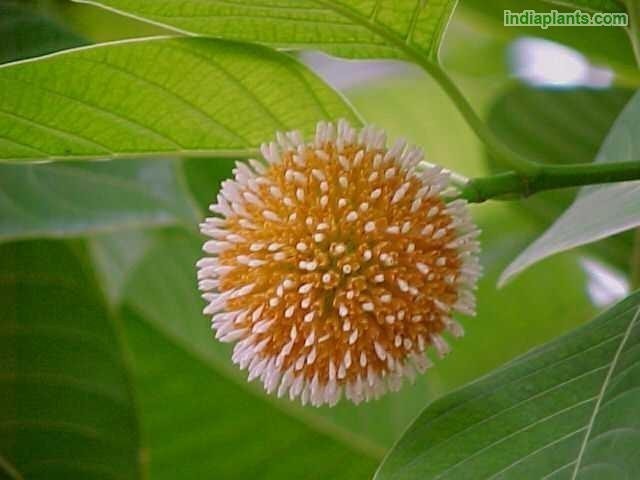
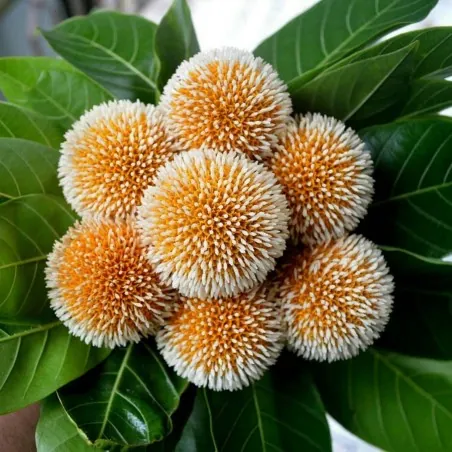
Kadam flowers are sweetly fragrant, red to orange in colour, occurring in dense, globular heads of approximately 5.5 cm (2.2 in) diameter.
The fruit of N. cadamba occur in small, fleshy capsules packed closely together to form a fleshy yellow-orange infructescence containing approximately 8000 seeds. On maturing, the fruit splits apart, releasing the seeds, which are then dispersed by wind or rain.
Stamens 5, inserted on the corolla tube, filaments short, anthers basifixed. Ovary inferior, bi-locular, sometimes 4-locular in the upper part, style exserted and a spindle-shaped stigma.
Fruitlets numerous with their upper parts containing 4 hollow or solid structures. Seed trigonal or irregularly shaped.
The sapwood is white with a light yellow tinge becoming creamy yellow on exposure and is not clearly differentiated from the heartwood.
Taxonomy
The botanical name of this species has been the subject of a long taxonomic debate, beginning in the 1930s. The problem arose because scientific names are based on type specimens. In 1785 Jean-Baptiste Lamarck described a specimen under the name Cephalanthus chinensis, stating that it came from Madagascar. In 1830, Achille Richard created the name Anthocephalus indicus, stating that the species came from Asia and that his description was based on the same specimen as Lamarck's Cephalanthus chinensis.[7] (Under the rules of the International Code of Nomenclature for algae, fungi, and plants, Richard should have used the name A. chinensis rather than A. indicus, as he should not have changed the specific epithet.)
The issue is whether Richard was indeed using the same specimen as Lamarck; the geographical origin is said to be different, and the descriptions do not match; for example in Lamarck's Cephalanthus chinensis the inflorescences are axillary whereas in Richard's Anthocephalus they are terminal. If specimens were the same, then Anthocephalus is a synonym of the Madagascan Cephalanthus and cannot be a generic name for the Asian kadam tree. If they were different (in spite of Richard's claim that they were the same) then Anthocephalus could be a generic name for the kadam tree. Based on the latter view, the name Anthocephalus chinensis has been widely used for the kadam tree.[7]
The current view taken by most taxonomic sources is that Richard's Anthocephalus indicus or Anthocephalus chinensis is a synonym of Cephalanthus chinensis (now transferred to the genus Breonia as Breonia chinensis (Lam.) Capuron), and that the widespread use of Anthocephalus chinensis for the kadam tree is an error. (This erroneous sense of the scientific name is shown by writing A. chinensis auct., where "auct." is an abbreviation of the Latin for "of authors", i.e. rather than of the correct authority.)
Given that Richard's name for the kadam tree is incorrect, the earliest name is William Roxburgh's 1824 Nauclea cadamba. In 1984, Jean Marie Bosser created the new generic name Neolamarckia, honouring Lamarck, for the Asian genus which matched Richard's description of his Anthocephalus, transferring Nauclea cadamba as Neolamarckia cadamba (Roxb.) Bosser.[7] However, not all botanical sources have accepted this taxonomic analysis and the name Anthocephalus is still in use for the Asian genus.
Uses
The fruit and inflorescences are reportedly edible by humans. The fresh leaves are fed to cattle. N. lamarckia is grown as an ornamental, and for low-grade timber and paper. The timber is used for plywood, light construction, pulp and paper, boxes and crates, dug-out canoes, and furniture components. Kadamba yields a pulp of satisfactory brightness and performance as a hand sheet. The wood can be easily impregnated with synthetic resins to increase its density and compressive strength. The wood has a density of 290–560 kg/cu m at 15% moisture content, a fine to medium texture; straight grain; low luster and has no characteristic odor or taste. It is easy to work, with hand and machine tools, cuts cleanly, gives a very good surface and is easy to nail. The timber air dries rapidly with little or no degrade. Kadamba wood is very easy to preserve using either open tank or pressure-vacuum systems.
Kadamba is one of the most frequently planted trees in the tropics. The tree is grown along avenues, roadsides and villages for shade. Kadamba are suitable for reforestation programs. It sheds large amounts of leaf and non-leaf litter which on decomposition improves some physical and chemical properties of soil under its canopy. This reflects an increase in the level of soil organic carbon, cation-exchange capacity, available plant nutrients and exchangeable bases.
A yellow dye is obtained from the root bark. Kadamba flowers are an important raw material in the production of ‘attar’, which is Indian perfume with sandalwood (Santalum spp.) base in which one of the essences is absorbed through hydro-distillation. An extract of the leaves serves as a mouth gargle.
The leaf extract has recently been used to produce silver nanoparticles for surface-enhanced Raman spectroscopy.
Symbolism
The kadamba flower was the emblem of Athmallik State, one of the princely states of India during the period of the British Raj.[10]
The kadamba lends its name to the Kadamba Dynasty that ruled from Banavasi in what is now the state of Karnataka from 345 CE to 525 CE, as per Talagunda inscription of c.450 CE.[11] The kadamba tree was considered a holy tree by the Kadamba dynasty.
According to tradition the 27 nakshatras, constituting 12 Houses (Rasis) and nine planets, are specifically represented precisely by 27 trees —one for each star. The kadamba tree is said to represent Shatabhisha, roughly corresponding to Aquarii
Religious significance
Kadamba is mentioned in the Bhagavata Purana. In North India, it is associated with Krishna while in the south it is known as "Parvati’s tree". Radha and Krishna are supposed to have conducted their love play in the hospitable and sweet-scented shade of the kadamba tree.[14] In the Sangam period of Tamil Nadu, Murugan of Tirupparankundram Hill of Madurai was referred to as a centre of nature worship. He was in the form of a spear under a kadamba tree.[15]
An episode from the life of Krishna narrates of when he stole the garments of gopis when they were bathing in a pond near Vrindavan. Varuna, the sea-god, had forbidden nude bathing in rivers, ponds and other public places, but gopis often resorted to it. One day, to teach them a lesson, Krishna reached the bank of the pond where they were taking a bath and took away their garments and spread them on the branches of nearby kadamba tree. He himself climbed the tree and hid there behind a branch. After the gopis had bathed, they looked for their garments but found them missing. Suddenly their attention was drawn to the nearby kadamba tree by the stirring of its branches. When they looked up, they saw Krishna hiding there and their garments scattered all over the branches of the tree. Krishna insisted that they come out naked to receive their garments. This episode is portrayed in song, story, painting and artifacts, in the backdrop of the kadamba tree.[16]
Karam-Kadamba is a popular harvest festival, celebrated on the eleventh lunar day of the month Bhadra. A twig of the tree is brought and worshipped in the courtyard of the house. Later in the day, young ears of grain are distributed among friends and relatives. This festive custom has been adopted by the Tulu people. Onam (Kerala) and Huttari (Kodagu) are regional variants of this festival.[17] Kadambotsava ("The festival of Kadamba") is also the festival that is celebrated every year by the Government of Karnataka in honor of the Kadamba kingdom, the first ruling Kingdom of Karnataka, at Banavasi, as it was here that the Kadamba kings organised the spring festival every year.[18]
The kadamba tree is also associated with a tree deity called Kadambariyamman.[19][20] The kadamba, which is considered the sthalavruksham ("tree of the place") of the city that is otherwise known as Kadambavanam (kadamba forest) and is present in Meenakshi Amman Temple.[19] A withered relic of the kadamba is also preserved there.[21]
In Theravada Buddhism, the kadamba tree was where Sumedha Buddha achieved enlightenment.
Ihre Bewertung der Rezension kann nicht gesendet werden
Kommentar melden
Möchten Sie diesen Kommentar wirklich melden?
Meldung gesendet
Ihre Meldung wurde übermittelt und wird durch einen Moderator geprüft.
Ihre Meldung kann nicht gesendet werden
Eigenen Kommentar verfassen
Bewertung gesendet
Ihr Kommentar wurde gespeichert und wird sofort nach Freigabe durch einen Moderator angezeigt.
Ihre Bewertung kann nicht gesendet werden
🌍 Weltweiter Versand aus der EU
Wir versenden weltweit aus der Europäischen Union per Einschreiben (Luftpost) mit Unterschriftspflicht bei Zustellung.
📦 Verfolgung Ihrer Bestellung
Um Ihre Sendungsnummer zu finden, melden Sie sich in Ihrem Konto an und gehen Sie zu: Bestellverlauf > Details. Ihre Sendungsnummer befindet sich direkt in den Bestelldetails.
Sie erhalten E-Mail-Benachrichtigungen für jede Phase Ihrer Bestellung.
Falls Sie diese Nachrichten nicht sehen, prüfen Sie bitte Ihren Spam/Junk-Ordner oder kontaktieren Sie Ihren E-Mail-Anbieter. Suchen Sie alternativ online nach Anleitungen zum Freischalten von Absender-E-Mails.
UNSER E-MAIL-SERVICE FUNKTIONIERT — Wenn Sie keine E-Mails erhalten, liegt es wahrscheinlich an Ihrem E-Mail-Anbieter oder Ihren Einstellungen.
📧 So stellen Sie sicher, dass E-Mails aus unserem Online-Shop immer im Posteingang landen
Um zu verhindern, dass unsere E-Mails als Spam markiert werden, fügen Sie unsere E-Mail-Adresse zu Ihren Kontakten hinzu:
Öffnen Sie Gmail (oder einen anderen Anbieter) und suchen Sie eine E-Mail von uns (xxxxxxxxxxxx@xxx.com).
Bewegen Sie den Mauszeiger über den Namen oder die E-Mail-Adresse des Absenders.
Klicken Sie auf das Symbol "Zu Kontakten hinzufügen" (das kleine Personensymbol).
Wir können Ihnen nicht helfen, wenn Ihre Einstellungen nicht so konfiguriert sind. Wenden Sie sich an Ihren E-Mail-Anbieter.
Alternativ können Sie in Gmail einen Filter erstellen:
Öffnen Sie Gmail: Einstellungen > Alle Einstellungen anzeigen.
Gehen Sie zum Tab Filter und blockierte Adressen.
Klicken Sie auf Neuen Filter erstellen und geben Sie unsere E-Mail-Adresse ein.
Wählen Sie Nie als Spam markieren und klicken Sie auf Filter erstellen.
📍 Paket verfolgen
Ihre Sendungsnummer befindet sich in Ihren Bestelldetails. Sie können Ihre Bestellung über die folgenden Plattformen verfolgen:
Geben Sie bei der Bestellung immer eine gültige Mobilnummer mit Ländervorwahl an (z. B. +365 456 7686 576).
Bestellen Sie NICHT an Postfächer (P.O. Boxes) oder wenn Sie nicht zu Hause sein können, um für das Paket zu unterschreiben. Pakete können nicht bei Nachbarn abgegeben werden.
Wenn ein an ein Postfach gesendetes Paket verloren geht oder nicht zugestellt werden kann, erfolgt keine Rückerstattung.
⚖️ Verantwortung des Kunden für die Einhaltung gesetzlicher Vorschriften
Der Kunde ist dafür verantwortlich sicherzustellen, dass das Produkt legal in sein Land eingeführt werden darf, einschließlich der Einhaltung aller Einfuhrbestimmungen, der Einholung erforderlicher Genehmigungen und der Zahlung anfallender Zölle, Steuern und sonstiger Gebühren. Bitte prüfen Sie Ihre lokalen Gesetze vor der Bestellung.
🔄 Verlorene, zurückgesandte & erneut versandte Pakete
Kunden in Brasilien & Mexiko: Wir können keine Rückerstattung für Pakete leisten, die vom Zoll beschlagnahmt oder vernichtet wurden.
Wenn Ihr Paket zurückgesendet wird, erstatten wir nur die Produktkosten — die Versandkosten sind nicht erstattungsfähig.
Die Rücksendegebühr (2 €) und alle Kosten für den erneuten Versand müssen vom Kunden getragen werden.
🚚 Zustellung der Sendung
Einschreiben erfordern eine Unterschrift.
Wenn das Tracking anzeigt, dass sich das Paket noch in der Herkunftspostfiliale befindet, ist es auf dem Weg — kontaktieren Sie Ihr örtliches Postamt für Updates.
Weder wir noch die Post, über die Ihre Bestellung versandt wurde, können Ihnen bei der Frage helfen, wo sich Ihre Bestellung genau befindet. Sobald das Paket in Ihrem Land ist, MÜSSEN Sie Ihr Postamt kontaktieren.
⏱️ Versandoptionen & geschätzte Zeiten
Versandoption
Bearbeitungszeit
Hinweise
Priority Delivery
1–7 Werktage
Priorisierte Bearbeitung; Verzögerungen an Feiertagen möglich (3–10 Tage)
Secured Delivery
1–7 Werktage
Verfügbar für Bestellungen bis 150 €; Erstattung bei Verlust
Standard Delivery
7–10 Werktage
Günstiger; Verzögerungen an Feiertagen möglich (7–14 Tage)
Geschätzte Lieferzeiten:
Innerhalb der EU: 3–20 days
Weltweit: 5–30 days
Hinweis: Die Lieferzeiten hängen von Ihrem Standort und dem lokalen Postsystem ab. COVID-19 oder Feiertage können zu zusätzlichen Verzögerungen führen.
💰 Versandkosten
Die Versand- und Bearbeitungsgebühren werden beim Checkout automatisch basierend auf dem Paketgewicht und dem Zielort berechnet.
⏰ Bearbeitungszeiten
Wir bearbeiten und versenden keine Bestellungen an Samstagen oder Sonntagen.
💳 Zahlungsoptionen
Wir möchten Sie über eine wichtige Änderung bei den Zahlungsgebühren informieren. Aufgrund der außergewöhnlich hohen Transaktionsgebühren von PayPal sind wir leider gezwungen, für Zahlungen über diesen Service einen Aufschlag zu berechnen.
Wir haben jedoch eine Lösung für Sie! Sie können diese astronomischen Gebühren vermeiden, indem Sie eine unserer alternativen Zahlungsmethoden mit ZERO PROVISION wählen:
✅ Kredit-/Debitkartenzahlung – 0 % Gebühr
✅ Banküberweisung – 0 % Gebühr
Banküberweisung (SEPA / IBAN / SWIFT-BIC): Geben Sie Ihre Bestellnummer im Verwendungszweck an. Bestellungen ohne Zahlung innerhalb von 4 Tagen werden automatisch storniert.
PayPal: Zahlungen werden nur in Euro akzeptiert. Bitte wählen Sie Euro beim Checkout.
Kartenzahlung: Wir akzeptieren Visa, MasterCard, American Express, CB, Diners Club, Discover, China UnionPay, JCB und Discover.
⚠️ Transaktionsgebühren
Kunden sind für alle Bank- oder PayPal-Transaktionsgebühren verantwortlich.
📝 Schlussbemerkungen
Prüfen Sie vor Ihrer Bestellung immer unsere Website auf spezielle Hinweise oder Feiertagspläne.