Prevod sledi. Neolamarckia cadamba, with English common names burflower-tree, laran, and Leichhardt pine, and called kadam locally, is an evergreen, tropical tree native to South and Southeast
Neolamarckia cadamba, with English common names burflower-tree, laran, and Leichhardt pine,[2] and called kadam[2] locally, is an evergreen, tropical tree native to South and Southeast Asia. The genus name honours French naturalist Jean-Baptiste Lamarck. It has scented orange flowers in dense globe-shaped clusters. The flowers are used in perfumes. The tree is grown as an ornamental plant and for timber and paper-making. Kadam features in Indian religions and mythologies.
A fully mature kadam tree can reach up to 45 m (148 ft) in height. It is a large tree with a broad crown and straight cylindrical bole. It is quick growing, with broad spreading branches and grows rapidly in the first 6–8 years. The trunk has a diameter of 100–160 cm, but typically less than that. Leaves are 13–32 cm (5.1–12.6 in) long. Flowering usually begins when the tree is 4–5 years old.
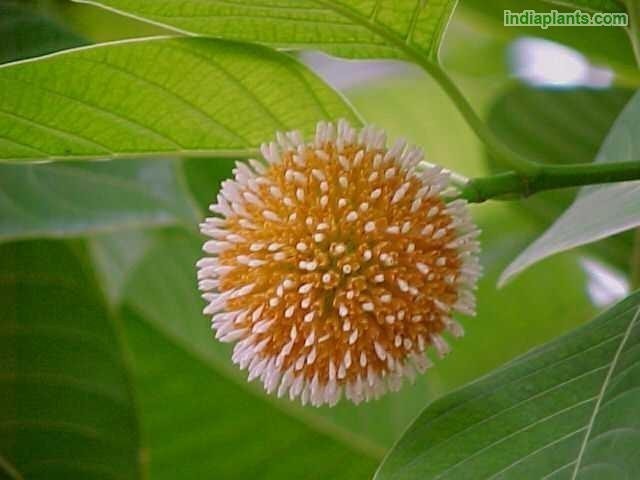
Kadam flowers are sweetly fragrant, red to orange in colour, occurring in dense, globular heads of approximately 5.5 cm (2.2 in) diameter.
The fruit of N. cadamba occur in small, fleshy capsules packed closely together to form a fleshy yellow-orange infructescence containing approximately 8000 seeds. On maturing, the fruit splits apart, releasing the seeds, which are then dispersed by wind or rain.
Stamens 5, inserted on the corolla tube, filaments short, anthers basifixed. Ovary inferior, bi-locular, sometimes 4-locular in the upper part, style exserted and a spindle-shaped stigma.
Fruitlets numerous with their upper parts containing 4 hollow or solid structures. Seed trigonal or irregularly shaped.
The sapwood is white with a light yellow tinge becoming creamy yellow on exposure and is not clearly differentiated from the heartwood.
Taxonomy
The botanical name of this species has been the subject of a long taxonomic debate, beginning in the 1930s. The problem arose because scientific names are based on type specimens. In 1785 Jean-Baptiste Lamarck described a specimen under the name Cephalanthus chinensis, stating that it came from Madagascar. In 1830, Achille Richard created the name Anthocephalus indicus, stating that the species came from Asia and that his description was based on the same specimen as Lamarck's Cephalanthus chinensis.[7] (Under the rules of the International Code of Nomenclature for algae, fungi, and plants, Richard should have used the name A. chinensis rather than A. indicus, as he should not have changed the specific epithet.)
The issue is whether Richard was indeed using the same specimen as Lamarck; the geographical origin is said to be different, and the descriptions do not match; for example in Lamarck's Cephalanthus chinensis the inflorescences are axillary whereas in Richard's Anthocephalus they are terminal. If specimens were the same, then Anthocephalus is a synonym of the Madagascan Cephalanthus and cannot be a generic name for the Asian kadam tree. If they were different (in spite of Richard's claim that they were the same) then Anthocephalus could be a generic name for the kadam tree. Based on the latter view, the name Anthocephalus chinensis has been widely used for the kadam tree.[7]
The current view taken by most taxonomic sources is that Richard's Anthocephalus indicus or Anthocephalus chinensis is a synonym of Cephalanthus chinensis (now transferred to the genus Breonia as Breonia chinensis (Lam.) Capuron), and that the widespread use of Anthocephalus chinensis for the kadam tree is an error. (This erroneous sense of the scientific name is shown by writing A. chinensis auct., where "auct." is an abbreviation of the Latin for "of authors", i.e. rather than of the correct authority.)
Given that Richard's name for the kadam tree is incorrect, the earliest name is William Roxburgh's 1824 Nauclea cadamba. In 1984, Jean Marie Bosser created the new generic name Neolamarckia, honouring Lamarck, for the Asian genus which matched Richard's description of his Anthocephalus, transferring Nauclea cadamba as Neolamarckia cadamba (Roxb.) Bosser.[7] However, not all botanical sources have accepted this taxonomic analysis and the name Anthocephalus is still in use for the Asian genus.
Uses
The fruit and inflorescences are reportedly edible by humans. The fresh leaves are fed to cattle. N. lamarckia is grown as an ornamental, and for low-grade timber and paper. The timber is used for plywood, light construction, pulp and paper, boxes and crates, dug-out canoes, and furniture components. Kadamba yields a pulp of satisfactory brightness and performance as a hand sheet. The wood can be easily impregnated with synthetic resins to increase its density and compressive strength. The wood has a density of 290–560 kg/cu m at 15% moisture content, a fine to medium texture; straight grain; low luster and has no characteristic odor or taste. It is easy to work, with hand and machine tools, cuts cleanly, gives a very good surface and is easy to nail. The timber air dries rapidly with little or no degrade. Kadamba wood is very easy to preserve using either open tank or pressure-vacuum systems.
Kadamba is one of the most frequently planted trees in the tropics. The tree is grown along avenues, roadsides and villages for shade. Kadamba are suitable for reforestation programs. It sheds large amounts of leaf and non-leaf litter which on decomposition improves some physical and chemical properties of soil under its canopy. This reflects an increase in the level of soil organic carbon, cation-exchange capacity, available plant nutrients and exchangeable bases.
A yellow dye is obtained from the root bark. Kadamba flowers are an important raw material in the production of ‘attar’, which is Indian perfume with sandalwood (Santalum spp.) base in which one of the essences is absorbed through hydro-distillation. An extract of the leaves serves as a mouth gargle.
The leaf extract has recently been used to produce silver nanoparticles for surface-enhanced Raman spectroscopy.
Symbolism
The kadamba flower was the emblem of Athmallik State, one of the princely states of India during the period of the British Raj.[10]
The kadamba lends its name to the Kadamba Dynasty that ruled from Banavasi in what is now the state of Karnataka from 345 CE to 525 CE, as per Talagunda inscription of c.450 CE.[11] The kadamba tree was considered a holy tree by the Kadamba dynasty.
According to tradition the 27 nakshatras, constituting 12 Houses (Rasis) and nine planets, are specifically represented precisely by 27 trees —one for each star. The kadamba tree is said to represent Shatabhisha, roughly corresponding to Aquarii
Religious significance
Kadamba is mentioned in the Bhagavata Purana. In North India, it is associated with Krishna while in the south it is known as "Parvati’s tree". Radha and Krishna are supposed to have conducted their love play in the hospitable and sweet-scented shade of the kadamba tree.[14] In the Sangam period of Tamil Nadu, Murugan of Tirupparankundram Hill of Madurai was referred to as a centre of nature worship. He was in the form of a spear under a kadamba tree.[15]
An episode from the life of Krishna narrates of when he stole the garments of gopis when they were bathing in a pond near Vrindavan. Varuna, the sea-god, had forbidden nude bathing in rivers, ponds and other public places, but gopis often resorted to it. One day, to teach them a lesson, Krishna reached the bank of the pond where they were taking a bath and took away their garments and spread them on the branches of nearby kadamba tree. He himself climbed the tree and hid there behind a branch. After the gopis had bathed, they looked for their garments but found them missing. Suddenly their attention was drawn to the nearby kadamba tree by the stirring of its branches. When they looked up, they saw Krishna hiding there and their garments scattered all over the branches of the tree. Krishna insisted that they come out naked to receive their garments. This episode is portrayed in song, story, painting and artifacts, in the backdrop of the kadamba tree.[16]
Karam-Kadamba is a popular harvest festival, celebrated on the eleventh lunar day of the month Bhadra. A twig of the tree is brought and worshipped in the courtyard of the house. Later in the day, young ears of grain are distributed among friends and relatives. This festive custom has been adopted by the Tulu people. Onam (Kerala) and Huttari (Kodagu) are regional variants of this festival.[17] Kadambotsava ("The festival of Kadamba") is also the festival that is celebrated every year by the Government of Karnataka in honor of the Kadamba kingdom, the first ruling Kingdom of Karnataka, at Banavasi, as it was here that the Kadamba kings organised the spring festival every year.[18]
The kadamba tree is also associated with a tree deity called Kadambariyamman.[19][20] The kadamba, which is considered the sthalavruksham ("tree of the place") of the city that is otherwise known as Kadambavanam (kadamba forest) and is present in Meenakshi Amman Temple.[19] A withered relic of the kadamba is also preserved there.[21]
In Theravada Buddhism, the kadamba tree was where Sumedha Buddha achieved enlightenment.
Vaša zahvalnost na komentar ne može biti registrovana
Prijavite nepristojan komentar
Da li ste sigurni da želite da prijavite ovaj komentar kao nepristojan?
Prija nepristojnog komentara registrovana
Vaša prijava nepristojnog komentara je registrovana i biće obrađena od strane moderatora.
Vaša prijava nepristojnog komentara ne može biti registrovana
Write your review
Komentar poslat
Vaš komentar je registrovan i biće objavljen čim bude odobren od strane moderatora.
Vaš komentar ne može biti registrovan
🌍 Dostava širom svijeta iz EU
Šaljemo širom svijeta iz Europske unije preporučenom zračnom poštom uz obavezan potpis prilikom isporuke.
📦 Praćenje vaše narudžbe
Kako biste pronašli svoj broj za praćenje, prijavite se na svoj račun i idite na: Povijest narudžbi > Detalji. Vaš broj za praćenje nalazi se izravno unutar detalja narudžbe.
Primat ćete e-mail obavijesti za svaku fazu vaše narudžbe.
Ako ne vidite ove poruke, provjerite svoju mapu Spam/Bezvrijedna pošta ili kontaktirajte svog pružatelja e-mail usluga. Alternativno, potražite na mreži kako deblokirati e-poštu pošiljatelja.
NAŠA E-MAIL USLUGA RADI — Ako ne primate e-poštu, vjerojatno je problem u vašem pružatelju e-mail usluga ili postavkama.
📧 Kako osigurati da e-poruke iz naše online trgovine uvijek završe u vašem sandučiću
Kako biste spriječili da se naše e-poruke označe kao spam, dodajte našu e-mail adresu u svoje kontakte:
Otvorite Gmail (ili bilo kojeg drugog pružatelja usluga) i pronađite našu e-poruku (xxxxxxxxxxxx@xxx.com).
Prijeđite mišem preko imena ili e-mail adrese pošiljatelja.
Kliknite na ikonu "Dodaj u kontakte" (ikona male osobe).
Ne možemo vam pomoći ako vaše postavke nisu ovakve. Za pomoć se obratite svom pružatelju e-mail usluga.
Alternativno, izradite filtar u Gmailu:
Otvorite Gmail i idite na Postavke > Vidi sve postavke.
Idite na karticu Filtri i blokirane adrese.
Kliknite na Izradi novi filtar i unesite našu e-mail adresu.
Označite Nikada ne šalji u Spam i kliknite na Izradi filtar.
📍 Pratite svoj paket
Vaš broj za praćenje nalazi se u detaljima vaše narudžbe. Svoj paket možete pratiti putem sljedećih platformi:
Posta.hr (za brojeve za praćenje poput RGxxxxxxHR)
⚠️ Važne napomene
Plaćanje pouzećem NIJE dostupno.
Prilikom narudžbe uvijek navedite važeći broj mobilnog telefona s pozivnim brojem države (npr. +385 91 123 4567).
NE naručujte na poštanske pretince (P.O. Box) ili ako ne možete biti kod kuće da potpišete paket. Pakete se ne mogu ostaviti kod susjeda.
Ako se paket poslan na poštanski pretinac izgubi ili ne isporuči, povrat novca neće biti izvršen.
⚖️ Odgovornost kupca za usklađenost sa zakonom
Kupac je odgovoran osigurati da je proizvod legalan za uvoz u njegovu zemlju, uključujući usklađenost sa svim uvoznim propisima, ishođenje potrebnih dozvola te plaćanje primjenjivih carina, poreza i drugih naknada. Prije narudžbe provjerite lokalne zakone.
🔄 Izgubljeni, vraćeni i ponovno poslani paketi
Kupci iz Brazila i Meksika: Ne možemo izvršiti povrat novca za pakete koje je carina izgubila ili uništila.
Ako se vaš paket vrati, vratit ćemo samo trošak proizvoda — troškovi dostave se ne vraćaju.
Povratnu poštarinu (2 €) i sve troškove ponovnog slanja mora snositi kupac.
🚚 Isporuka pošiljke
Preporučene pošiljke zahtijevaju potpis.
Ako praćenje pokazuje da je paket još uvijek u polaznom poštanskom uredu, on je u tranzitu — kontaktirajte svoj lokalni poštanski ured za ažuriranja.
Nažalost, ni mi ni pošta preko koje je vaša narudžba poslana ne možemo vam pomoći oko pitanja gdje se točno nalazi vaša narudžba. Kada vidite da je paket u vašoj zemlji, MORATE kontaktirati svoj poštanski ured s brojem za praćenje.
⏱️ Opcije dostave i procijenjena vremena
Opcija dostave
Vrijeme obrade
Napomene
Priority Delivery
Šalje se u roku od 1–7 radnih dana
Prioritetna obrada; moguća kašnjenja tijekom praznika (3–10 dana)
Secured Delivery
Šalje se u roku od 1–7 radnih dana
Dostupno za narudžbe do 150 €; povrat novca u slučaju gubitka
Standard Delivery
Šalje se u roku od 7–10 radnih dana
Ekonomičnije; moguća kašnjenja tijekom praznika (7–14 dana)
Procijenjena vremena dostave:
Unutar EU: 3–20 dana
Ostatak svijeta: 5–30 dana
Napomena: Vrijeme dostave ovisi o vašoj lokaciji i lokalnom poštanskom sustavu. COVID-19 ili blagdanska razdoblja mogu uzrokovati dodatna kašnjenja.
💰 Troškovi dostave
Troškovi dostave i rukovanja izračunavaju se automatski prilikom naplate na temelju težine paketa i odredišta.
⏰ Radno vrijeme obrade narudžbi
Narudžbe ne obrađujemo niti šaljemo subotom i nedjeljom.
💳 Opcije plaćanja
Željeli bismo vas informirati o važnoj promjeni u vezi s naknadama za plaćanje. Nažalost, zbog iznimno visokih transakcijskih naknada koje nameće PayPal, prisiljeni smo primijeniti doplatu za plaćanja izvršena putem njihove usluge.
Međutim, imamo rješenje za vas! Ove astronomske naknade možete izbjeći odabirom jednog od naših alternativnih načina plaćanja s NULA PROVIZIJE:
Bankovni prijenos (SEPA / IBAN / SWIFT-BIC): U opis plaćanja navedite referencu svoje narudžbe. Narudžbe bez uplate u roku od 4 dana bit će automatski otkazane.
PayPal: Plaćanja se prihvaćaju isključivo u eurima. Molimo odaberite eure prilikom naplate.
Plaćanje karticom: Za kartična plaćanja posjetite našu partnersku stranicu: exotic-seeds.com
Prihvaćamo Visa, MasterCard, American Express, CB, Diners Club, Discover, China UnionPay, JCB i Discover.
⚠️ Transakcijske naknade
Kupci su odgovorni za sve bankovne ili PayPal transakcijske naknade.
📝 Završne napomene
Prije narudžbe uvijek provjerite našu web stranicu za posebne obavijesti, rasporede praznika ili specifične uvjete dostave koji bi mogli utjecati na vašu kupnju.