Un árbol muy grande, de crecimiento rápido, que llega hasta 45 m de altura y presenta una copa extensa de hojas grandes, con venas bien llamativas e inflorescencias poco comunes,
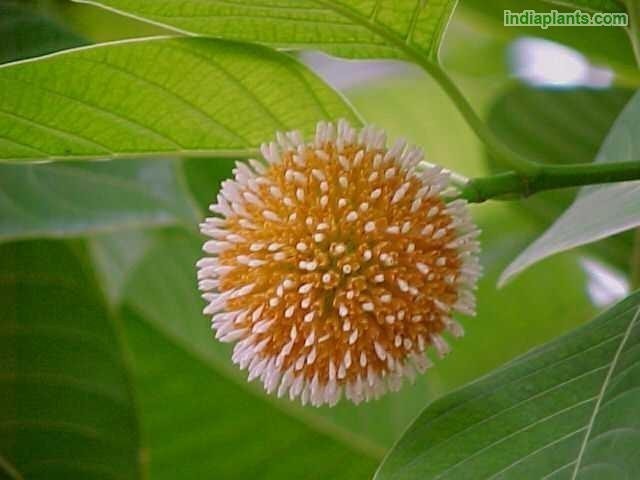
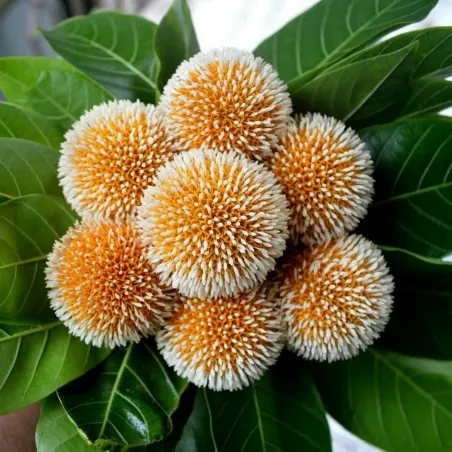
Un árbol muy grande, de crecimiento rápido, que llega hasta 45 m de altura y presenta una copa extensa de hojas grandes, con venas bien llamativas e inflorescencias poco comunes, perfectamente esféricas, aproximadamente 5 cm en diámetro, similares en forma a unos alfileteros, de color blanco y naranja.
Neolamarckia cadamba, with English common names burflower-tree, laran, and Leichhardt pine,[2] and called kadam[2] locally, is an evergreen, tropical tree native to South and Southeast Asia. The genus name honours French naturalist Jean-Baptiste Lamarck. It has scented orange flowers in dense globe-shaped clusters. The flowers are used in perfumes. The tree is grown as an ornamental plant and for timber and paper-making. Kadam features in Indian religions and mythologies.
A fully mature kadam tree can reach up to 45 m (148 ft) in height. It is a large tree with a broad crown and straight cylindrical bole. It is quick growing, with broad spreading branches and grows rapidly in the first 6–8 years. The trunk has a diameter of 100–160 cm, but typically less than that. Leaves are 13–32 cm (5.1–12.6 in) long. Flowering usually begins when the tree is 4–5 years old.
Kadam flowers are sweetly fragrant, red to orange in colour, occurring in dense, globular heads of approximately 5.5 cm (2.2 in) diameter.
The fruit of N. cadamba occur in small, fleshy capsules packed closely together to form a fleshy yellow-orange infructescence containing approximately 8000 seeds. On maturing, the fruit splits apart, releasing the seeds, which are then dispersed by wind or rain.
Stamens 5, inserted on the corolla tube, filaments short, anthers basifixed. Ovary inferior, bi-locular, sometimes 4-locular in the upper part, style exserted and a spindle-shaped stigma.
Fruitlets numerous with their upper parts containing 4 hollow or solid structures. Seed trigonal or irregularly shaped.
The sapwood is white with a light yellow tinge becoming creamy yellow on exposure and is not clearly differentiated from the heartwood.
Taxonomy
The botanical name of this species has been the subject of a long taxonomic debate, beginning in the 1930s. The problem arose because scientific names are based on type specimens. In 1785 Jean-Baptiste Lamarck described a specimen under the name Cephalanthus chinensis, stating that it came from Madagascar. In 1830, Achille Richard created the name Anthocephalus indicus, stating that the species came from Asia and that his description was based on the same specimen as Lamarck's Cephalanthus chinensis.[7] (Under the rules of the International Code of Nomenclature for algae, fungi, and plants, Richard should have used the name A. chinensis rather than A. indicus, as he should not have changed the specific epithet.)
The issue is whether Richard was indeed using the same specimen as Lamarck; the geographical origin is said to be different, and the descriptions do not match; for example in Lamarck's Cephalanthus chinensis the inflorescences are axillary whereas in Richard's Anthocephalus they are terminal. If specimens were the same, then Anthocephalus is a synonym of the Madagascan Cephalanthus and cannot be a generic name for the Asian kadam tree. If they were different (in spite of Richard's claim that they were the same) then Anthocephalus could be a generic name for the kadam tree. Based on the latter view, the name Anthocephalus chinensis has been widely used for the kadam tree.[7]
The current view taken by most taxonomic sources is that Richard's Anthocephalus indicus or Anthocephalus chinensis is a synonym of Cephalanthus chinensis (now transferred to the genus Breonia as Breonia chinensis (Lam.) Capuron), and that the widespread use of Anthocephalus chinensis for the kadam tree is an error. (This erroneous sense of the scientific name is shown by writing A. chinensis auct., where "auct." is an abbreviation of the Latin for "of authors", i.e. rather than of the correct authority.)
Given that Richard's name for the kadam tree is incorrect, the earliest name is William Roxburgh's 1824 Nauclea cadamba. In 1984, Jean Marie Bosser created the new generic name Neolamarckia, honouring Lamarck, for the Asian genus which matched Richard's description of his Anthocephalus, transferring Nauclea cadamba as Neolamarckia cadamba (Roxb.) Bosser.[7] However, not all botanical sources have accepted this taxonomic analysis and the name Anthocephalus is still in use for the Asian genus.
Uses
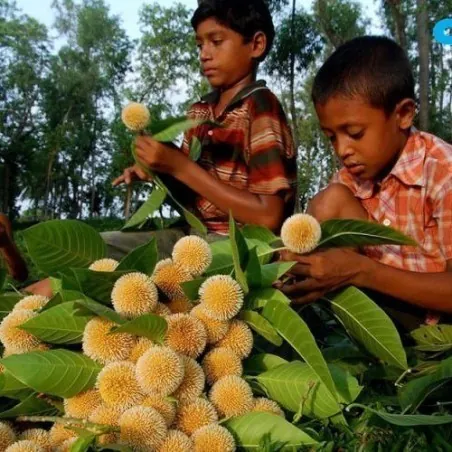
The fruit and inflorescences are reportedly edible by humans. The fresh leaves are fed to cattle. N. lamarckia is grown as an ornamental, and for low-grade timber and paper. The timber is used for plywood, light construction, pulp and paper, boxes and crates, dug-out canoes, and furniture components. Kadamba yields a pulp of satisfactory brightness and performance as a hand sheet. The wood can be easily impregnated with synthetic resins to increase its density and compressive strength. The wood has a density of 290–560 kg/cu m at 15% moisture content, a fine to medium texture; straight grain; low luster and has no characteristic odor or taste. It is easy to work, with hand and machine tools, cuts cleanly, gives a very good surface and is easy to nail. The timber air dries rapidly with little or no degrade. Kadamba wood is very easy to preserve using either open tank or pressure-vacuum systems.
Kadamba is one of the most frequently planted trees in the tropics. The tree is grown along avenues, roadsides and villages for shade. Kadamba are suitable for reforestation programs. It sheds large amounts of leaf and non-leaf litter which on decomposition improves some physical and chemical properties of soil under its canopy. This reflects an increase in the level of soil organic carbon, cation-exchange capacity, available plant nutrients and exchangeable bases.
A yellow dye is obtained from the root bark. Kadamba flowers are an important raw material in the production of ‘attar’, which is Indian perfume with sandalwood (Santalum spp.) base in which one of the essences is absorbed through hydro-distillation. An extract of the leaves serves as a mouth gargle.
The leaf extract has recently been used to produce silver nanoparticles for surface-enhanced Raman spectroscopy.
Symbolism
The kadamba flower was the emblem of Athmallik State, one of the princely states of India during the period of the British Raj.[10]
The kadamba lends its name to the Kadamba Dynasty that ruled from Banavasi in what is now the state of Karnataka from 345 CE to 525 CE, as per Talagunda inscription of c.450 CE.[11] The kadamba tree was considered a holy tree by the Kadamba dynasty.
According to tradition the 27 nakshatras, constituting 12 Houses (Rasis) and nine planets, are specifically represented precisely by 27 trees —one for each star. The kadamba tree is said to represent Shatabhisha, roughly corresponding to Aquarii
Religious significance
Kadamba is mentioned in the Bhagavata Purana. In North India, it is associated with Krishna while in the south it is known as "Parvati’s tree". Radha and Krishna are supposed to have conducted their love play in the hospitable and sweet-scented shade of the kadamba tree.[14] In the Sangam period of Tamil Nadu, Murugan of Tirupparankundram Hill of Madurai was referred to as a centre of nature worship. He was in the form of a spear under a kadamba tree.[15]
An episode from the life of Krishna narrates of when he stole the garments of gopis when they were bathing in a pond near Vrindavan. Varuna, the sea-god, had forbidden nude bathing in rivers, ponds and other public places, but gopis often resorted to it. One day, to teach them a lesson, Krishna reached the bank of the pond where they were taking a bath and took away their garments and spread them on the branches of nearby kadamba tree. He himself climbed the tree and hid there behind a branch. After the gopis had bathed, they looked for their garments but found them missing. Suddenly their attention was drawn to the nearby kadamba tree by the stirring of its branches. When they looked up, they saw Krishna hiding there and their garments scattered all over the branches of the tree. Krishna insisted that they come out naked to receive their garments. This episode is portrayed in song, story, painting and artifacts, in the backdrop of the kadamba tree.[16]
Karam-Kadamba is a popular harvest festival, celebrated on the eleventh lunar day of the month Bhadra. A twig of the tree is brought and worshipped in the courtyard of the house. Later in the day, young ears of grain are distributed among friends and relatives. This festive custom has been adopted by the Tulu people. Onam (Kerala) and Huttari (Kodagu) are regional variants of this festival.[17] Kadambotsava ("The festival of Kadamba") is also the festival that is celebrated every year by the Government of Karnataka in honor of the Kadamba kingdom, the first ruling Kingdom of Karnataka, at Banavasi, as it was here that the Kadamba kings organised the spring festival every year.[18]
The kadamba tree is also associated with a tree deity called Kadambariyamman.[19][20] The kadamba, which is considered the sthalavruksham ("tree of the place") of the city that is otherwise known as Kadambavanam (kadamba forest) and is present in Meenakshi Amman Temple.[19] A withered relic of the kadamba is also preserved there.[21]
In Theravada Buddhism, the kadamba tree was where Sumedha Buddha achieved enlightenment.
¿Está seguro de que quiere denunciar este comentario?
Reporte enviado
Su reporte ha sido enviado y será considerada por un moderador.
Su reporte no pudo ser enviado
Escriba su propia reseña
Reseña enviada
Su comentario ha sido añadido y estará disponible una vez sea aprobado por un moderador.
Su reseña no pudo ser enviada
🌍 Envíos a todo el mundo desde la UE
Realizamos envíos a todo el mundo desde la Unión Europea mediante correo aéreo certificado con firma obligatoria en el momento de la entrega.
📦 Seguimiento de su pedido
Para encontrar su número de seguimiento, inicie sesión en su cuenta y vaya a: Historial de pedidos > Detalles. Su número de seguimiento se encuentra directamente dentro de los detalles del pedido.
Recibirá notificaciones por correo electrónico en cada etapa de su pedido.
Si no ve estos mensajes, revise su carpeta de Spam/Correo no deseado o contacte con su proveedor de correo. Alternativamente, busque en línea cómo desbloquear correos de remitentes específicos.
NUESTRO SERVICIO DE CORREO FUNCIONA — Si no recibe correos, es probable que sea un problema de su proveedor de correo o de su configuración.
📧 Cómo asegurar que los correos de nuestra tienda online lleguen siempre a su bandeja de entrada
Para evitar que nuestros correos sean marcados como spam, agregue nuestra dirección de correo a sus contactos:
Abra Gmail (o cualquier otro proveedor) y busque un correo naš (xxxxxxxxxxxx@xxx.com).
Pase el cursor sobre el nombre o la dirección de correo del remitente.
Haga clic en el icono "Añadir a contactos" (el icono de la personita).
No podemos ayudarle si su configuración no es esta. Contacte con su proveedor de correo para obtener ayuda.
Alternativamente, cree un filtro en Gmail:
Abra Gmail y vaya a Configuración > Ver todos los ajustes.
Vaya a la pestaña Filtros y direcciones bloqueadas.
Haga clic en Crear un nuevo filtro e introduzca nuestra dirección de correo.
Marque No marcar nunca como spam y haga clic en Crear filtro.
📍 Rastree su paquete
Su número de seguimiento se encuentra en los detalles de su pedido. Puede rastrear su pedido a través de las siguientes plataformas:
Posta.hr (para números de seguimiento como RGxxxxxxHR)
⚠️ Avisos importantes
El pago contra reembolso NO está disponible.
Al realizar el pedido, proporcione siempre un número de teléfono móvil válido con el código del país (ej: +34 612 345 678).
NO realice pedidos a apartados de correos (P.O. Boxes) o si no puede estar en casa para firmar el paquete. Los paquetes no se pueden dejar a vecinos.
Si un paquete enviado a un apartado de correos se pierde o no se entrega, no se realizará ningún reembolso.
⚖️ Responsabilidad del cliente sobre el cumplimiento legal
El cliente es responsable de asegurarse de que el producto es legal de importar en su país, incluyendo el cumplimiento de todas las regulaciones de importación, obtención de permisos necesarios y el pago de aranceles aduaneros, impuestos y otras tasas aplicables. Verifique las leyes locales antes de realizar el pedido.
🔄 Paquetes perdidos, devueltos y reenvíos
Clientes de Brasil y México: No podemos reembolsar paquetes perdidos o destruidos por la aduana.
Si su paquete es devuelto, reembolsaremos únicamente el coste del producto — los gastos de envío no son reembolsables.
La tasa de devolución (2 €) y cualquier coste de reenvío deben ser cubiertos por el cliente.
🚚 Entrega del envío
Los envíos certificados requieren una firma.
Si el seguimiento indica que el paquete aún está en la oficina de correos de origen, está en tránsito — contacte con su oficina de correos local para obtener actualizaciones.
Lamentablemente, ni nosotros ni la oficina de correos por la que se envió su pedido podemos ayudarle con la ubicación exacta de su pedido. Cuando vea que el paquete está en su país, DEBE contactar con su oficina de correos con el número de seguimiento.
⏱️ Opciones de entrega y tiempos estimados
Opción de entrega
Tiempo de procesamiento
Notas
Priority Delivery
Envío en 1–7 días hábiles
Prioriza el procesamiento del pedido; posibles retrasos en festivos (3–10 días)
Secured Delivery
Envío en 1–7 días hábiles
Disponible para pedidos de hasta 150 €; reembolso en caso de pérdida
Standard Delivery
Envío en 7–10 días hábiles
Más económico; posibles retrasos en festivos (7–14 días)
Tiempos de entrega estimados:
Dentro de la UE: 3–20 días
Resto del mundo: 5–30 días
Nota: Los tiempos de entrega dependen de su ubicación y del sistema postal local. El COVID-19 o las temporadas festivas pueden causar retrasos adicionales.
💰 Gastos de envío
Los gastos de envío y gestión se calculan automáticamente al finalizar la compra en función del peso del paquete y el destino.
⏰ Horario de procesamiento de pedidos
No procesamos ni enviamos pedidos los sábados ni domingos.
💳 Opciones de pago
Nos gustaría informarle sobre un cambio importante relacionado con las comisiones de pago. Lamentablemente, debido a las tasas de transacción excepcionalmente altas impuestas por PayPal, nos vemos obligados a aplicar un recargo para los pagos realizados a través de su servicio.
¡Sin embargo, tenemos una solución para usted! Puede evitar estas comisiones astronómicas eligiendo uno de nuestros métodos de pago alternativos con CERO COMISIÓN:
✅ Pago con Tarjeta de Crédito/Débito – 0% de Comisión
✅ Transferencia Bancaria – 0% de Comisión
Transferencia Bancaria (SEPA / IBAN / SWIFT-BIC): Incluya su referencia de pedido en la descripción del pago. Los pedidos sin pago dentro de los 4 días se cancelarán automáticamente.
PayPal: Los pagos se aceptan únicamente en euros. Seleccione euros durante la compra.
Pago con tarjeta: Aceptamos Visa, MasterCard, American Express, CB, Diners Club, Discover, China UnionPay, JCB y Discover.
⚠️ Comisiones de transacción
Los clientes son responsables de cualquier comisión de transacción bancaria o de PayPal.
📝 Notas finales
Antes de realizar su pedido, verifique siempre nuestro sitio web para avisos especiales, calendarios de festivos o condiciones de envío específicas.