

Medicinal or spice plant
Echinacea purpurea, the eastern purple coneflower, purple coneflower, hedgehog coneflower, or echinacea, is a North American species of flowering plant in the sunflower family. It is native to parts of eastern North America and presents to some extent
Echinacea purpurea, the eastern purple coneflower, purple coneflower, hedgehog coneflower, or echinacea, is a North American species of flowering plant in the sunflower family. It is native to parts of eastern North America and presents to some extent in the wild in much of the eastern, southeastern, and midwestern United States as well as in the Canadian Province of Ontario. It is most common in the Ozarks and in the Mississippi/Ohio Valley. Its habitats include dry open woods, prairies, and barrens.
Echinacea is derived from Greek, meaning ‘spiny one’, in reference to the spiny sea urchins 'εχίνοι' which the ripe flower heads of species of this genus resemble. The epithet purpurea means 'reddish-purple'.[7] Originally named Rudbeckia purpurea by Linnaeus in 1753 in Species plantarum 6, it was reclassified in 1794 by Conrad Moench, in a new genus named Echinacea purpurea (L.) Moench. In 1818, Thomas Nuttall describes a new variety that he named Rudbeckia purpurea var. serotina. Just two decades later, De Candolle raised him to the rank of species of the other genus Echinacea serotina (Nutt.) DC. (1836).[8] In 2002, Binns et al. discovered a misapplication of the name Echinacea purpurea (L.) Moench for the taxon correctly named Echinacea serotina (Nutt.) DC. in 1836. The authors proposed to retain the names not to cause confusion among gardeners and herbalists.[9] Other names include: Broad-leaved purple coneflower, Eastern Purple Coneflower, Hedgehog Coneflower, Echinacea.
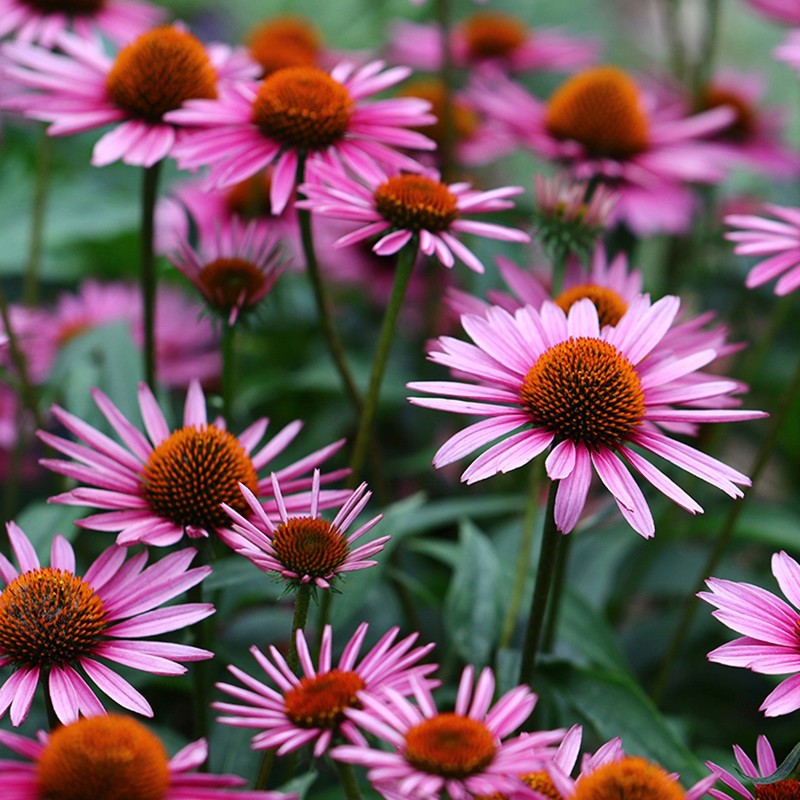
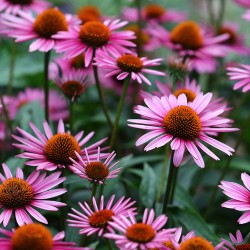
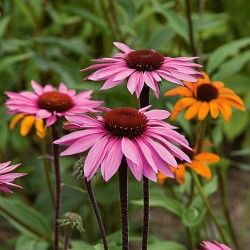
Echinacea purpurea is an herbaceous perennial up to 120 cm (47 in) tall by 25 cm (10 in) wide at maturity. Depending on the climate, it blooms throughout summer into autumn. Its cone-shaped flowering heads are usually, but not always, purple in the wild. Its individual flowers (florets) within the flower head are hermaphroditic, having both male and female organs in each flower. It is pollinated by butterflies and bees. The alternate leaves, borne by a petiole from 0 to 17 cm, are oval to lanceolate, 5-30 x 5-12 cm; the margin is tightened to toothed.
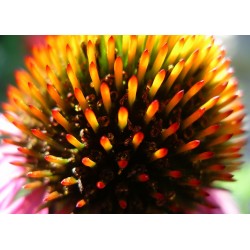
The inflorescence is a capitulum, 7 to 15 cm in diameter, formed by a prominent domed central protuberance consisting of multiple small yellow florets. These are surrounded by a ring of pink or purple ligulate florets. The tubular florets are hermaphrodite while the ligular florets are sterile. The involucral bracts are linear to lanceolate. The plant prefers well-drained soils in full sun.[2] The fruit is an achene, sought after by birds.
Echinacea purpurea is grown as an ornamental plant in temperate regions. It is ideal for curbs, walkways or beds. The flowers can also go into the composition of fresh bouquets. Numerous cultivars have been developed for flower quality and plant form.[3] The plant grows in sun or light shade.[10] It thrives in either dry or moist soil and can tolerate drought once established. The cultivars 'Ruby Giant'[11] and Elton Knight='Elbrook'[12] have gained the Royal Horticultural Society's Award of Garden Merit.[13]
Echinacea purpurea is propagated either vegetatively or from seeds.[4] Useful vegetative techniques include division, root cuttings, and basal cuttings. Clumps can be divided, or broken into smaller bunches, which is normally done in the spring or autumn. Cuttings made from roots that are "pencil-sized" will develop into plants when started in late autumn or early winter.[3] Cuttings of basal shoots in the spring may be rooted when treated with rooting hormones, such as IBA at 1000 ppm.[14]
Seed germination occurs best with daily temperature fluctuations[4] or after stratification,[15] which help to end dormancy. Seeds may be started indoors in advance of the growing season or outdoors after the growing season has started.
Slugs[4] and rabbits will also eat the foliage when young, or shortly after emerging in the spring.[16] Additionally, roots can be damaged and eaten by gophers.[5]
Echinacea purpurea contains alkamides, caffeic acid derivatives, polysaccharides, and glycoproteins.[17] Nicotiflorin is the dominant flavonoid in E. purpurea, followed by the flavonoid rutin.[18]
Native Americans used the plant as a traditional medicine to treat many ailments.
Medicinal ingredients
Three types of echinacea show healing properties: (Echinacea purpurea, Echinacea angustifolia and Echinacea pallida). These species contain in different ratios: phenolic carboxylic acids and depsidic acids: caffeic, chlorogenic and dicapheoylcholic acid; esters of caffeic ivic acid and ferulinic and tartaric acid. Esters of sugar and caffeic acid - echinacosides are also present; unsaturated, aliphatic compounds: amides, isobutylamides, polyene acids ...
Medicinal effect and use
Both above-ground and underground parts of the plant are used, from which syrup, tea, tinctures, sprays, tablets, juices, etc. can be made. Various products based on this plant can now be found on our market, but caution is advised when using them. It is best to seek advice from experts (pharmacists) in order to avoid the use of insufficiently good preparations and for the dosage to be correct.
Among the American Indians, this plant is the basis of folk medicine, like lynx in our nation. They use it against snake bites and stings of poisonous insects (it has an antiseptic effect) and inflammation, as well as for raising and maintaining immunity.
Today, it is mostly used to raise immunity and to improve the defense against infection by microorganisms (viruses, bacteria). The use of echinacea increases non-specific immunity, ie it achieves a better defense ability of the organism against anything that could harm it.
Echinacea is considered to increase the body's defenses by increasing the number of leukocytes (white blood cells), and stimulates the synthesis of interferon, a protein that participates in the body's defense against viral infections. The best effect is achieved when preparations of this plant are taken as soon as the first symptoms of flu or cold are noticed, that is, before the disease develops. This helps the body to resist infection. Echinacea has antibacterial and antiviral effects. It is also applied locally, for wounds, injuries, bites, stings ... because it has an antibacterial effect and accelerates wound healing by creating connective tissue. It is used in case of infections or preventively, to stimulate immunity, and it is not recommended to use it for more than 8 weeks in a row. German Commission E approved the use of echinacea extract in colds and chronic respiratory infections, and in lower urinary tract infections.
Side effects
No side effects were reported. Allergies are possible in people who are allergic to other plants from the Asteraceae family (dandelion, chamomile ...).
Contraindications
Due to its immunostimulatory properties, echinacea should not be used in autoimmune diseases (AIDS, multiple sclerosis, collagenosis, lupus, rheumatoid arthritis, ...). Concomitant use with immunosuppressants and corticosteroids is contraindicated. It does not apply to children younger than 2 years.
Due to insufficient knowledge of the composition and action of echinacea, it is not recommended during pregnancy and breastfeeding. The application is contraindicated in the following systemic diseases: tuberculosis, multiple sclerosis, autoimmune diseases.
Data sheet
Echinacea purpurea, the eastern purple coneflower, purple coneflower, hedgehog coneflower, or echinacea, is a North American species of flowering plant in the sunflower family. It is native to parts of eastern North America and presents to some extent