


Cassava, Yuca, Macaxeira, Mandioca, Aipim Seeds (Manihot esculenta)
Price for Package of 3 seeds.
Manihot esculenta, commonly called cassava (/kəˈsɑːvə/), manioc, yuca, macaxeira, mandioca and aipim, is a woody shrub native to South America of the spurge family, Euphorbiaceae. Although a perennial plant, cassava is extensively cultivated as an annual crop in tropical and subtropical regions for its edible starchy tuberous root, a major source of carbohydrates. Though it is often called yuca in Latin American Spanish and in the United States, it is not related to yucca, a shrub in the family Asparagaceae. Cassava is predominantly consumed in boiled form, but substantial quantities are used to extract cassava starch, called tapioca, which is used for food, animal feed, and industrial purposes. The Brazilian farinha, and the related garri of West Africa, is an edible coarse flour obtained by grating cassava roots, pressing moisture off the obtained grated pulp, and finally drying it (and roasting in the case of farinha).
Cassava is the third-largest source of food carbohydrates in the tropics, after rice and maize.[3][4] Cassava is a major staple food in the developing world, providing a basic diet for over half a billion people.[5] It is one of the most drought-tolerant crops, capable of growing on marginal soils. Nigeria is the world's largest producer of cassava, while Thailand is the largest exporter of cassava starch.
Cassava is classified as either sweet or bitter. Like other roots and tubers, both bitter and sweet varieties of cassava contain antinutritional factors and toxins, with the bitter varieties containing much larger amounts.[6] It must be properly prepared before consumption, as improper preparation of cassava can leave enough residual cyanide to cause acute cyanide intoxication,[7][8] goiters, and even ataxia, partial paralysis, or death. The more toxic varieties of cassava are a fall-back resource (a "food security crop") in times of famine or food insecurity in some places.[7][6] Farmers often prefer the bitter varieties because they deter pests, animals, and thieves.
Description
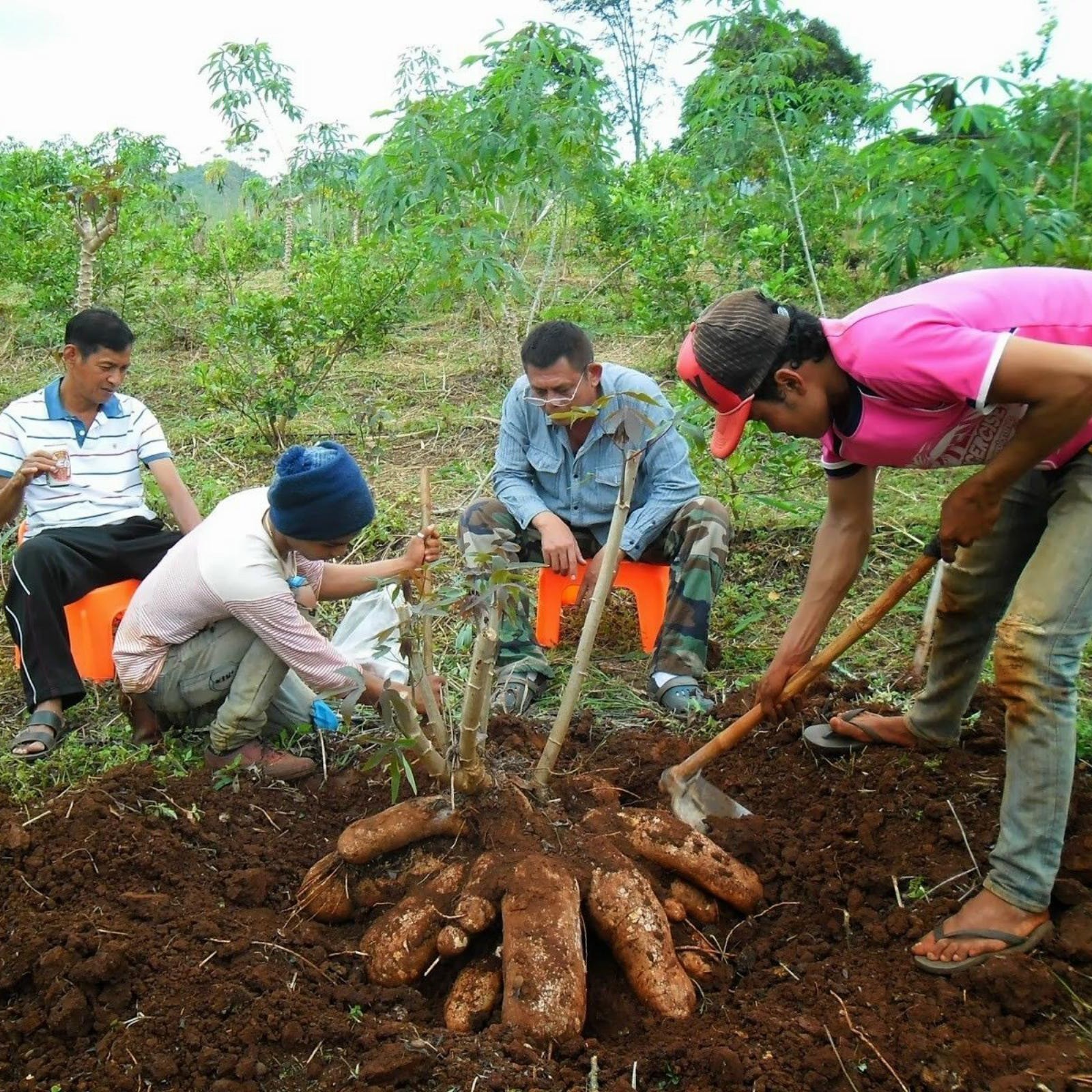
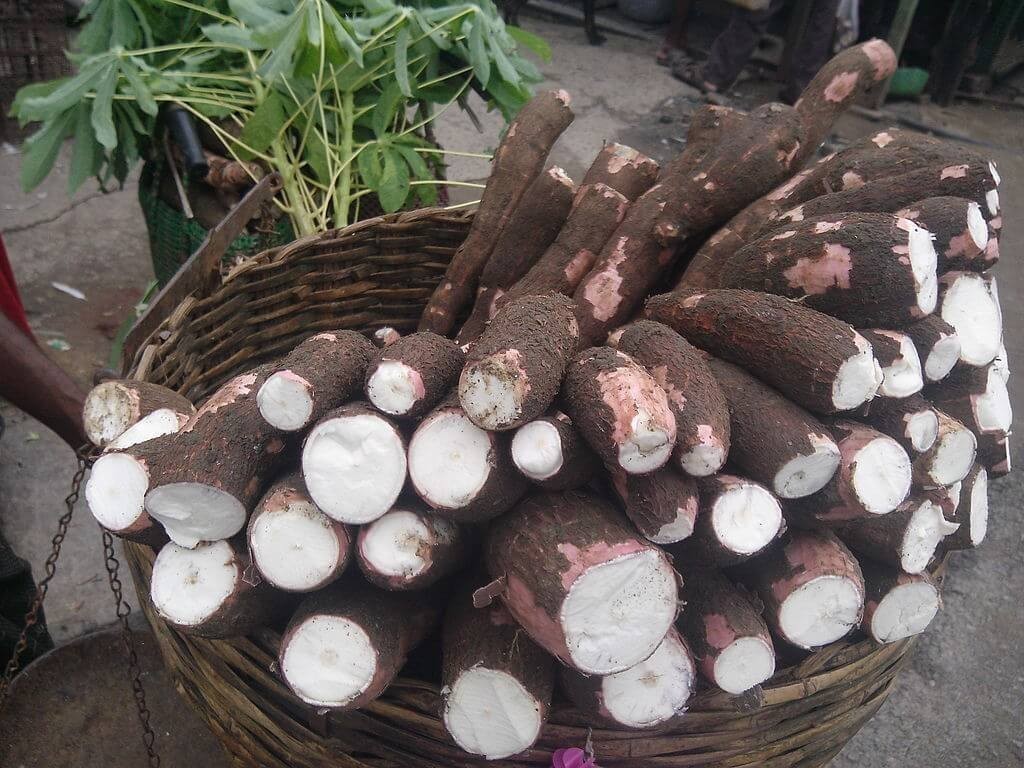
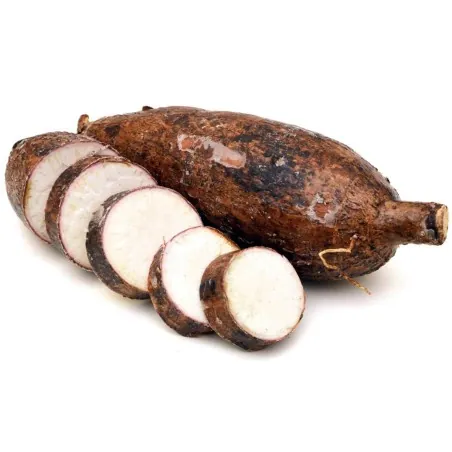
The cassava root is long and tapered, with a firm, homogeneous flesh encased in a detachable rind, about 1 mm thick, rough and brown on the outside. Commercial cultivars can be 5 to 10 cm (2.0 to 3.9 in) in diameter at the top, and around 15 to 30 cm (5.9 to 11.8 in) long. A woody vascular bundle runs along the root's axis. The flesh can be chalk-white or yellowish. Cassava roots are very rich in starch and contain small amounts of calcium (16 mg/100 g), phosphorus (27 mg/100 g), and vitamin C (20.6 mg/100 g).[10] However, they are poor in protein and other nutrients. In contrast, cassava leaves are a good source of protein (rich in lysine), but deficient in the amino acid methionine and possibly tryptophan.[11]
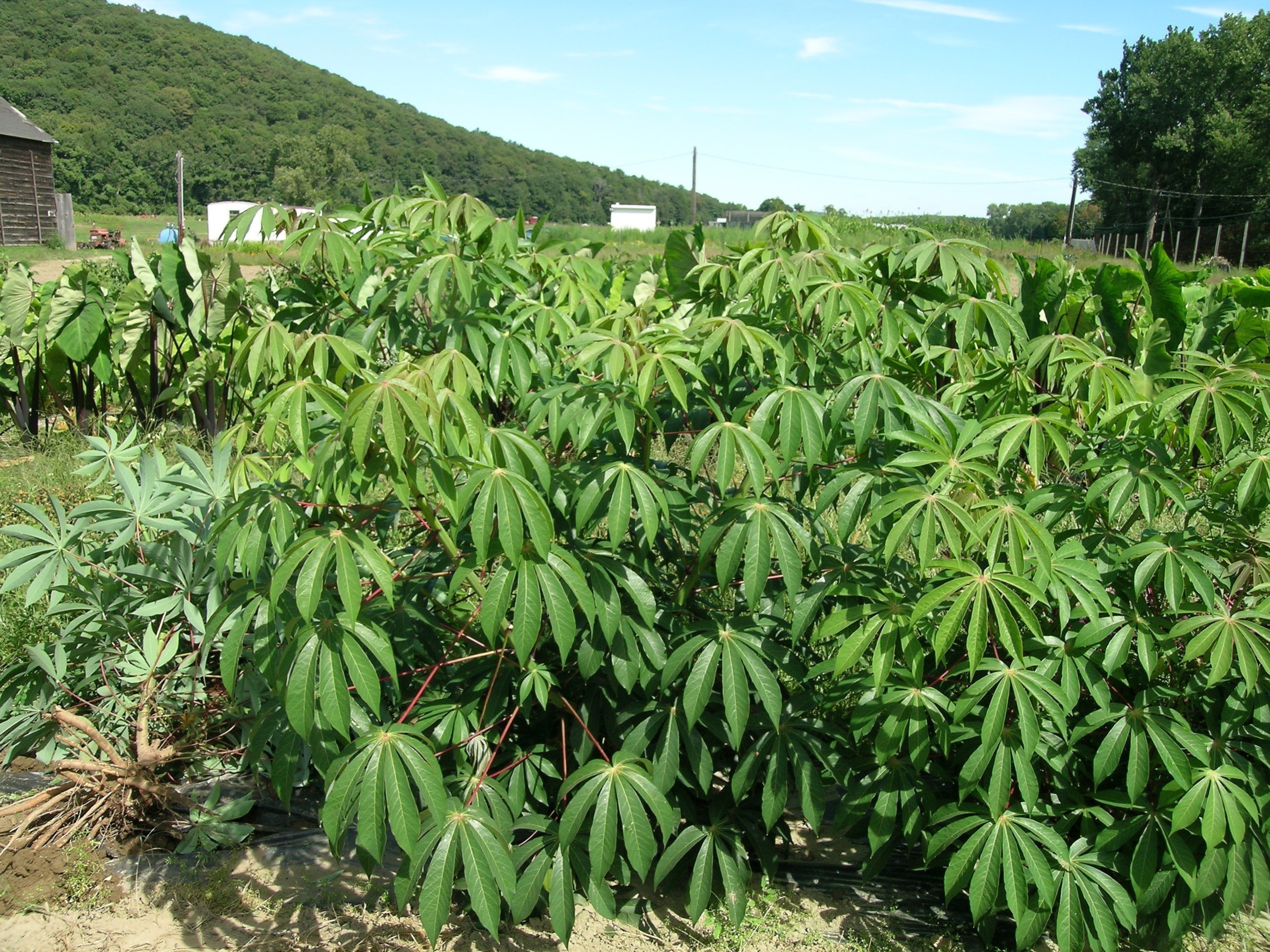
Details of cassava plants

Unprocessed roots

Leaf

Leaf detail

Picked buds

Seeds
History
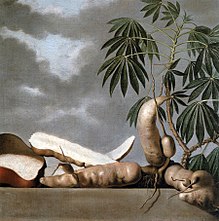
17th c. painting by Albert Eckhout in Dutch Brazil
Wild populations of M. esculenta subspecies flabellifolia, shown to be the progenitor of domesticated cassava, are centered in west-central Brazil, where it was likely first domesticated no more than 10,000 years BP.[12] Forms of the modern domesticated species can also be found growing in the wild in the south of Brazil. By 4,600 BC, manioc (cassava) pollen appears in the Gulf of Mexico lowlands, at the San Andrés archaeological site.[13] The oldest direct evidence of cassava cultivation comes from a 1,400-year-old Maya site, Joya de Cerén, in El Salvador.[14] With its high food potential, it had become a staple food of the native populations of northern South America, southern Mesoamerica, and the Caribbean by the time of European contact in 1492. Cassava was a staple food of pre-Columbian peoples in the Americas and is often portrayed in indigenous art. The Moche people often depicted yuca in their ceramics.[15]
Spaniards in their early occupation of Caribbean islands did not want to eat cassava or maize, which they considered insubstantial, dangerous, and not nutritious. They much preferred foods from Spain, specifically wheat bread, olive oil, red wine, and meat, and considered maize and cassava damaging to Europeans.[16] The cultivation and consumption of cassava was nonetheless continued in both Portuguese and Spanish America. Mass production of cassava bread became the first Cuban industry established by the Spanish,[17]Ships departing to Europe from Cuban ports such as Havana, Santiago, Bayamo, and Baracoa carried goods to Spain, but sailors needed to be provisioned for the voyage. The Spanish also needed to replenish their boats with dried meat, water, fruit, and large amounts of cassava bread.[18] Sailors complained that it caused them digestive problems.[19] Tropical Cuban weather was not suitable for wheat planting and cassava would not go stale as quickly as regular bread.
Cassava was introduced to Africa by Portuguese traders from Brazil in the 16th century. Around the same period, it was also introduced to Asia through Columbian Exchange by Portuguese and Spanish traders, planted in their colonies in Goa, Malacca, Eastern Indonesia, Timor and the Philippines. Maize and cassava are now important staple foods, replacing native African crops in places such as Tanzania.[20] Cassava has also become an important staple in Asia, extensively cultivated in Indonesia, Thailand and Vietnam.[21] Cassava is sometimes described as the "bread of the tropics"[22] but should not be confused with the tropical and equatorial bread tree (Encephalartos), the breadfruit (Artocarpus altilis) or the African breadfruit (Treculia africana).
Production
In 2016, global production of cassava root was 277 million tonnes, with Nigeria as the world's largest producer having 21% of the world total (table). Other major growers were Thailand, Brazil, and Indonesia.[23]
| Cassava production – 2016 | |
|---|---|
| Country | Production (millions of tonnes) |
 Nigeria Nigeria |
|
 Thailand Thailand |
|
 Brazil Brazil |
|
 Indonesia Indonesia |
|
 Democratic Republic of the Congo Democratic Republic of the Congo |
|
Cassava is one of the most drought-tolerant crops, can be successfully grown on marginal soils, and gives reasonable yields where many other crops do not grow well. Cassava is well adapted within latitudes 30° north and south of the equator, at elevations between sea level and 2,000 m (6,600 ft) above sea level, in equatorial temperatures, with rainfalls from 50 mm (2.0 in) to 5 m (16 ft) annually, and to poor soils with a pH ranging from acidic to alkaline. These conditions are common in certain parts of Africa and South America.
Cassava is a highly-productive crop when considering food calories produced per unit land area, per unit of time. Significantly higher than other staple crops, cassava can produce food calories at rates exceeding 250,000 kcal/hectare/day, as compared with 176,000 for rice, 110,000 for wheat and 200,000 for maize (corn).
Economic importance
See also: Tapioca § Production

A cassava tuber in cross-section
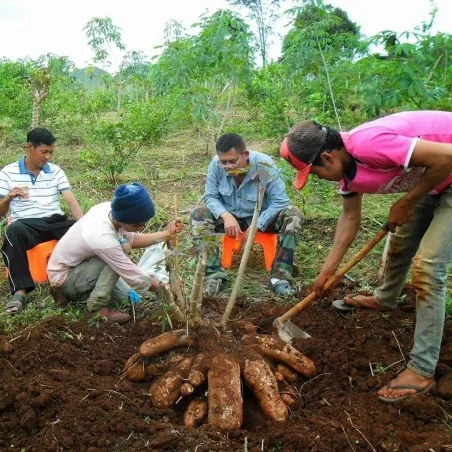
Cassava, yams (Dioscorea spp.), and sweet potatoes (Ipomoea batatas) are important sources of food in the tropics. The cassava plant gives the third-highest yield of carbohydrates per cultivated area among crop plants, after sugarcane and sugar beets.[24] Cassava plays a particularly important role in agriculture in developing countries, especially in sub-Saharan Africa, because it does well on poor soils and with low rainfall, and because it is a perennial that can be harvested as required. Its wide harvesting window allows it to act as a famine reserve and is invaluable in managing labor schedules. It offers flexibility to resource-poor farmers because it serves as either a subsistence or a cash crop.[25]
Worldwide, 800 million people depend on cassava as their primary food staple.[26] No continent depends as much on root and tuber crops in feeding its population as does Africa. In the humid and sub-humid areas of tropical Africa, it is either a primary staple food or a secondary costaple. In Ghana, for example, cassava and yams occupy an important position in the agricultural economy and contribute about 46 percent of the agricultural gross domestic product. Cassava accounts for a daily caloric intake of 30 percent in Ghanaand is grown by nearly every farming family. The importance of cassava to many Africans is epitomised in the Ewe (a language spoken in Ghana, Togo and Benin) name for the plant, agbeli, meaning "there is life".
In Tamil Nadu, India, there are many cassava processing factories alongside National Highway 68 between Thalaivasal and Attur. Cassava is widely cultivated and eaten as a staple food in Andhra Pradesh and in Kerala. In Assam it is an important source of carbohydrates especially for natives of hilly areas.
In the subtropical region of southern China, cassava is the fifth-largest crop in term of production, after rice, sweet potato, sugar cane, and maize. China is also the largest export market for cassava produced in Vietnam and Thailand. Over 60 percent of cassava production in China is concentrated in a single province, Guangxi, averaging over seven million tonnes annually.
Uses
See also: Tapioca § Uses

|
|
This section needs additional citations for verification. Please help improve this article by adding citations to reliable sources. Unsourced material may be challenged and removed.
Find sources: "Cassava" – news · newspapers · books · scholar · JSTOR (August 2017) (Learn how and when to remove this template message) |

Processing cassava starch into cassava noodles, Kampong Cham
Alcoholic beverages
Main article: Alcoholic beverage § Beverages by type
Alcoholic beverages made from cassava include cauim and tiquira (Brazil), kasiri (Guyana, Suriname), impala (Mozambique), masato (Peruvian Amazonia chicha), parakari or kari (Guyana), nihamanchi (South America) also known as nijimanche (Ecuador and Peru), ö döi (chicha de yuca, Ngäbe-Bugle, Panama), sakurá (Brazil, Suriname), and tarul ko jaarh (Darjeeling, Sikkim, India).
Culinary
Main article: Cassava-based dishes
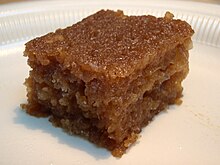
Cassava heavy cake
Cassava-based dishes are widely consumed wherever the plant is cultivated; some have regional, national, or ethnic importance.[27] Cassava must be cooked properly to detoxify it before it is eaten.
Cassava can be cooked in many ways. The root of the sweet variety has a delicate flavor and can replace potatoes. It is used in cholent in some households.[citation needed] It can be made into a flour that is used in breads, cakes and cookies. In Brazil, detoxified manioc is ground and cooked to a dry, often hard or crunchy meal known as farofa used as a condiment, toasted in butter, or eaten alone as a side dish.
Nutritional profile
| Nutritional value per 100 g (3.5 oz) | |
|---|---|
| Energy | 160 kcal (670 kJ) |
|
Carbohydrates |
38.1 g |
| Sugars | 1.7 g |
| Dietary fiber | 1.8 g |
|
Fat |
0.3 g |
|
Protein |
1.4 g |
| Vitamins | Quantity%DV† |
| Thiamine (B1) |
8% 0.087 mg |
| Riboflavin (B2) |
4% 0.048 mg |
| Niacin (B3) |
6% 0.854 mg |
| Vitamin B6 |
7% 0.088 mg |
| Folate (B9) |
7% 27 μg |
| Vitamin C |
25% 20.6 mg |
| Minerals | Quantity%DV† |
| Calcium |
2% 16 mg |
| Iron |
2% 0.27 mg |
| Magnesium |
6% 21 mg |
| Phosphorus |
4% 27 mg |
| Potassium |
6% 271 mg |
| Sodium |
1% 14 mg |
| Zinc |
4% 0.34 mg |
| Other constituents | Quantity |
| Water | 60 g |
Full Link to USDA Database entry
|
|
|
|
| †Percentages are roughly approximated using US recommendations for adults. | |
Raw cassava is 60% water, 38% carbohydrates, 1% protein, and has negligible fat (table).[28] In a 100 gram amount, raw cassava provides 160 calories and contains 25% of the Daily Value (DV) for vitamin C, but otherwise has no micronutrients in significant content (no values above 10% DV; table). Cooked cassava starch has a digestibility of over 75%.[28]
Cassava, like other foods, also has antinutritional and toxic factors. Of particular concern are the cyanogenic glucosides of cassava (linamarin and lotaustralin). On hydrolysis, these release hydrocyanic acid (HCN).[citation needed] The presence of cyanide in cassava is of concern for human and for animal consumption. The concentration of these antinutritional and unsafe glycosides varies considerably between varieties and also with climatic and cultural conditions. Selection of cassava species to be grown, therefore, is quite important. Once harvested, bitter cassava must be treated and prepared properly prior to human or animal consumption, while sweet cassava can be used after simply boiling.
Comparison with other major staple foods
A comparative table shows that cassava is a good energy source. In its prepared forms in which its toxic or unpleasant components have been reduced to acceptable levels, it contains an extremely high proportion of starch. Compared to most staples however, cassava accordingly is a poorer dietary source of protein and most other essential nutrients. Though an important staple, its main value is as a component of a balanced diet.
Comparisons between the nutrient content of cassava and other major staple foods when raw, as shown in the table, must be interpreted with caution because most staples are not edible in such forms and many are indigestible, even dangerously poisonous or otherwise harmful.[citation needed] For consumption, each must be prepared and cooked as appropriate. Suitably cooked or otherwise prepared, the nutritional and antinutritional contents of each of these staples is widely different from that of raw form and depends on the methods of preparation such as soaking, fermentation, sprouting, boiling, or baking.
Comentarii (0)
Aprecierea ta pentru recenzie nu a putut fi trimisa
Reclama un comentariu
Raport trimis
Reclamatia tau nu a putut fi trimisa