Dual-use variety. Delicious parsnip like roots. Full-flavored parsley leaves. Easy from seed. This species of parsley is widely grown in Europe and the Mediterranean but seldom seen in British gardens.
Dual-use variety. Delicious parsnip like roots. Full-flavored parsley leaves. Easy from seed. This species of parsley is widely grown in Europe and the Mediterranean but seldom seen in British gardens. One sowing in spring will provide all the parsley leaves you need for a whole season. Underground the plants produce a large parsnip like tap root identical to a parsnip.
These roots are delicious roasted and have a unique flavor and can be used as you would parsnips. The roots can be left in the ground through winter.
Wikipedia:
Parsley or garden parsley (Petroselinum crispum) is a species of flowering plant in the family Apiaceae that is native to the central Mediterranean region (Cyprus, southern Italy, Greece, Portugal, Spain, Malta, Morocco, Algeria, and Tunisia), but has naturalized elsewhere in Europe, and is widely cultivated as an herb, a spice, and a vegetable.
Where it grows as a biennial, in the first year, it forms a rosette of tripinnate leaves, 10–25 cm (3.9–9.8 in) long, with numerous 1–3 cm (0.4–1.2 in) leaflets and a taproot used as a food store over the winter. In the second year, it grows a flowering stem with sparser leaves and umbels with yellow to yellowish-green flowers.
Parsley is widely used in European, Middle Eastern, and American cuisine. Curly leaf parsley is often used as a garnish. In central Europe, eastern Europe, and southern Europe, as well as in western Asia, many dishes are served with fresh green chopped parsley sprinkled on top. Flat-leaf parsley is similar, but it is easier to cultivate, and some say it has a stronger flavor. Root parsley is very common in central, eastern, and southern European cuisines, where it is used as a snack or a vegetable in many soups, stews, and casseroles.
Etymology
Freeze-dried parsley showing name in German, Spanish and Greek on the label
The word "parsley" is a merger of Old English petersilie (which is identical to the contemporary German word for parsley: Petersilie) and the Old French peresil, both derived from Medieval Latin petrosilium, from Latin petroselinum,[1] which is the latinization of the Greek πετροσέλινον (petroselinon), "rock-celery",[2] from πέτρα (petra), "rock, stone",[3] + σέλινον (selinon), "celery".[4][5][6] Mycenaean Greek se-ri-no, in Linear B, is the earliest attested form of the word selinon.[7]
Description
Parsley leaves
Garden parsley is a bright green, biennial plant in temperate climates, or an annual herb in subtropical and tropical areas.
Where it grows as a biennial, in the first year, it forms a rosette of tripinnate leaves 10–25 cm long with numerous 1–3 cm leaflets, and a taproot used as a food store over the winter. In the second year, it grows a flowering stem to 75 cm (30 in) tall with sparser leaves and flat-topped 3–10 cm diameter umbels with numerous 2 mm diameter yellow to yellowish-green flowers. The seeds are ovoid, 2–3 mm long, with prominent style remnants at the apex. One of the compounds of the essential oil is apiol. The plant normally dies after seed maturation.[6][8][9]
Nutritional content
Parsley, fresh
Nutritional value per 100 g (3.5 oz)
Energy
151 kJ (36 kcal)
Carbohydrates
6.33 g
Sugars
0.85 g
Dietary fiber
3.3 g
Fat
0.79 g
Protein
2.97 g
Vitamins
Quantity%DV†
Vitamin A equiv.
beta-Carotene
lutein zeaxanthin
53%
421 μg
47%
5054 μg
5561 μg
Thiamine (B1)
7%
0.086 mg
Riboflavin (B2)
8%
0.09 mg
Niacin (B3)
9%
1.313 mg
Pantothenic acid (B5)
8%
0.4 mg
Vitamin B6
7%
0.09 mg
Folate (B9)
38%
152 μg
Vitamin C
160%
133 mg
Vitamin E
5%
0.75 mg
Vitamin K
1562%
1640 μg
Minerals
Quantity%DV†
Calcium
14%
138 mg
Iron
48%
6.2 mg
Magnesium
14%
50 mg
Manganese
8%
0.16 mg
Phosphorus
8%
58 mg
Potassium
12%
554 mg
Sodium
4%
56 mg
Zinc
11%
1.07 mg
Link to USDA Database entry
Units
μg = micrograms • mg = milligrams
IU = International units
†Percentages are roughly approximated using US recommendations for adults. Source: USDA Nutrient Database
Parsley is a source of flavonoids and antioxidants, especially luteolin, apigenin,[10] folic acid, vitamin K, vitamin C, and vitamin A. Half a tablespoon (a gram) of dried parsley contains about 6.0 µg of lycopene and 10.7 µg of alpha carotene as well as 82.9 µg of lutein+zeaxanthin and 80.7 µg of beta carotene.
Precautions
Excessive consumption of parsley should be avoided by pregnant women. Normal food quantities are safe for pregnant women, but consuming excessively large amounts may have uterotonic effects.
Cultivation
Parsley grows best in moist, well-drained soil, with full sun. It grows best between 22–30 °C (72–86 °F), and usually is grown from seed.[9] Germination is slow, taking four to six weeks,[9] and it often is difficult because of furanocoumarins in its seed coat.[13] Typically, plants grown for the leaf crop are spaced 10 cm apart, while those grown as a root crop are spaced 20 cm apart to allow for the root development.[9]
Parsley attracts several species of wildlife. Some swallowtail butterflies use parsley as a host plant for their larvae; their caterpillars are black and green striped with yellow dots, and will feed on parsley for two weeks before turning into butterflies. Bees and other nectar-feeding insects also visit the flowers. Birds such as the goldfinch feed on the seeds.
Cultivars
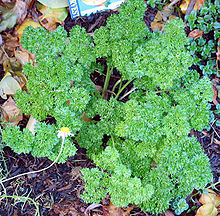
Parsley plant, crispum group
In cultivation, parsley is subdivided into several cultivar groups,[14] depending on the form of the plant, which is related to its end use. Often these are treated as botanical varieties,[15] but they are cultivated selections, not of natural botanical origin.[8]
Leaf parsley
The two main groups of parsley used as herbs are French, or curly leaf (P. crispum crispum group; syn. P. crispum var. crispum); and, Italian, or flat leaf (P. crispum neapolitanum group; syn. P. crispum var. neapolitanum). Of these, the neapolitanum group more closely resembles the natural wild species. Flat-leaved parsley is preferred by some gardeners as it is easier to cultivate, being more tolerant of both rain and sunshine,[16] and is said to have a stronger flavor[9] — although this is disputed[16] — while curly leaf parsley is preferred by others because of its more decorative appearance in garnishing.[16][17] A third type, sometimes grown in southern Italy, has thick leaf stems resembling celery.[16]
Root parsley
Root parsley
Another type of parsley is grown as a root vegetable, the Hamburg root parsley (P. crispum radicosum group, syn. P. crispum var. tuberosum). This type of parsley produces much thicker roots than types cultivated for their leaves. Although seldom used in Britainand the United States, root parsley is common in central and eastern European cuisine, where it is used in soups and stews, or simply eaten raw, as a snack (similar to carrots).[16]
Although root parsley looks similar to the parsnip, which is among its closest relatives in the family Apiaceae, its taste is quite different.
Culinary use
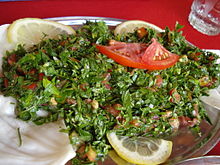
Tabbouleh salad
Parsley is widely used in Middle Eastern, European, Brazilian, and American cooking. Curly leaf parsley is used often as a garnish. Green parsley is used frequently as a garnish on potato dishes (boiled or mashed potatoes), on rice dishes (risotto or pilaf), on fish, fried chicken, lamb, goose, and steaks, as well in meat or vegetable stews (including shrimp creole, beef bourguignon, goulash, or chicken paprikash).[18]
In central Europe, eastern Europe, and southern Europe, as well as in western Asia, many dishes are served with fresh green, chopped parsley sprinkled on top. In southern and central Europe, parsley is part of bouquet garni, a bundle of fresh herbs used as an ingredient in stocks, soups, and sauces. Freshly chopped green parsley is used as a topping for soups such as chicken soup, green salads, or salads such as salade Olivier, and on open sandwiches with cold cuts or pâtés.
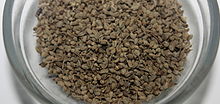
Parsley seeds
Persillade is a mixture of chopped garlic and chopped parsley in French cuisine.
Parsley is the main ingredient in Italian salsa verde, which is a mixed condiment of parsley, capers, anchovies, garlic, and sometimes bread, soaked in vinegar. It is an Italian custom to serve it with bollito misto or fish. Gremolata, a mixture of parsley, garlic, and lemon zest, is a traditional accompaniment to the Italian veal stew, ossobuco alla milanese.
In England, parsley sauce is a roux-based sauce, commonly served over fish or gammon.
Root parsley is very common in Central, Eastern, and Southern European cuisines, where it is used as a snack or a vegetable in many soups, stews, and casseroles, and as ingredient for broth.
In Brazil, freshly chopped parsley (salsa) and freshly chopped scallion (cebolinha) are the main ingredients in the herb seasoning called cheiro-verde (literally "green aroma"), which is used as key seasoning for major Brazilian dishes, including meat, chicken, fish, rice, beans, stews, soups, vegetables, salads, condiments, sauces, and stocks. Cheiro-verde is sold in food markets as a bundle of both types of fresh herbs. In some Brazilian regions, chopped parsley may be replaced by chopped coriander (also called cilantro, coentro in Portuguese) in the mixture.
Parsley is a key ingredient in several Middle Eastern salads such as Lebanese tabbouleh; it is also often mixed in with the chickpeas and/or fava beans while making falafel (that gives the inside of the falafel its green color).
Are you sure that you want to report this comment?
Report sent
Your report has been submitted and will be considered by a moderator.
Your report cannot be sent
Write your review
Review sent
Your comment has been submitted and will be available once approved by a moderator.
Your review cannot be sent
🌍 Worldwide Shipping from the EU
We ship worldwide from the European Union using registered air mail with signature confirmation upon delivery.
📦 Tracking Your Order Log in to your account and navigate to Order History > Details to find your tracking number.
You will receive email notifications for each stage of your order. If you don’t see these messages, please check your Spam/Junk folder or contact your email provider. Alternatively, search online for how to unblock sender emails.
OUR EMAIL SERVICE IS WORKING
You will receive email notifications for each stage of your order. If you don’t see these messages, please check your Spam/Junk folder or contact your email provider.
📧 How to Ensure Emails from Our Online Shop Always Land in Your Gmail or any other email provider'sInbox and Aren't Marked as Spam or Blocked:
Add the Sender to your Google or any other email provider's contacts. We can't help you if your settings are not like this. Contact your email provider for help.
Step 1: Open Gmail and find an email from us xxxxxxxxxxxx@xxx.com Do not try to send us an email directly to this address; we will not receive it. Every contact is exclusively through the contact form in our online shop! If you can’t find our email, it might have been blocked. In that case, proceed with Step 4 below.
Step 2: Hover over the sender’s name or email address at the top of the email.
Step 3: Click the "Add to Contacts" icon (the little person icon).
This will help Gmail recognize us as a trusted sender, ensuring our emails go straight to your inbox and not to spam.
Create a Filter to Prevent Emails from Being Marked as Spam or Blocked
Step 1: Open Gmail and click on the gear icon in the top-right corner, then select "See all settings".
Step 2: Go to the "Filters and Blocked Addresses" tab.
Step 3: Click "Create a new filter".
Step 4: In the "From" field, enter the email address you want to whitelist (e.g., our shop’s email).
Step 5: Click "Create filter".
Step 6: In the next window, check the box labeled "Never send it to Spam".
Step 7: Click "Create filter" to save.
This will ensure our emails always land in your inbox and won’t get marked as spam or blocked by mistake.
Track your package via:
Aftership
17Track
Posta.hr (for tracking numbers like RGxxxxxxHR)
⚠️ Important Notices
Cash on delivery is NOT available.
Always provide a valid mobile number with country code when ordering (e.g., +365 456 7686 576).
Do not order to P.O. Boxes, or if you cannot be home to sign for the package, parcels cannot be left with neighbors.
If a package sent to a P.O. Box is lost or undelivered, no refund will be issued.
⚖️ Customer Responsibility for Legal Compliance The customer is responsible for ensuring that the product is legal to import into their country, including complying with all import regulations, obtaining necessary permits, and paying applicable customs duties, taxes, and other fees. Please check your local laws before ordering to avoid any issues with customs or delivery.
📦 Lost, Returned & Reshipping Packages
Brazil & Mexico Customers: We cannot refund packages lost or destroyed by customs.
If your package is returned, we will refund only the product cost — shipping costs are non-refundable.
Return postage (€2) and any reshipping costs must be covered by the customer.
If a package is returned to us for any reason, you are responsible for paying the return shipping (€2) plus the cost to resend the package.
🚚 Shipment Delivery Registered shipments require a signature.
If your tracking shows that the package is still at the origin post office, it is in transit — contact your local post office for updates.
Unfortunately, neither we nor the post office through which your order was sent can help you with the question of where your order is. When you see that your package is in your country, you MUST contact your post office with the tracking number and discuss the matter with them. We send all orders by official state mail.
We are not responsible for delivery times and cannot track shipments on your behalf.
📅 Delivery Options & Estimated Times
Delivery Option
Processing Time
Notes
Priority Delivery
Ships in 1–7 business days
Prioritizes order processing (not guaranteed faster delivery); delays possible during holidays (3–10 days)
Secured Delivery
Ships in 1–7 business days
Available for orders up to €150; refund if lost
Standard Delivery
Ships in 7–10 business days
More economical; delays possible during holidays (7–14 days)
Estimated Delivery Time:
Within the EU: 3–20 days
Worldwide: 5–30 days
USA Examples: Delivered in 13, 17, 19, 22, or 27 days.
Note: Delivery times depend on your location and local postal system. COVID-19 or holiday seasons may cause additional delays.
💰 Shipping Costs Shipping and handling fees are calculated automatically at checkout based on the parcel weight and destination.
⏰ Order Processing Hours We do not process or ship orders on Saturdays or Sundays.
💳 Payment Options
Bank Transfer (SEPA / IBAN / SWIFT-BIC) Include your order reference in the payment description (e.g., "SGS-19811702"). Orders without payment within 7 days will be automatically cancelled.
PayPal Payments are accepted in Euros only. Please select Euros during checkout.
Card Payment For card payments, visit our partner site: exotic-seeds.store We accept Visa, MasterCard, American Express, CB, Diners Club, Discover, China UnionPay, JCB, and Discover.
⚠️ Transaction Fees Customers are responsible for any bank or PayPal transaction fees. Please ensure accurate payment details for faster order processing.
📢 Final Notes Before placing your order, always check our website for special notices, holiday schedules, or specific shipping conditions that might affect your purchase.
Important Notice: Digital Invoices
To help reduce paper waste, we do not include a printed invoice with your order. You can easily download and print your invoice at any time by visiting your Order History in your account profile.