SWEET WILLIAM Seeds edible flowers (Dianthus barbatus) 🌸 Fragrant Sweet William with colorful clustered blooms, edible flowers and excellent value for cottage gardens and borders.
SWEET WILLIAM Seeds edible flowers (Dianthus barbatus)
Price for Package of 50 seeds.
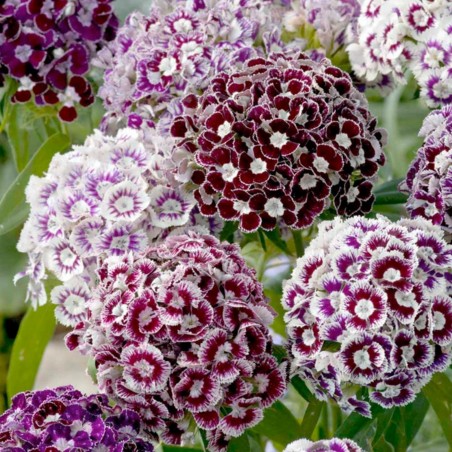
SWEET WILLIAM Seeds edible flowers (Dianthus barbatus) are an excellent choice for colorful borders, cottage gardens, rock gardens and naturalistic planting. Sweet William is a herbaceous biennial or short lived perennial that produces dense clusters of beautifully colored flowers above attractive green to blue green foliage. The flowers have a distinctive spicy, clove like fragrance and are considered edible, making this variety particularly interesting for gardeners who enjoy edible flower displays.
🌱 Plant Features
Winter hardiness: The supplied source describes Dianthus barbatus as a herbaceous biennial or short lived perennial. Plants commonly establish foliage first and flower in the following year when sown after the last frost.
Height: 30 to 75 cm (12 to 30 inches).
Flower size: Approximately 2 to 3 cm across.
Flower colors: White, pink, red, purple and attractive variegated patterns.
Flower arrangement: Dense clusters containing up to 30 flowers at the top of each stem.
Foliage: Green to glaucous blue green tapered leaves approximately 4 to 10 cm long and 1 to 2 cm wide.
The individual flowers have five petals with serrated edges. Wild plants generally produce red flowers with a white base, while cultivated varieties offer a much broader range of colors and patterns.
🌿 Growing Conditions
Sweet William thrives in loamy, slightly alkaline soil and performs well in full sun to partial shade. It is a versatile garden plant that can be used in borders, rock gardens, informal cottage gardens and naturalistic planting schemes.
Choose a location with good soil and adequate drainage. Sweet William can establish successfully in a variety of garden situations, while its nectar rich flowers provide an attractive resource for bees and butterflies.
🌱 Sowing Instructions
Sweet William can be propagated from seed, cuttings or division. When planted from seed after the last frost, the plants generally develop during the first season and flower in the second year.
For earlier flowering, seeds can be started in flats before the last frost and the young plants transplanted outdoors after suitable conditions arrive. This approach may allow flowering during the first year.
Keep young plants appropriately watered while they establish and provide suitable light. Sweet William can also self seed naturally in the garden when conditions are favorable.
🌸 Flowering and Garden Use
Sweet William is highly valued for its dense flower clusters, attractive colors and spicy clove like fragrance. Its height makes it particularly useful for flower arrangements, while the colorful blooms provide excellent visual impact in borders and cottage style gardens.
The plant is also well suited to rock gardens and naturalistic planting. Its nectar attracts bees, butterflies and birds, making it a useful addition to wildlife friendly garden areas.
🍃 Edible Flowers
The flowers of Sweet William are considered edible and can be used as a decorative addition to suitable culinary presentations. The colorful petals make an attractive garnish, while the flowers also provide an unusual edible feature for garden enthusiasts.
Only flowers that have been grown specifically for edible use and have not been treated with unsuitable pesticides or chemicals should be used for consumption.
✂️ Support and Pruning
Deadheading spent flowers can encourage further flowering and helps maintain a tidy appearance. Because Sweet William can self seed, allowing some flowers to mature can also provide new plants naturally in suitable garden locations.
The plant can be useful for cutting because its stems and dense flower clusters create attractive arrangements. In the Victorian language of flowers, Sweet William was associated with gallantry.
🐝 Wildlife Value
Sweet William is particularly valuable in naturalistic and wildlife friendly gardens. Its nectar rich flowers attract bees and butterflies, while the plant can also provide interest for birds. This combination of ornamental beauty and wildlife value makes it suitable for informal garden designs.
🌿 Cultivation and Important Notes
Sweet William was introduced to northern Europe in the 16th century and later became established in North America and other regions. Numerous cultivars and hybrids have been developed for their different flower colors and patterns.
Seeds collected from cultivated varieties may not reproduce the exact characteristics of the parent plant. The plant can be affected by Fusarium Wilt, which may cause leaves to curl or droop.
Sweet William is generally an easy and rewarding plant for gardeners who want dense, colorful flower clusters combined with fragrance and edible flowers. With suitable soil, sun or partial shade and regular care, it can provide a strong display in borders, cottage gardens, rockeries and naturalistic planting areas.
Are you sure that you want to report this comment?
Report sent
Your report has been submitted and will be considered by a moderator.
Your report cannot be sent
Review sent
Your comment has been submitted and will be available once approved by a moderator.
Your review cannot be sent
🌍 Worldwide Shipping from the EU
We ship worldwide from the European Union using registered air mail with signature confirmation upon delivery.
📦 Tracking Your Order Log in to your account and navigate to Order History > Details to find your tracking number.
You will receive email notifications for each stage of your order. If you don’t see these messages, please check your Spam/Junk folder or contact your email provider. Alternatively, search online for how to unblock sender emails.
OUR EMAIL SERVICE IS WORKING
You will receive email notifications for each stage of your order. If you don’t see these messages, please check your Spam/Junk folder or contact your email provider.
📧 How to Ensure Emails from Our Online Shop Always Land in Your Gmail or any other email provider'sInbox and Aren't Marked as Spam or Blocked:
Add the Sender to your Google or any other email provider's contacts. We can't help you if your settings are not like this. Contact your email provider for help.
Step 1: Open Gmail and find an email from us xxxxxxxxxxxx@xxx.com Do not try to send us an email directly to this address; we will not receive it. Every contact is exclusively through the contact form in our online shop! If you can’t find our email, it might have been blocked. In that case, proceed with Step 4 below.
Step 2: Hover over the sender’s name or email address at the top of the email.
Step 3: Click the "Add to Contacts" icon (the little person icon).
This will help Gmail recognize us as a trusted sender, ensuring our emails go straight to your inbox and not to spam.
Create a Filter to Prevent Emails from Being Marked as Spam or Blocked
Step 1: Open Gmail and click on the gear icon in the top-right corner, then select "See all settings".
Step 2: Go to the "Filters and Blocked Addresses" tab.
Step 3: Click "Create a new filter".
Step 4: In the "From" field, enter the email address you want to whitelist (e.g., our shop’s email).
Step 5: Click "Create filter".
Step 6: In the next window, check the box labeled "Never send it to Spam".
Step 7: Click "Create filter" to save.
This will ensure our emails always land in your inbox and won’t get marked as spam or blocked by mistake.
Track your package via:
Aftership
17Track
Posta.hr (for tracking numbers like RGxxxxxxHR)
⚠️ Important Notices
Cash on delivery is NOT available.
Always provide a valid mobile number with country code when ordering (e.g., +365 456 7686 576).
Do not order to P.O. Boxes, or if you cannot be home to sign for the package, parcels cannot be left with neighbors.
If a package sent to a P.O. Box is lost or undelivered, no refund will be issued.
⚖️ Customer Responsibility for Legal Compliance The customer is responsible for ensuring that the product is legal to import into their country, including complying with all import regulations, obtaining necessary permits, and paying applicable customs duties, taxes, and other fees. Please check your local laws before ordering to avoid any issues with customs or delivery.
📦 Lost, Returned & Reshipping Packages
Brazil & Mexico Customers: We cannot refund packages lost or destroyed by customs.
If your package is returned, we will refund only the product cost — shipping costs are non-refundable.
Return postage (€2) and any reshipping costs must be covered by the customer.
If a package is returned to us for any reason, you are responsible for paying the return shipping (€2) plus the cost to resend the package.
🚚 Shipment Delivery Registered shipments require a signature.
If your tracking shows that the package is still at the origin post office, it is in transit — contact your local post office for updates.
Unfortunately, neither we nor the post office through which your order was sent can help you with the question of where your order is. When you see that your package is in your country, you MUST contact your post office with the tracking number and discuss the matter with them. We send all orders by official state mail.
We are not responsible for delivery times and cannot track shipments on your behalf.
📅 Delivery Options & Estimated Times
Delivery Option
Processing Time
Notes
Priority Delivery
Ships in 1–7 business days
Prioritizes order processing (not guaranteed faster delivery); delays possible during holidays (3–10 days)
Secured Delivery
Ships in 1–7 business days
Available for orders up to €150; refund if lost
Standard Delivery
Ships in 7–10 business days
More economical; delays possible during holidays (7–14 days)
Estimated Delivery Time:
Within the EU: 3–20 days
Worldwide: 5–30 days
USA Examples: Delivered in 13, 17, 19, 22, or 27 days.
Note: Delivery times depend on your location and local postal system. COVID-19 or holiday seasons may cause additional delays.
💰 Shipping Costs Shipping and handling fees are calculated automatically at checkout based on the parcel weight and destination.
⏰ Order Processing Hours We do not process or ship orders on Saturdays or Sundays.
💳 Payment Options
Bank Transfer (SEPA / IBAN / SWIFT-BIC) Include your order reference in the payment description (e.g., "SGS-19811702"). Orders without payment within 7 days will be automatically cancelled.
PayPal Payments are accepted in Euros only. Please select Euros during checkout.
Card Payment For card payments, visit our partner site: exotic-seeds.store We accept Visa, MasterCard, American Express, CB, Diners Club, Discover, China UnionPay, JCB, and Discover.
⚠️ Transaction Fees Customers are responsible for any bank or PayPal transaction fees. Please ensure accurate payment details for faster order processing.
📢 Final Notes Before placing your order, always check our website for special notices, holiday schedules, or specific shipping conditions that might affect your purchase.
Important Notice: Digital Invoices
To help reduce paper waste, we do not include a printed invoice with your order. You can easily download and print your invoice at any time by visiting your Order History in your account profile.



Comments (0)
Your review appreciation cannot be sent
Report comment
Report sent
Your report cannot be sent